39 Years vs. 1 Year: The Massive Tax Advantage of Automated Parking Garages
Parking is usually treated as a cost center and a “39-year problem” (slow depreciation, heavy concrete, dead square footage). Automated and semi-automated parking changes that equation in two ways:
Tax acceleration: A meaningful portion of an automated parking project can often qualify as 1– or 3-year personal property (and some site/land improvements often hit 5-year), rather than being trapped in 39-year nonresidential real property buckets—creating large early-year deductions and improving after-tax returns. The IRS cost segregation framework explicitly discusses reallocating building-related costs into shorter-life property classes (e.g., 1 or 3-year) to accelerate depreciation for equipment IRS Cost Segregation ATG (Pub. 5653).
Total cost of ownership (TCO) advantage: With vertical/automated parking, the cheapest initial bid is frequently not the lowest long-term cost. OEM + turnkey delivery (design, manufacturing, install, controls integration, and service) reduces downtime risk, parts risk, and “vendor gaps,” improving NOI resilience—especially for multifamily, office, mixed-use, and hospitality assets where parking is a leasing and revenue engine.
When developers evaluate parking solutions, they typically focus on construction costs, space efficiency, and operational expenses. But there’s a financial lever hiding in plain sight that can dramatically change your project’s bottom line: tax depreciation.
Here’s the reality most commercial real estate professionals overlook: traditional concrete parking structures are depreciated over 39 years. Automated parking systems? They can qualify for depreciation schedules as short as 1 to 3 years. That’s not a minor accounting difference. That’s a massive shift in early-stage cash flow, tax liability, and overall project ROI.
Let’s break down why this matters and how it can transform the financial performance of your next development.
Please Speak With Your Tax Professional To Confirm Accelerated Depreciation of Your Parking Equipment and Project.
39 Years vs. 1 Year: Why Automated Parking Can Be a Tax Weapon (Not Just a Space Saver)
1) The baseline problem: 39-year depreciation is slow capital recovery
Under MACRS, nonresidential real property is generally depreciated over 39 years using straight-line (typical for commercial buildings and structural components). The IRS cost segregation guide highlights that buildings (“§1250 property”) are generally nonresidential real property with a 39-year recovery periodIRS Cost Segregation ATG (Pub. 5653).
2) Cost segregation: the IRS-recognized pathway to faster depreciation
The IRS describes cost segregation as the process of separating a project’s costs into components with different recovery periods, specifically to take advantage of shorter recovery periods and accelerated depreciation methodsIRS Cost Segregation ATG (Pub. 5653).
It also states that tangible personal property or equipment (“§1245 property equipment”) typically has a shorter recovery period (e.g., 1 or 3 years) and may be eligible for accelerated methods, including bonus depreciation and §179 in the right circumstances IRS Cost Segregation ATG (Pub. 5653).
Why this matters for automated parking: automated/semi-automated parking systems include substantial “equipment-like” components—mechanical, electrical, controls, sensors, platforms, motors, conveyors, PLCs, etc.—which are far more “personal property-like” than poured-in-place ramps.
3) The “parking structure” caution: don’t confuse the building with the equipment
Investors often hear “parking is 15-year” or “parking is land improvement.” Reality is nuanced.
A key IRS memo discusses the dispute over whether open-air parking structures are 15-year land improvements or 39-year buildings, and notes IRS positions treating those structures as buildings (39-year) based on definitions of “building” IRS Counsel Memorandum 20125201F (PDF).
Investor takeaway: the concrete “structure” (if you build one) can still be a long-life asset class. The strategic move is not arguing a ramp garage is magically 5-year—it’s designing parking so that a large portion of the capital is equipment that can be classified into shorter-life categories through a defensible engineering-based study.
4) Why “1-3 year” is plausible for automated parking components
The IRS cost segregation guidance explicitly notes that reallocating costs from 39-year building to 1– or 3-year tangible personal property is a primary incentive behind cost segregation IRS Cost Segregation ATG (Pub. 5653).
Automated parking projects typically contain:
Mechanized transport and storage equipment (platforms/shuttles/lifts/rotary movement systems)
Control systems and electronics (PLCs, sensors, software-enabled controls)
Power distribution serving equipment loads (often partially allocable)
These are the exact types of assets cost segregation studies evaluate and classify into shorter lives when properly supported by design documents, takeoffs, invoices, and engineering methodology IRS Cost Segregation ATG (Pub. 5653).
IRS Publication 946 explains depreciation rules, including the phase-down of special depreciation allowance (bonus depreciation) percentages by year (for certain qualified property) IRS Pub. 946.
Investor takeaway: if your automated parking scope includes significant 1–3-year property, timing the “placed in service” date can materially affect first-year deductions.
6) Real estate value creation is not just tax—automated parking can unlock more rentable area
The Automated Parking Company publishes a developer-oriented case study framing how robotic parking can convert parking footprint into incremental rentable/sellable area, materially increasing project capitalization The Automated Parking Company case study.
Even if you ignore tax advantages, CRE returns often hinge on:
more units (multifamily)
more NRA (office)
better ground-floor activation (retail)
reduced excavation/ramps (cost + schedule risk)
The Depreciation Gap: 39 Years vs. 1 to 3 Years
Under IRS guidelines, traditional parking garages are classified as nonresidential real property. That means they’re subject to a 39-year straight-line depreciation schedule. For a $5 million concrete parking structure, you’re looking at roughly $128,000 in annual depreciation deductions.
Automated parking systems tell a completely different story.
Because systems like stackers, puzzle parking units, and AGV (Automated Guided Vehicle) robotic garages are classified as tangible personal property or capital equipment, they qualify for accelerated depreciation under MACRS (Modified Accelerated Cost Recovery System). This typically means a 1-year or 3-year depreciation schedule: and in many cases, eligibility for bonus depreciation that allows you to deduct a significant portion of the cost in year one.
For that same $5 million investment in an automated parking system, you could potentially deduct the entire amount in the first year under current bonus depreciation rules, or spread it over just 5-7 years. The difference in tax savings during those critical early years is substantial.
Why Automated Parking Qualifies as Equipment
The key distinction comes down to how the IRS classifies different types of assets. A poured concrete parking garage is considered part of the building: a permanent structure that’s integral to the real property. It depreciates slowly because, theoretically, it will last for decades.
Automated parking systems are different. Here’s why:
Mechanical components: Stackers, lifts, turntables, and conveyance systems are machinery
Electrical systems: Motors, sensors, control panels, and software are equipment
Modular design: Many systems can be relocated or reconfigured
Functional classification: They serve a specific operational purpose beyond simply being a structure
Industry analysis suggests that approximately 75% of an automated parking system can be classified as capital equipment rather than building structure. This classification unlocks the accelerated depreciation schedules that make such a dramatic difference in your tax position.
The Real Financial Impact on Your Project
Let’s put some numbers to this so you can see the actual impact on a development pro forma.
Scenario: $4 Million Parking Investment
That’s a potential difference of nearly $1.3 million in tax savings over the first five years. For developers working with investors or managing multiple projects, this kind of early-stage tax benefit can be the difference between a project that barely pencils and one that delivers exceptional returns.
Bonus Depreciation: The Multiplier Effect
Under current tax law, bonus depreciation allows businesses to deduct a large percentage of eligible asset costs in the year the property is placed in service. While bonus depreciation percentages are scheduled to phase down over the coming years, significant first-year deductions remain available.
For automated parking systems, this means:
Immediate cash flow benefit from reduced tax liability in year one
Improved debt service coverage as tax savings boost net operating income
Enhanced investor returns when structuring partnership distributions
Greater flexibility in managing taxable income across your portfolio
Combined with Section 179 expensing (which allows businesses to deduct the full purchase price of qualifying equipment), developers have powerful tools to optimize the tax efficiency of their parking investments.
How This Changes Developer Decision-Making
When you factor depreciation into your parking analysis, the value proposition of automated systems shifts dramatically.
Traditional Analysis (Construction Cost Only)
Many developers look at a $4 million concrete garage versus a $4.5 million automated system and see the automated option as more expensive. End of analysis.
When you include the depreciation advantage, that automated system might deliver $1+ million more in tax benefits over the first five years. Suddenly, the “more expensive” option actually costs less on an after-tax basis.
This is before you factor in the other financial advantages of automated parking:
55% lower operational costs compared to conventional garages
Smaller building footprint freeing up sellable or leasable square footage
Reduced construction timeline accelerating your path to revenue
Lower long-term maintenance with no open decks exposed to weather
Beyond Depreciation: LEED and Additional Tax Incentives
The tax advantages don’t stop at depreciation. Automated parking systems can contribute up to 17 LEED points toward green building certification, potentially unlocking additional tax incentives and rebates depending on your jurisdiction.
Many municipalities offer:
Property tax abatements for LEED-certified buildings
Expedited permitting for sustainable development
Density bonuses that increase allowable units
Green building grants and low-interest financing
When you stack these incentives on top of the depreciation advantage, the financial case for automated parking becomes even more compelling.
Working with Your Tax Professional
While the depreciation benefits of automated parking are significant, tax strategy should always be developed in consultation with qualified professionals. Key considerations include:
Cost segregation studies to properly allocate equipment vs. structural costs
Timing of asset placement to maximize deductions in optimal tax years
Entity structure to ensure depreciation benefits flow to the right parties
State tax implications which may differ from federal treatment
At The Automated Parking Company, we work with developers and their tax advisors to provide the documentation and system specifications needed to support appropriate equipment classification.
Making the Smart Investment Decision
The 39-year vs. 1 to 3-year depreciation gap represents one of the most overlooked financial advantages in commercial real estate development. For projects where parking is a significant cost component: which is most urban developments: this tax treatment can materially improve returns.
When evaluating your next project’s parking solution, consider:
Total cost of ownership, not just construction cost
After-tax returns over your investment horizon
Cash flow timing and the value of early-stage deductions
Operational savings that compound over the life of the asset
A 1 to 3-year depreciation schedule versus 39 years isn’t just an accounting detail: it’s a fundamental shift in how parking investments perform financially. For developers focused on maximizing ROI and delivering returns to investors, this tax advantage deserves serious consideration.
The numbers don’t lie. When you can recover your parking investment 8x faster through depreciation, the automated solution often costs less than the “cheaper” concrete alternative.
Ready to see how accelerated depreciation could impact your next project? Contact our team for a consultation and custom financial analysis. We’ll help you understand exactly how automated parking can improve your development’s bottom line( starting with the tax benefits most developers miss.)
Please Speak With Your Tax Professional To Confirm Accelerated Depreciation of Your Parking Equipment and Project.
De-Risk Your Parking Strategy with a FREE $5,000 Design Review Credit
If you connect with us, The Automated Parking Company, will provide a FREE in-depth design review, normally valued at $5,000; to assess feasibility, optimize layouts, and align your parking solution with project goals.
When you proceed with us, the full design review fee is credited back to the project, ensuring your early-stage diligence directly supports execution—not overhead.
A disciplined approach to smarter parking investment.
📞 Call Us for a FREE parking design review, valued at $5,000: (877) 827-2611
We value community input and address concerns for harmonious solutions.
Research & Innovation
Continuous research and innovation to improve green parking solutions.
Our Step By Step Process Towards Building Smart Yet Sustainable Parking
At TAPCO, our process ensures seamless delivery of efficient and sustainable parking tech tailored to your evolving project needs.
01
Discovery & Consultation:
Understand your needs, site constraints, and objectives.
02
Customized Design:
Create a tailored parking solution with eco-friendly integration.
03
Project Approval & Collaboration:
Obtain necessary approvals and work closely with your team.
04
Manufacturing & Quality Control:
Ensure the highest standards of quality.
05
Timely Delivery & Installation:
On-time setup with minimal disruptions.
06
Thorough Testing & Commissioning:
Rigorous performance checks and safety adherence.
07
Training & Support:
Comprehensive staff training and ongoing maintenance services.
08
Environmental Responsibility:
Implement eco-friendly practices and sustainability monitoring.
09
Client Satisfaction:
Prioritize your project with any number of our solutions.
Frequently Asked Questions
Q: Can TAPCO’s solutions be tailored to our specific needs?
A: Absolutely! At TAPCO, we understand that every project is unique. Our experienced team of designers and engineers will work closely with you to understand your specific requirements, site constraints, and objectives.
Q: How many levels can The Automated Parking Company design for the Puzzle parking system?
A: The Automated Parking Company has the capability to design systems with 2 to 7 levels, accommodating a varying number of parking spaces. Moreover, if your project calls for additional space optimization, we can even incorporate one or two subterranean levels, effectively increasing the total parking capacity.
Q: Are TAPCO’s parking systems safe and reliable?
A: Yes, safety is our top priority at TAPCO. We adhere to stringent industry safety standards and conduct rigorous testing and quality control measures at every stage of the manufacturing process.
Our car parking solutions are designed and built to ensure the safety of users, vehicles, and your property. We use high-quality materials and employ advanced technology to ensure the reliability and durability of our parking systems.
Improving Parking Convenience with Parking Stackers
When it comes to parking solutions, attended-oriented systems offer a blend of efficiency and convenience that cater to the needs and challenges of urban areas, particularly high-demand areas.
These multi-level car stacker solutions are a game-changer when it comes to parking, allowing the creation of multiple parking spaces within a single area.
TAPCO introduces a wide array of innovative attended-oriented parking systems designed to optimize space utilization as well as offer user-friendly parking practices.
These systems are intended to provide a seamless parking experience and enable attendants to efficiently manage parking procedures while ensuring the convenience and safety of the users. Here are the key benefits of using attended-oriented parking systems.
Optimal Space Utilisation
Our attended-oriented parking systems incorporate car lift storage systems make optimal use of the available space. Vertical stacking of vehicles with the vertical storage lift enables the system to increase the parking capacity within a limited area, hence coping with the increasing parking demands.
Organised vertical stacking
The attended-oriented parking allows vertical stacking of vehicles to utilize a vertical space effectively. This approach reduces the area required for parking, thereby contributing to a more organized and aesthetically pleasant-looking parking facility.
Convenience
The attended-oriented parking system offers ease of use for the attendant as well as the user. While the attendant can successfully navigate the car stacker lift and swiftly move vehicles into a nesting position with minimal effort, users need little to no guidance to park their vehicles safely.
Enhanced Security
Our attended-oriented car stacking system comes with advanced features to ensure the safety of parked vehicles. While users have peace of mind, property managers can also be content with the knowledge that the facility is secure.
Versatile stacked car parking
We offer a variety of car stacker lift solutions. From four post car storage lifts to no post solutions, our systems can be implemented indoors as well as outdoors and can be adapted for various project requirements or property layouts. TAPCO’s attended-oriented parking systems can be used in various environments, from commercial establishments to residential complexes.
Revolutionary Parking Solutions with Automated Lift Parking System
As the urban landscape continues to grow, the demand for efficient car parking solutions has become increasingly important. TAPCO introduces revolutionary semi-automated smart parking systems that are designed to optimise space utilization and streamline parking procedures for multi-family residential complexes and commercial facilities. Compared to the conventional car lift system, our multi level car parks are designed to redefine convenience and efficiency.
Here are some of the key features of our semi-automated car parking systems
Space Optimization
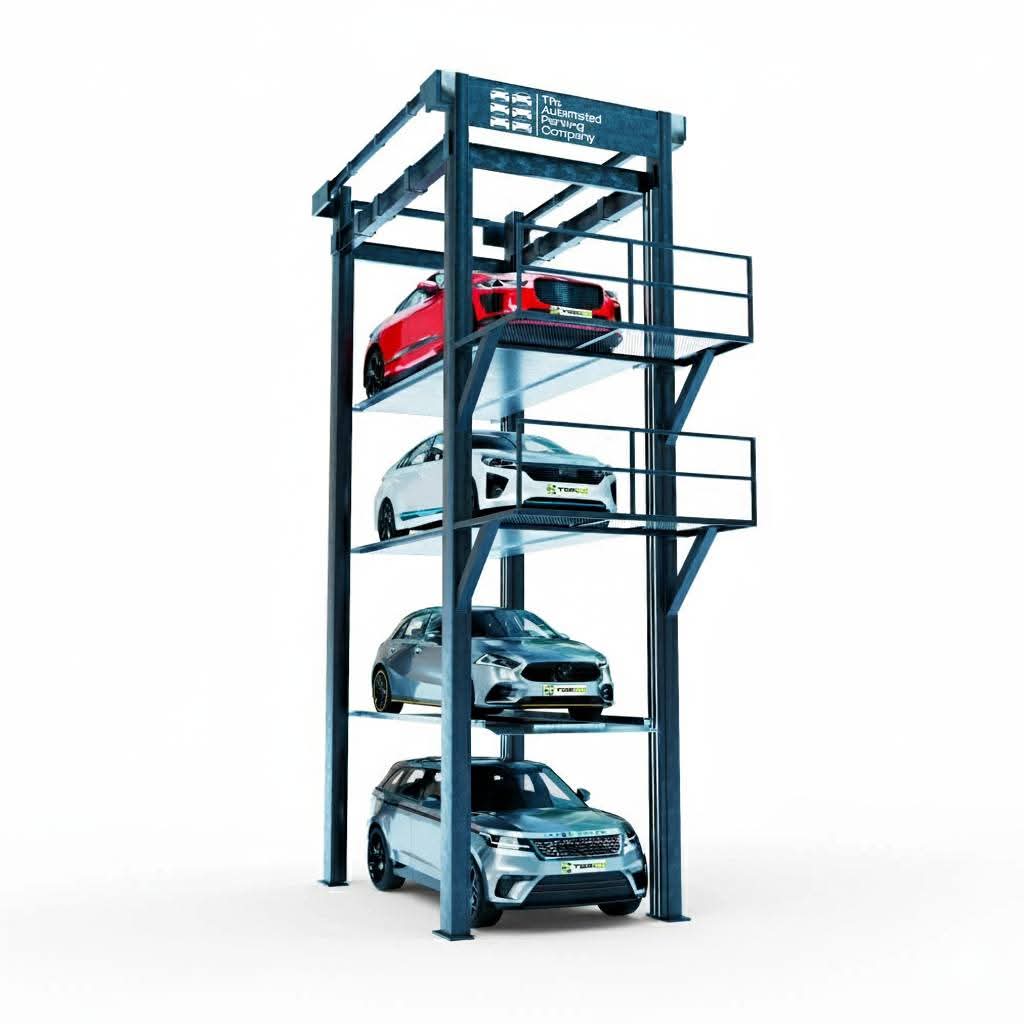
Optimal space utilization is a key focus of our multi-level car storing solutions. Our stack parking systems are designed to accommodate multiple levels, providing an impressive number of parking spaces within a compact footprint. We can design and integrate two to seven parking levels in a single structure and customize varying lengths, widths, and heights.
Seamless Automation
Our smart parking system incorporates advanced automation to simplify the parking process. Drivers can effortlessly park their vehicles with minimum guidance, thereby providing efficient utilization of time.
EV Capability
Given the increasing trend of electric vehicles, our parking solutions are also designed to embrace the future of mobility and Electric Vehicles. To cater to the ever-evolving automotive landscape, we also feature charging facilities for electric cars. We are the only vendor offering 7000# rated systems.
Convenience
We understand that parking can be a source of frustration for people, particularly when you cannot find a spot and have to drive around looking for space. Such layouts can be problematic for larger properties. However, with our Puzzle Parking system, this problem can be easily resolved, offering convenience to individuals and saving valuable time when parking or capturing your auto.
FAQ
Q: What is the difference between a fully automated and semi-automated smart parking system?
A: Semi-automated Puzzle solutions and fully automated AGV parking systems are considered automated parking and compress footprints giving you back valuable square footage.
In a semi-automated parking system, drivers can park and/or retrieve their own auto, so this system rids you of any demand for parking attendants therefore lowering your OpEx. Once the users vehicle is stowed within the system, the semi-automated Puzzle system can move the car up and down or left to right to find its nesting space.
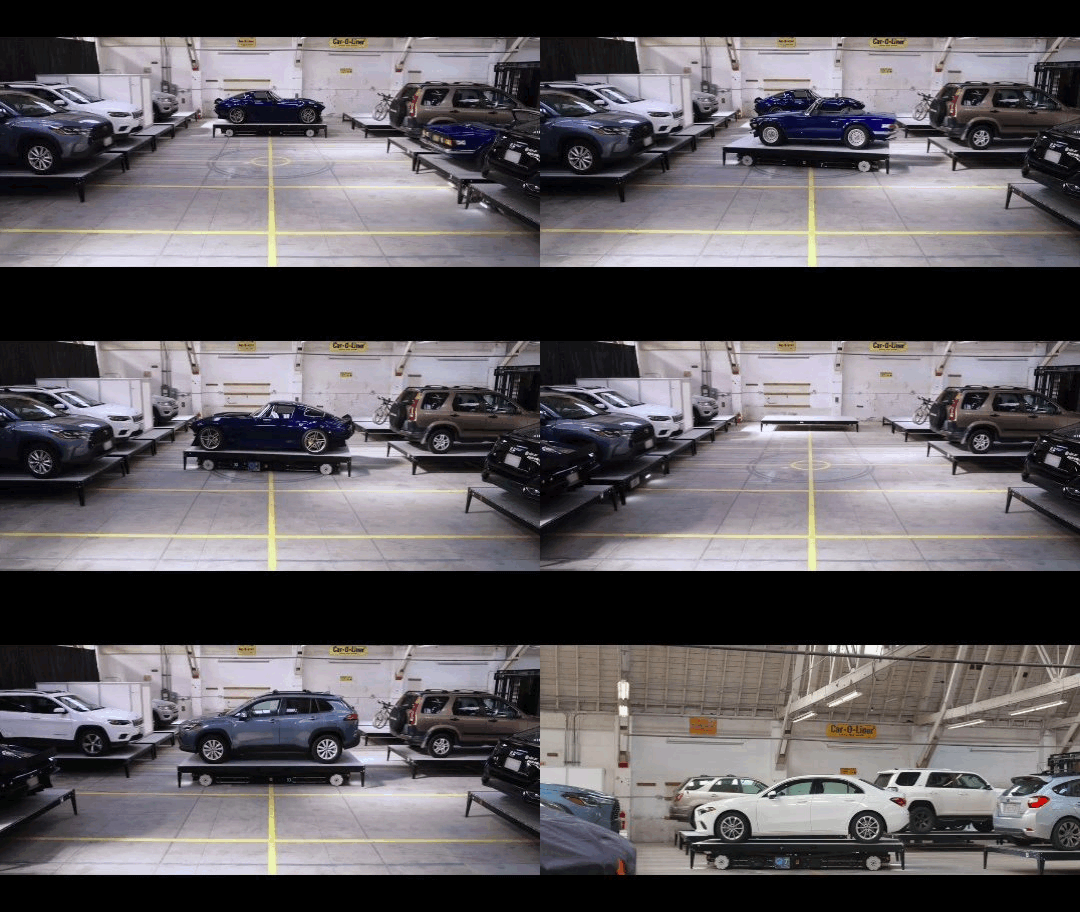
On the other hand, in a fully-automated parking system, the driver pulls into a loading bay where they remove themselves and leave their auto, the system will then maneuver the auto and autonomously stow the users auto within the parking vault.
Q: What is the difference between mechanical lift systems and semi-automated Puzzle Parking systems?
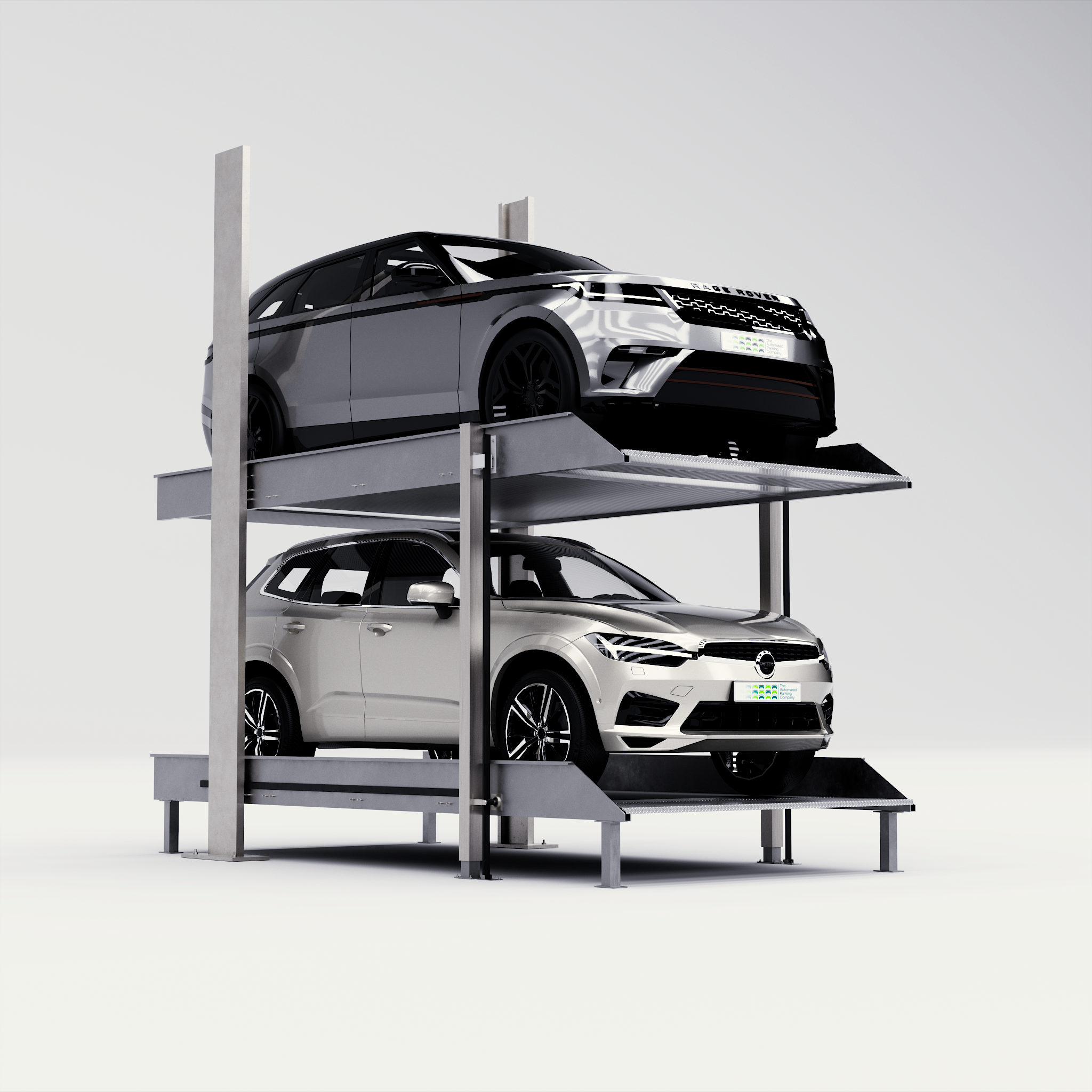
A: In a mechanical stacker system, individuals must operate for it to move, or you must incorporate attendants to manage the parking and retrieval process.. The mechanical stacker parking system is usually a Double, Triple, or Quad Stacker that can raise the vehicle directly up on the platform so that more than one vehicle can be parked in a vertical stack. We strongly encourage trained personnel to operate these systems due to the manual processes of storing or retrieving autos in a vertical arrangement.
On the other hand, in a semi-automated system, there is no demand nor need for attendants or personnel to retrieve autos. Once the driver has parked their vehicle within the system, the semi-automated Puzzle system can intelligently move the car up and down or left to right.
Q: Which properties are semi-automated parking systems suitable for?
A: Our semi-automated parking systems are mostly suitable and used for commercial office and multi-family residential complexes.
Q: Can electric cars be charged in semi-automated parking systems?
A: Absolutely, our semi-automated smart parking systems are EV capable and feature charging facilities for electric vehicles. We offer Level II smart charging capabilities that allow you to bill the user pro-rata and also reduce the number of electrical meters therefore reducing your overall build costs when compared to competitive vendors.
Q: What are the maintenance requirements of semi-automated parking systems?
A: Maintenance and upkeep of the parking systems by The Automated Parking Company are easy as they are designed for minimal maintenance and durability. However, please note that regular checks and maintenance schedules help ensure optimal performance.