Are Traditional Parking Garages Dead? Why Smart Developers Choose Stacked Car Parking Systems
The short answer? Traditional parking garages aren’t dead, but they’re quickly becoming obsolete for smart urban development. While these concrete behemoths still serve a purpose in suburban sprawl, forward-thinking developers are increasingly turning to stacked car parking systems to maximize space, reduce costs, and meet the demands of modern urban planning.
The numbers tell the story: automated and stacked parking systems can save up to 50% of space compared to traditional parking structures, while costing significantly less to build and maintain. For developers working in high-value urban markets where every square foot counts, this isn’t just an advantage: it’s a game-changer.
Are Traditional Parking Garages Dead? Why Smart Developers Choose Stacked Car Parking Systems
The Reality Check: Traditional Parking Garages in 2025
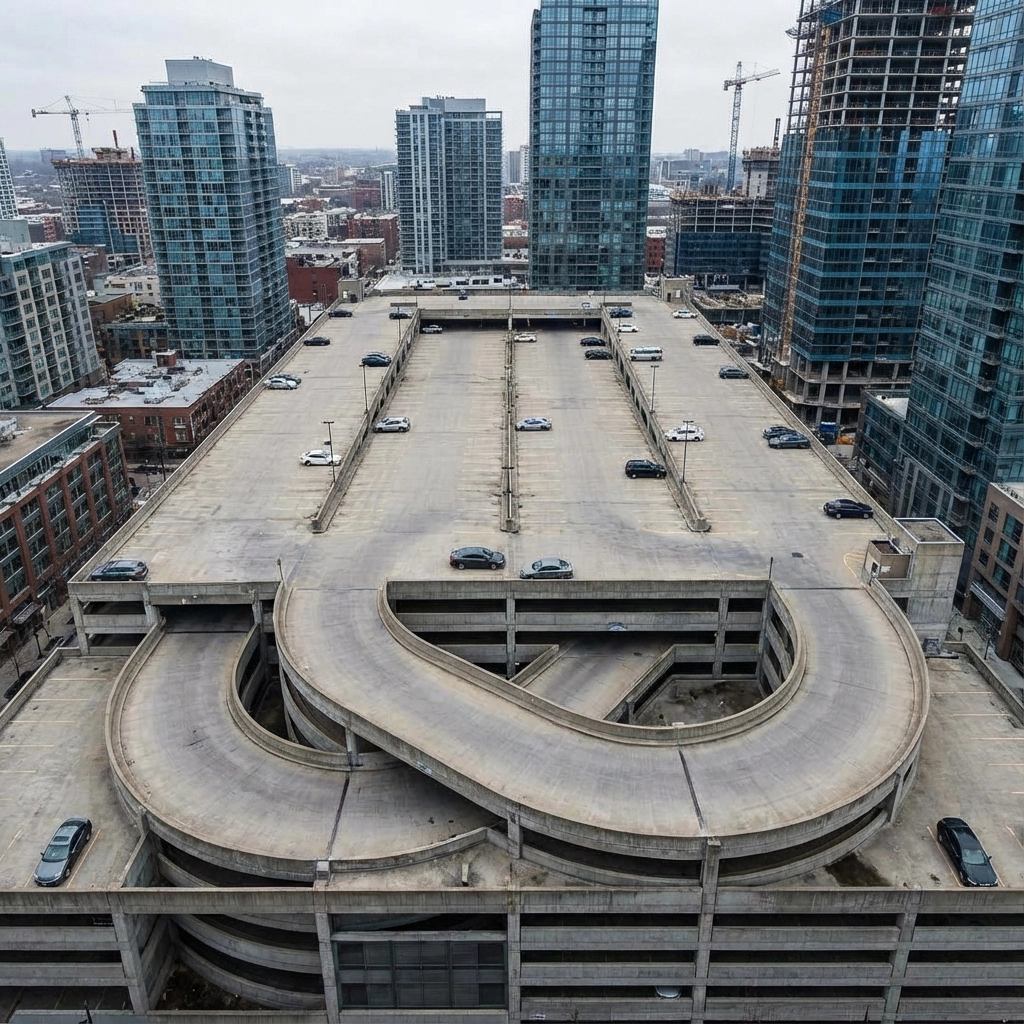
Traditional parking garages were designed for a different era. They work on a simple principle: one car, one space, connected by ramps and driving aisles. This approach made sense when land was cheap and cities were expanding outward rather than upward.
But here’s the problem: Traditional garages are space hogs. They lose valuable floor area to ramps, circulation aisles, and safety requirements. A typical parking garage dedicates 30-40% of its footprint to non-parking infrastructure: space that could otherwise generate revenue through additional units, retail, or office space.
In dense urban markets like Manhattan, San Francisco, or downtown Seattle, this inefficiency is financially devastating. When land costs $500-1,000 per square foot, every wasted square foot represents thousands in lost opportunity.
Traditional garages also come with significant construction costs. Building a multi-level parking structure requires extensive foundation work, reinforced concrete, sophisticated ventilation systems, and fire safety infrastructure. The result? Construction costs that can easily exceed $25,000-35,000 per parking space in urban markets.
Traditional Parking Garages are extremely expensive to design and build and take away too much expensive space in urban developments. Vertical Lift Parking Systems From OEM The Automated Parking Company has the solutions for your CRE Developments.
Why Developers Are Making the Switch
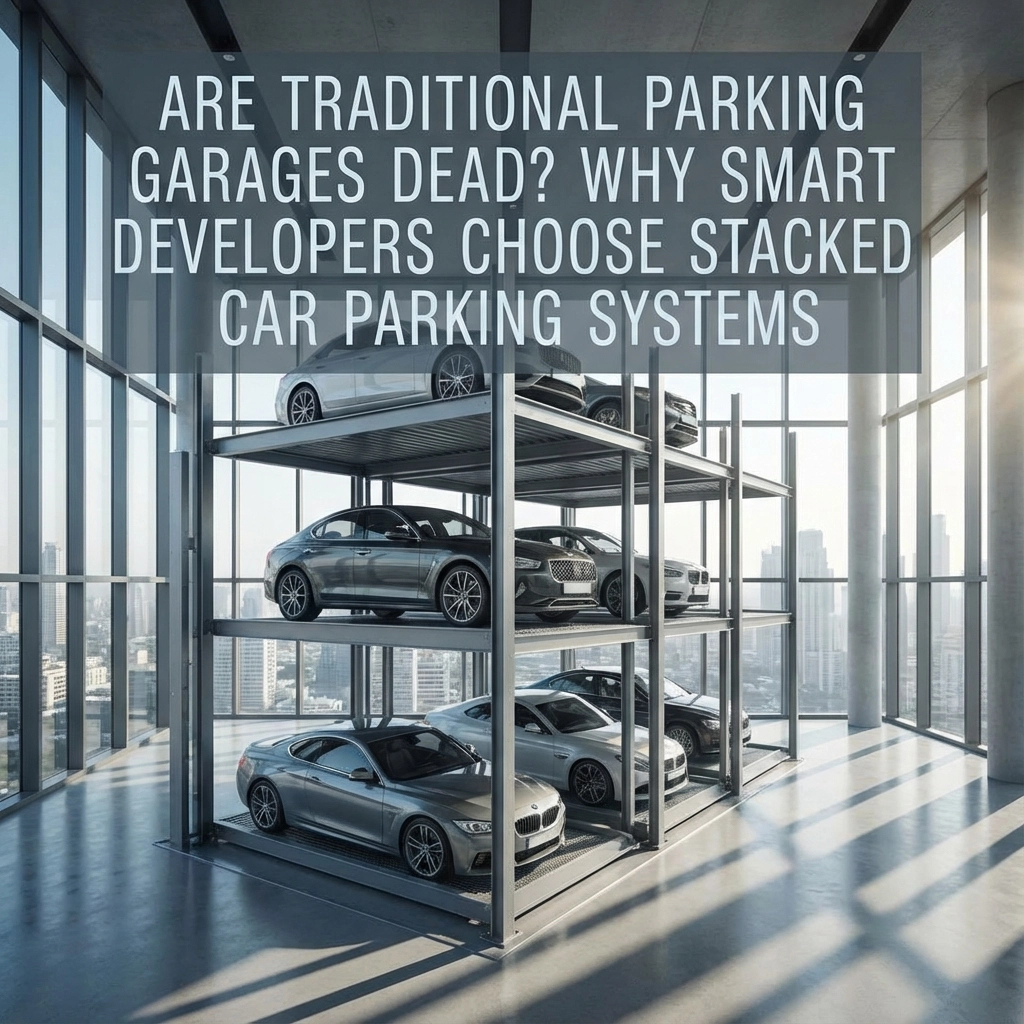
Stacked car parking systems flip the equation entirely. Instead of spreading cars horizontally across multiple levels, these systems stack vehicles vertically within the same footprint as traditional parking spaces.
The space savings are immediate and dramatic. A triple-stacker system can accommodate three vehicles in the space traditionally required for one, instantly tripling parking capacity without breaking ground on expensive additional construction.
Maximizing Developable Space
For developers, the most compelling advantage is simple math. Stacked systems free up valuable square footage that can be converted into revenue-generating space. That saved space can become:
Additional residential units in mixed-use developments
Retail space that generates ongoing rental income
Office space commanding premium urban rents
Outdoor amenities that increase property values
In markets where ground-floor retail space rents for $50-100 per square foot annually, the ability to reclaim 30-40% of a parking structure’s footprint for commercial use can transform a project’s economics.
Construction Cost Advantages
Stacked parking systems cost a fraction of traditional garage construction. While a multi-level garage requires extensive excavation, structural engineering, and months of construction, stackers can be installed in weeks with minimal site disruption.
The modular nature of these systems means developers can start with basic capacity and expand later as demand grows. This flexibility is particularly valuable for phased developments where parking needs may evolve over time.
Construction Cost Advantages Stacked parking systems cost a fraction of traditional garage construction. While a multi-level garage requires extensive excavation, structural engineering, and months of construction, stackers can be installed in weeks with minimal site disruption.
Addressing Common Developer Concerns
Despite the clear advantages, some developers remain hesitant about stacked parking systems. Let’s address the most common objections:
“Residents Won’t Accept the Inconvenience”
This concern typically comes from developers unfamiliar with modern stacked parking technology. Today’s systems operate more like elevators than traditional car lifts. Users simply park their vehicle and press a button: the system handles the rest.
The process takes 60-90 seconds, comparable to finding and walking from a distant parking space in a traditional garage. Most residents quickly adapt, especially when they understand the trade-off: slightly longer retrieval time in exchange for lower parking costs and better building amenities.
“Maintenance Costs Will Be Prohibitive”
Modern stacked parking systems are engineered for reliability and minimal maintenance. The mechanical components are far simpler than the elevators, HVAC systems, and lighting infrastructure required in traditional garages. With proper maintenance contracts, annual operating costs typically run $300-500 per parking space: often less than the lighting and cleaning costs alone for traditional garage spaces.
“What About Code Compliance and Insurance?”
Stacked parking systems meet all relevant building codes and fire safety requirements. In fact, they often provide better fire safety than traditional garages because vehicles are contained in individual spaces rather than clustered together with shared ventilation.
“What About Code Compliance and Insurance?” Stacked parking systems meet all relevant building codes and fire safety requirements.
Insurance costs are typically comparable to traditional parking, with some insurers offering discounts because stacked systems reduce vehicle theft and vandalism risks.
Market Trends Driving Adoption
Several converging trends are accelerating the shift toward stacked parking systems:
Urban Densification Mandates
Cities across the US are implementing policies that encourage higher-density development while reducing parking requirements. San Francisco, Seattle, and New York have all reduced or eliminated minimum parking requirements for transit-oriented developments. This creates opportunities for developers to optimize parking efficiency without over-building capacity.
ESG and Sustainability Goals
Stacked parking systems align with Environmental, Social, and Governance (ESG) commitments that are increasingly important for both developers and investors. The reduced construction footprint, lower material requirements, and improved land use efficiency contribute to green building certifications and sustainability scores.
EV Integration Capabilities
Electric vehicle charging integration is easier and more cost-effective with stacked systems. Each parking position can be equipped with charging infrastructure without the complex electrical distribution required in traditional garages. As EV adoption accelerates, this advantage will become increasingly valuable.
Labor and Construction Challenges
The construction industry faces ongoing labor shortages and supply chain disruptions that make traditional garage construction more expensive and time-consuming. Stacked systems can be manufactured off-site and installed with smaller crews in shorter time frames, reducing exposure to these industry challenges.
The Financial Case Study
Consider a typical urban development scenario: a mixed-use project requiring 100 parking spaces in a market where land costs $800 per square foot.
Traditional Garage Approach:
Space required: 25,000 square feet (including ramps and aisles)
Land cost: $20 million
Construction cost: $3 million
Total parking investment: $23 million
Stacked Parking Approach:
Space required: 8,000 square feet
Land cost: $6.4 million
System cost: $1.5 million
Total parking investment: $7.9 million
The $15.1 million savings can be reinvested in additional revenue-generating space or returned as profit. In this example, the 17,000 square feet saved could accommodate 15-20 additional residential units worth $150,000-200,000 each.
Stacked systems can be manufactured off-site and installed with smaller crews in shorter timeframes, reducing exposure to these industry challenges.
Looking Forward: The Future of Urban Parking
The question isn’t whether traditional parking garages will disappear entirely: they won’t. Suburban developments, large-scale facilities, and specific use cases will continue to favor traditional approaches. But for urban developers working with constrained sites and demanding economics, stacked parking systems represent the logical evolution of parking infrastructure.
The developers succeeding in competitive urban markets are those who recognize that parking is infrastructure, not destination. By treating parking efficiently and cost-effectively, they free up capital and space for the amenities, units, and commercial space that actually drive project returns.
As cities continue densifying and land values climb, the developers who adapt first will capture the advantage. Stacked parking systems aren’t just about solving parking problems: they’re about unlocking the full potential of urban development sites.
The smart money is already moving. The question is whether you’ll join them or continue building yesterday’s solutions for tomorrow’s challenges.
De-Risk Your Parking Strategy with a FREE $5,000 Design Review Credit
If you connect with us, The Automated Parking Company, will provide a FREE in-depth design review, normally valued at $5,000; to assess feasibility, optimize layouts, and align your parking solution with project goals.
When you proceed with us, the full design review fee is credited back to the project, ensuring your early-stage diligence directly supports execution—not overhead.
A disciplined approach to smarter parking investment.
📞 Call Us for a FREE parking design review, valued at $5,000: (877) 827-2611
We value community input and address concerns for harmonious solutions.
Research & Innovation
Continuous research and innovation to improve green parking solutions.
Our Step By Step Process Towards Building Smart Yet Sustainable Parking
At TAPCO, our process ensures seamless delivery of efficient and sustainable parking tech tailored to your evolving project needs.
01
Discovery & Consultation:
Understand your needs, site constraints, and objectives.
02
Customized Design:
Create a tailored parking solution with eco-friendly integration.
03
Project Approval & Collaboration:
Obtain necessary approvals and work closely with your team.
04
Manufacturing & Quality Control:
Ensure the highest standards of quality.
05
Timely Delivery & Installation:
On-time setup with minimal disruptions.
06
Thorough Testing & Commissioning:
Rigorous performance checks and safety adherence.
07
Training & Support:
Comprehensive staff training and ongoing maintenance services.
08
Environmental Responsibility:
Implement eco-friendly practices and sustainability monitoring.
09
Client Satisfaction:
Prioritize your project with any number of our solutions.
Frequently Asked Questions
Q: Can TAPCO’s solutions be tailored to our specific needs?
A: Absolutely! At TAPCO, we understand that every project is unique. Our experienced team of designers and engineers will work closely with you to understand your specific requirements, site constraints, and objectives.
Q: How many levels can The Automated Parking Company design for the Puzzle parking system?
A: The Automated Parking Company has the capability to design systems with 2 to 7 levels, accommodating a varying number of parking spaces. Moreover, if your project calls for additional space optimization, we can even incorporate one or two subterranean levels, effectively increasing the total parking capacity.
Q: Are TAPCO’s parking systems safe and reliable?
A: Yes, safety is our top priority at TAPCO. We adhere to stringent industry safety standards and conduct rigorous testing and quality control measures at every stage of the manufacturing process.
Our car parking solutions are designed and built to ensure the safety of users, vehicles, and your property. We use high-quality materials and employ advanced technology to ensure the reliability and durability of our parking systems.
Improving Parking Convenience with Parking Stackers
When it comes to parking solutions, attended-oriented systems offer a blend of efficiency and convenience that cater to the needs and challenges of urban areas, particularly high-demand areas.
These multi-level car stacker solutions are a game-changer when it comes to parking, allowing the creation of multiple parking spaces within a single area.
TAPCO introduces a wide array of innovative attended-oriented parking systems designed to optimize space utilization as well as offer user-friendly parking practices.
These systems are intended to provide a seamless parking experience and enable attendants to efficiently manage parking procedures while ensuring the convenience and safety of the users. Here are the key benefits of using attended-oriented parking systems.
Optimal Space Utilisation
Our attended-oriented parking systems incorporate car lift storage systems make optimal use of the available space. Vertical stacking of vehicles with the vertical storage lift enables the system to increase the parking capacity within a limited area, hence coping with the increasing parking demands.
Organised vertical stacking
The attended-oriented parking allows vertical stacking of vehicles to utilize a vertical space effectively. This approach reduces the area required for parking, thereby contributing to a more organized and aesthetically pleasant-looking parking facility.
Convenience
The attended-oriented parking system offers ease of use for the attendant as well as the user. While the attendant can successfully navigate the car stacker lift and swiftly move vehicles into a nesting position with minimal effort, users need little to no guidance to park their vehicles safely.
Enhanced Security
Our attended-oriented car stacking system comes with advanced features to ensure the safety of parked vehicles. While users have peace of mind, property managers can also be content with the knowledge that the facility is secure.
Versatile stacked car parking
We offer a variety of car stacker lift solutions. From four post car storage lifts to no post solutions, our systems can be implemented indoors as well as outdoors and can be adapted for various project requirements or property layouts. TAPCO’s attended-oriented parking systems can be used in various environments, from commercial establishments to residential complexes.
Revolutionary Parking Solutions with Automated Lift Parking System
As the urban landscape continues to grow, the demand for efficient car parking solutions has become increasingly important. TAPCO introduces revolutionary semi-automated smart parking systems that are designed to optimise space utilization and streamline parking procedures for multi-family residential complexes and commercial facilities. Compared to the conventional car lift system, our multi level car parks are designed to redefine convenience and efficiency.
Here are some of the key features of our semi-automated car parking systems
Space Optimization
Optimal space utilization is a key focus of our multi-level car storing solutions. Our stack parking systems are designed to accommodate multiple levels, providing an impressive number of parking spaces within a compact footprint. We can design and integrate two to seven parking levels in a single structure and customize varying lengths, widths, and heights.
Seamless Automation
Our smart parking system incorporates advanced automation to simplify the parking process. Drivers can effortlessly park their vehicles with minimum guidance, thereby providing efficient utilization of time.
EV Capability
Given the increasing trend of electric vehicles, our parking solutions are also designed to embrace the future of mobility and Electric Vehicles. To cater to the ever-evolving automotive landscape, we also feature charging facilities for electric cars. We are the only vendor offering 7000# rated systems.
Convenience
We understand that parking can be a source of frustration for people, particularly when you cannot find a spot and have to drive around looking for space. Such layouts can be problematic for larger properties. However, with our Puzzle Parking system, this problem can be easily resolved, offering convenience to individuals and saving valuable time when parking or capturing your auto.
FAQ
Q: What is the difference between a fully automated and semi-automated smart parking system?
A: Semi-automated Puzzle solutions and fully automated AGV parking systems are considered automated parking and compress footprints giving you back valuable square footage.
In a semi-automated parking system, drivers can park and/or retrieve their own auto, so this system rids you of any demand for parking attendants therefore lowering your OpEx. Once the users vehicle is stowed within the system, the semi-automated Puzzle system can move the car up and down or left to right to find its nesting space.
On the other hand, in a fully-automated parking system, the driver pulls into a loading bay where they remove themselves and leave their auto, the system will then maneuver the auto and autonomously stow the users auto within the parking vault.
Q: What is the difference between mechanical lift systems and semi-automated Puzzle Parking systems?
A: In a mechanical stacker system, individuals must operate for it to move, or you must incorporate attendants to manage the parking and retrieval process.. The mechanical stacker parking system is usually a Double, Triple, or Quad Stacker that can raise the vehicle directly up on the platform so that more than one vehicle can be parked in a vertical stack. We strongly encourage trained personnel to operate these systems due to the manual processes of storing or retrieving autos in a vertical arrangement.
On the other hand, in a semi-automated system, there is no demand nor need for attendants or personnel to retrieve autos. Once the driver has parked their vehicle within the system, the semi-automated Puzzle system can intelligently move the car up and down or left to right.
Q: Which properties are semi-automated parking systems suitable for?
A: Our semi-automated parking systems are mostly suitable and used for commercial office and multi-family residential complexes.
Q: Can electric cars be charged in semi-automated parking systems?
A: Absolutely, our semi-automated smart parking systems are EV capable and feature charging facilities for electric vehicles. We offer Level II smart charging capabilities that allow you to bill the user pro-rata and also reduce the number of electrical meters therefore reducing your overall build costs when compared to competitive vendors.
Q: What are the maintenance requirements of semi-automated parking systems?
A: Maintenance and upkeep of the parking systems by The Automated Parking Company are easy as they are designed for minimal maintenance and durability. However, please note that regular checks and maintenance schedules help ensure optimal performance.