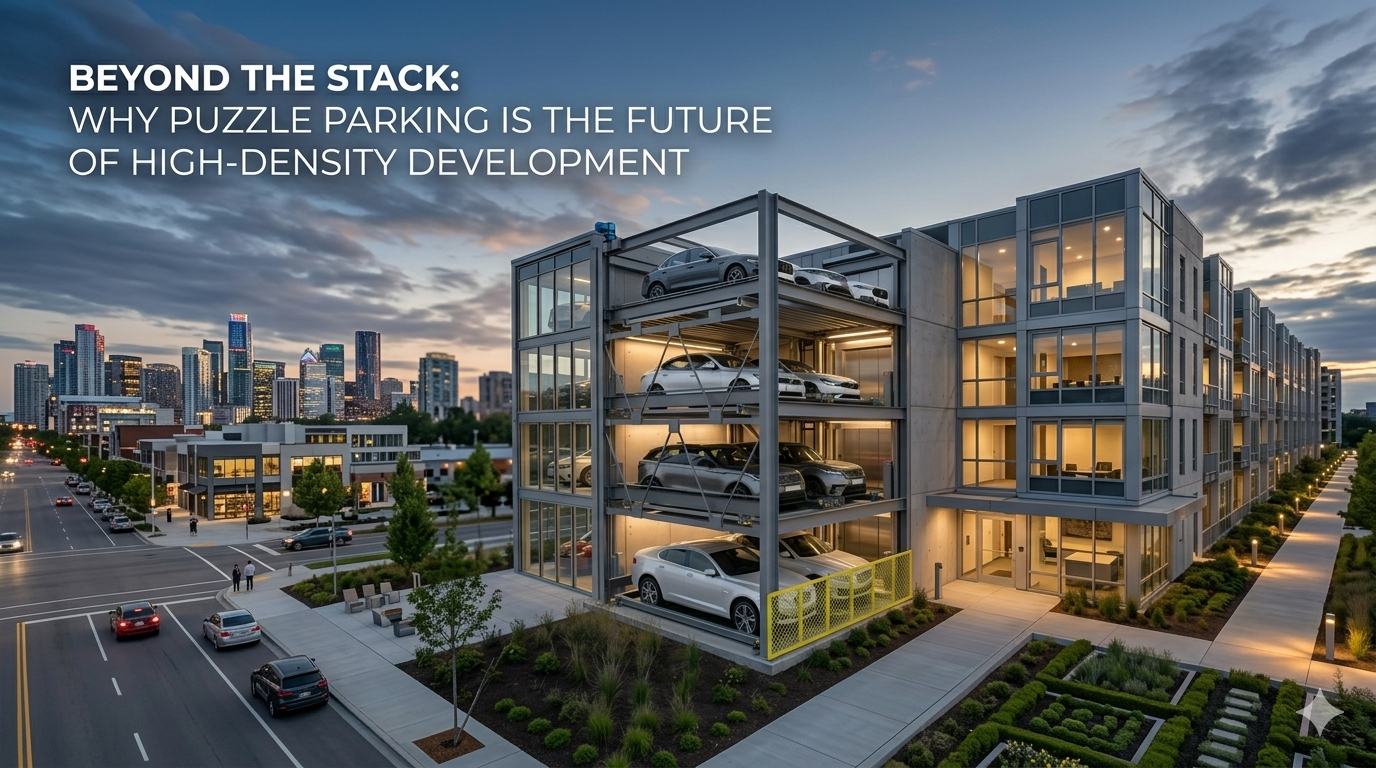
Beyond the Stack: Why Puzzle Parking is the Future of High-Density Development
Beyond the Stack: Why Puzzle Parking is the Future of High-Density Development: 1 High Puzzle Parking, 2 High Puzzle Parking, 3 High Puzzle Parking Lifts, 4 High Puzzle Parking Lifts, 5 High Puzzle Parking Lifts, 6 High Puzzle Parking Lifts, 7 High Puzzle Parking Lifts
If you’re developing in markets like Los Angeles or Seattle, you already know the drill. Land costs are astronomical, zoning requirements for parking are a headache, and every square inch of concrete you pour for a traditional ramp-and-aisle garage is a square inch you aren’t selling as a luxury condo or leasing as premium office space.
For years, the “go-to” solution for tight footprints was the basic mechanical stacker. You’ve seen them: the double vehicle stacker or the standard garage car stacker. They served a purpose, but they came with a significant logistical “tax”: the dreaded valet shuffle.
Beyond the Stack: Why Puzzle Parking is the Future of High-Density Development: 1 High Puzzle Parking, 2 High Puzzle Parking, 3 High Puzzle Parking Lifts, 4 High Puzzle Parking Lifts, 5 High Puzzle Parking Lifts, 6 High Puzzle Parking Lifts, 7 High Puzzle Parking Lifts
But the industry is shifting. We are moving beyond the simple stack. As high-density development becomes the standard rather than the exception, savvy developers are turning to hybrid puzzle parking systems. These aren’t just “better lifts”; they are fundamental game-changers for urban site optimization. At The Automated Parking Company, we’re seeing a massive surge in interest for these systems because they solve the one thing stackers can’t: the need for independent access at scale.
The “Stacker Ceiling”: Why Basic Lifts Aren’t Enough Anymore
To understand why puzzle systems are the future, we have to look at where we’ve been. Simple stackers are “dependent” systems. If you have a two-high stacker, the car on the bottom has to move before the car on the top can come down. In a residential building, that means either a 24/7 valet service (high OpEx) or neighbors awkwardly texting each other at 7:00 AM to move their SUVs.
While stackers offer roughly 60-64% space savings over traditional parking, they hit a ceiling in high-density projects. As soon as you scale up to a three-level or four-level project, the “dependent” nature of simple lifts becomes a logistical nightmare.
This is where the transition happens. Developers are realizing that the initial savings on a simple stacker system are often eaten alive by long-term operational costs and lower tenant satisfaction. If you want to maximize your Floor Area Ratio (FAR) and provide a premium experience, you need to go beyond the stack.
Decoding the Puzzle: How Hybrid Systems Work
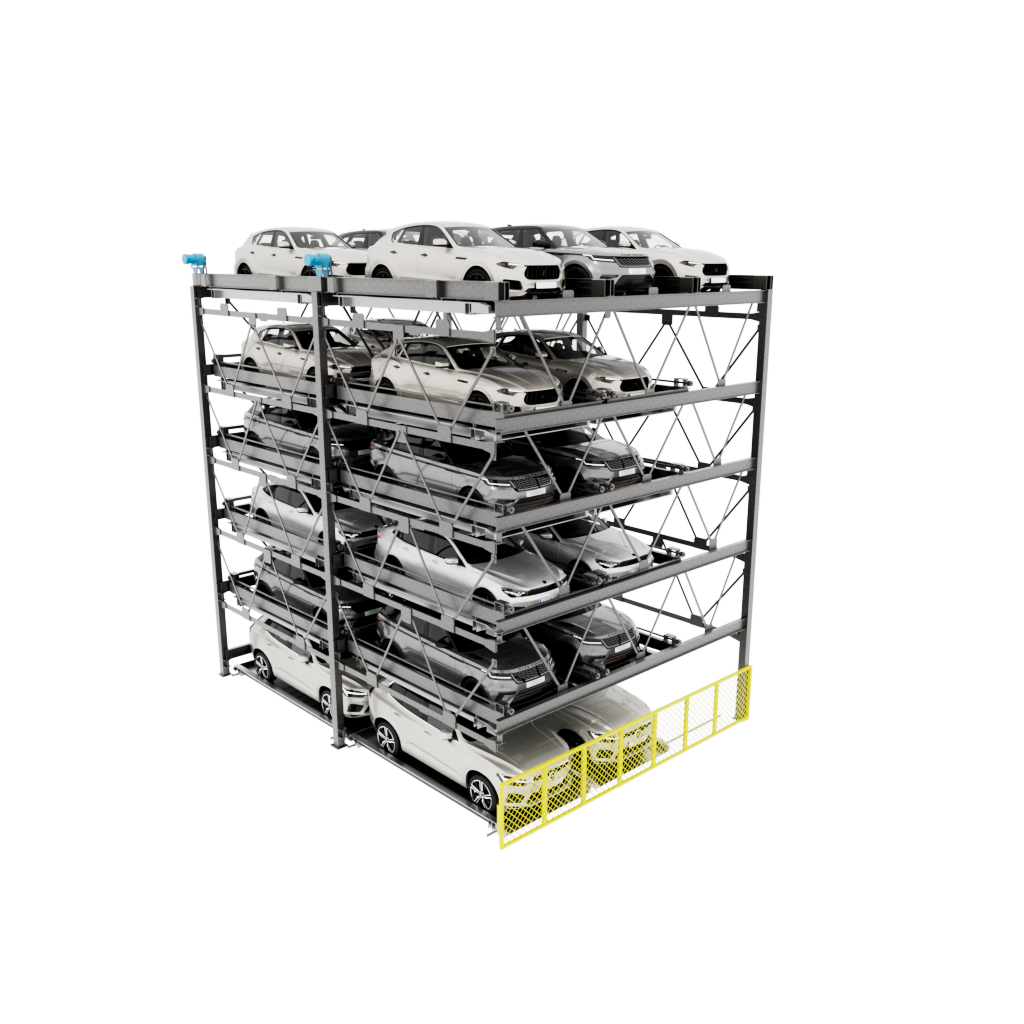
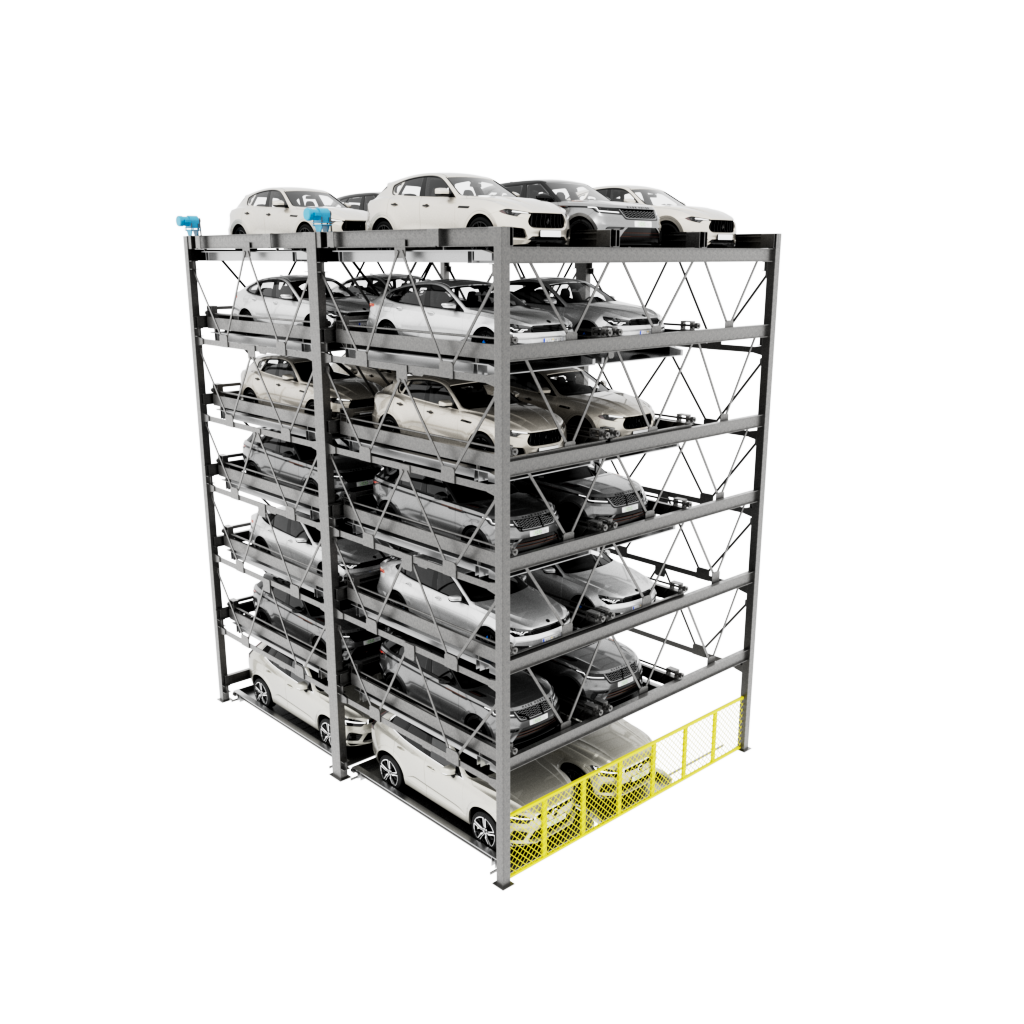
So, what exactly is “Puzzle Parking”? Think of it as a vertical and horizontal sliding grid: similar to those plastic sliding tile puzzles you played with as a kid.
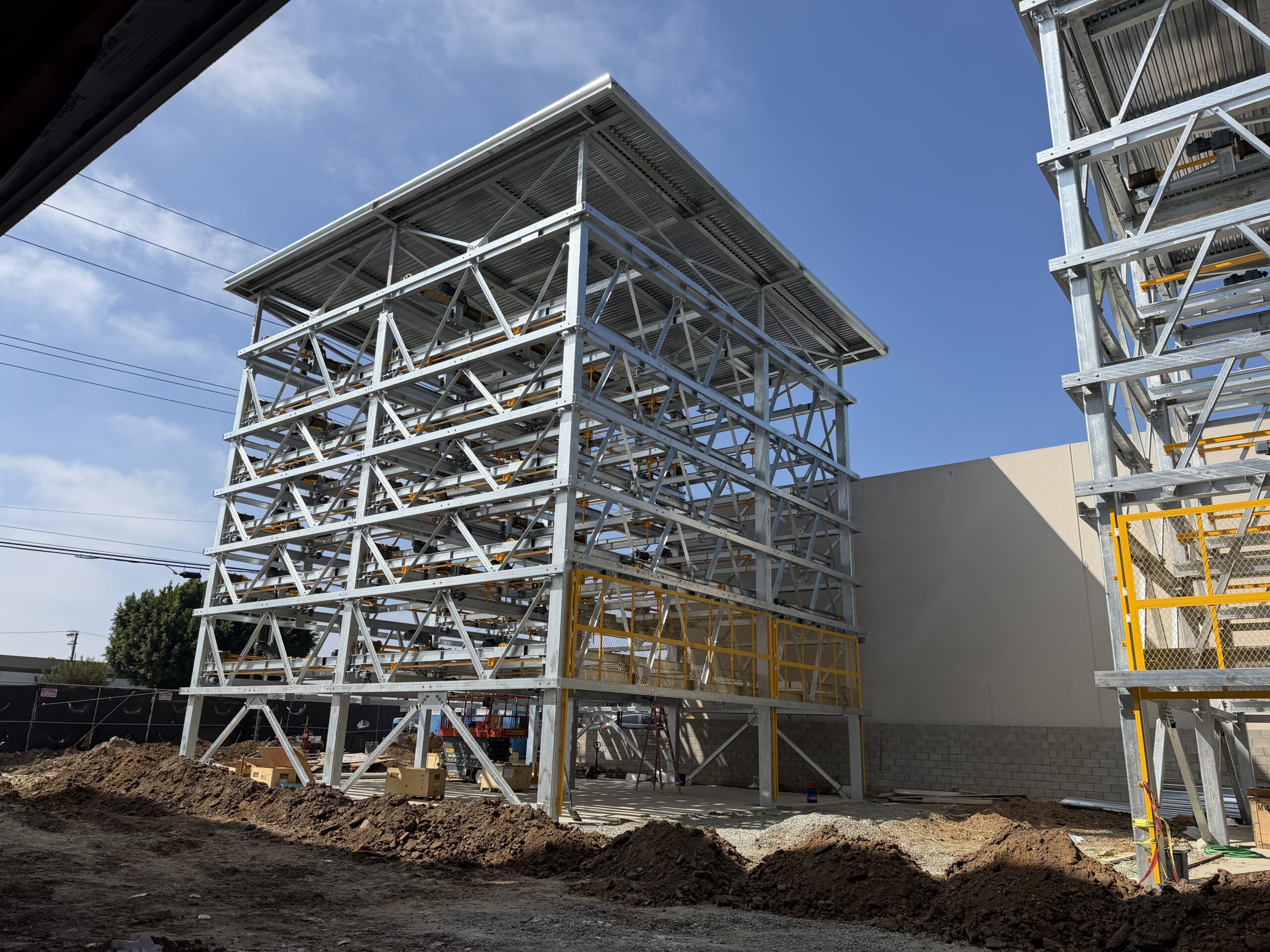
Unlike a standard lift that only moves up and down, a puzzle system (often categorized under semi-automated systems) uses a combination of mechanical platforms, lifts, and conveyors. These systems allow vehicles to be moved both vertically and horizontally.
By maintaining one or two empty “buffer” spaces within the grid, the system can automatically shuffle platforms around to bring any specific car down to the ground level. The beauty here is independent access. The user (or a valet) can retrieve any car without moving another vehicle.
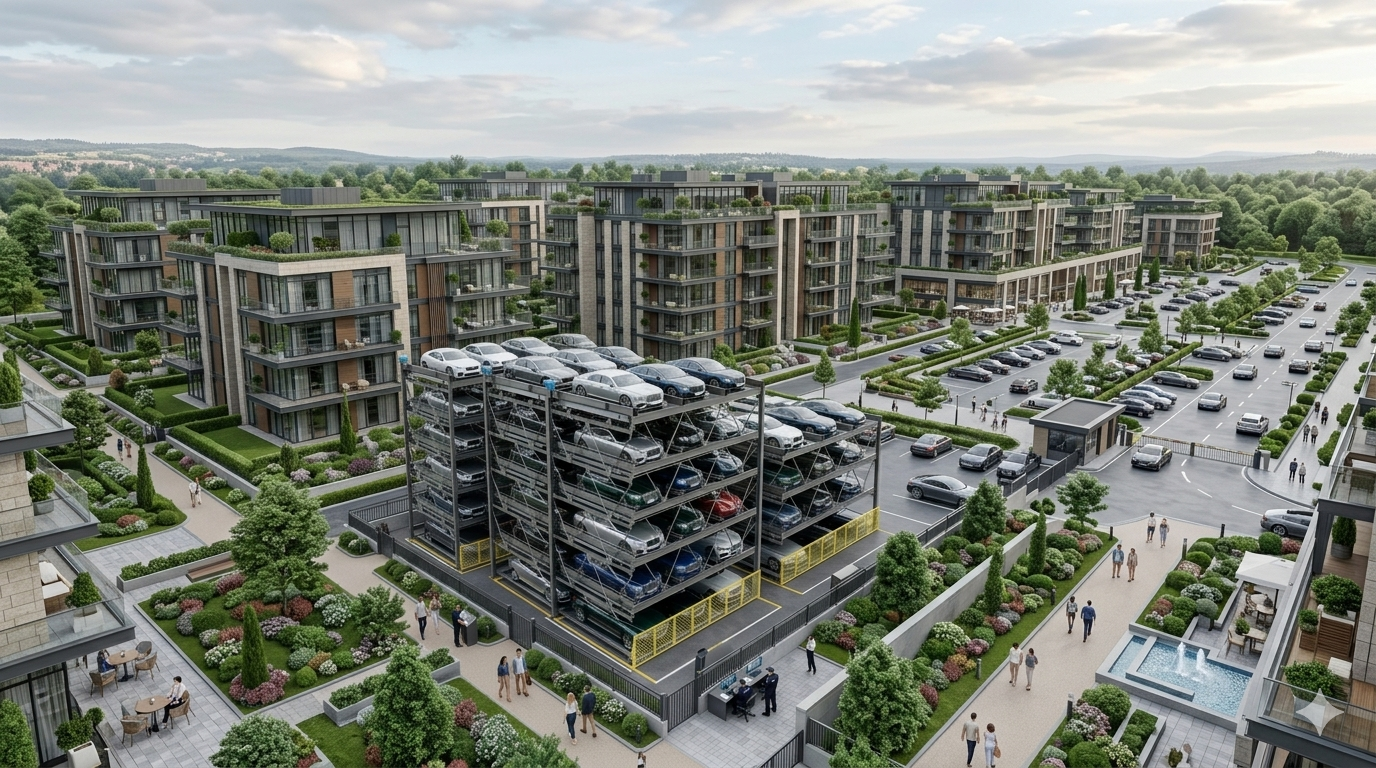
We offer various configurations to fit different site constraints, ranging from a three-high tandem puzzle for smaller infill lots to massive seven-high tandem puzzle systems for major towers. This flexibility allows developers to reclaim up to 72% of the space normally wasted on ramps and drive aisles.
The Independent Access Revolution
The biggest hurdle for automated parking adoption has always been the “retrieval anxiety.” Tenants worry about how long it will take to get their car. In a puzzle system, that anxiety is largely eliminated.
Because these systems utilize “mechanical translation technology,” any vehicle can be retrieved in roughly 60 to 90 seconds. Because no other cars need to be moved manually, the throughput is significantly higher than a stacker-plus-valet setup.
For projects in places like Florida, where luxury buyers expect seamless transitions from their front door to their driver’s seat, independent access is a non-negotiable. Whether you are installing a four-high one deep puzzle or a more complex six-high puzzle, you are selling convenience. You are selling the idea that technology serves the resident, not the other way around.
Crunching the Numbers: Density and Land Value
Let’s talk about the math, because at the end of the day, that’s what drives the “go” or “no-go” on a project.
In a traditional garage, you’re looking at an average of 300 to 350 square feet per parking stall once you account for ramps, aisles, and turning radii.
A three-level car stacker system brings that down to about 109 square feet per vehicle.
A five-level puzzle system, like our five-high puzzle, slashes that further to just 85 square feet per vehicle.
That delta: 24 square feet per car: might not sound like much until you multiply it by 200 stalls. That’s 4,800 square feet of real estate. In a high-density urban core, that’s the difference between adding two more units to your plan or losing them to a concrete ramp.
Furthermore, puzzle systems can be installed in tandem configurations. A four-high one deep tandem puzzle or a five-high tandem puzzle allows you to park cars two-deep, further compressing the footprint without sacrificing the ability to retrieve any vehicle on demand.
Sustainability: The Hidden Incentive
Urban development in 2026 isn’t just about density; it’s about ESG (Environmental, Social, and Governance) goals and local mandates. Traditional garages are carbon-intensive and promote idling.
When you implement a puzzle system, you aren’t just saving space; you’re building a “greener” project:
Reduced Emissions: There is no “circling for a spot.” The engine is turned off the moment the driver exits the vehicle at the transfer cabin.
EV Integration: Modern puzzle systems can be equipped with integrated EV charging stations. As the platform moves, the charging infrastructure moves with it, ensuring that the “high-density” parking of the future is ready for the electric transition.
Reduced Excavation: Because you can stack higher: up to a six-high tandem puzzle or even a seven-high puzzle: you often don’t need to dig as deep. Excavation and shoring are two of the biggest “wild cards” in a construction budget. Reducing the depth of your subterranean levels can save millions in unforeseen soil issues and water table management.
Future-Proofing Your Development
We often see developers make the mistake of “designing for today.” They look at the current building code and provide the minimum parking required using the cheapest lifts available. But buildings are 50-year assets.
The global puzzle parking market is projected to grow at over 10% CAGR through 2032. This isn’t a niche trend; it’s the new standard for urban logistics. By choosing a more advanced system like a four-high two deep puzzle, you are future-proofing the asset.
If vehicle ownership trends shift toward car-sharing or autonomous pods, puzzle systems are much easier to adapt than a sloped concrete ramp garage. The platforms can be modified to hold different types of micro-mobility solutions or even converted into automated storage modules if parking demand drops decades from now. You can’t do that with a ramp.
The Insider Verdict
The transition from “stacking” to “puzzle” is essentially the transition from “storage” to “logistics.” As a developer, you aren’t just looking for a place to put cars; you’re looking for a way to unlock the full potential of your land.
If your site is tight, if your excavation costs are soaring, or if your target demographic demands an “independent” parking experience without the high cost of a valet, the puzzle is the answer. It’s about more than just the stack: it’s about the intelligence behind it.
Ready to see how a puzzle system fits into your next project? Whether you’re looking at a three-high tandem or a massive seven-high tandem layout, the math usually speaks for itself. The future of high-density development isn’t just vertical; it’s automated.
Beyond the Stack: Why Puzzle Parking is the Future of High-Density Development: 1 High Puzzle Parking, 2 High Puzzle Parking, 3 High Puzzle Parking Lifts, 4 High Puzzle Parking Lifts, 5 High Puzzle Parking Lifts, 6 High Puzzle Parking Lifts, 7 High Puzzle Parking Lifts
De-Risk Your Parking Strategy with a FREE $5,000 Design Review Credit
If you connect with us, The Automated Parking Company, will provide a FREE in-depth design review, normally valued at $5,000; to assess feasibility, optimize layouts, and align your parking solution with project goals.
When you proceed with us, the full design review fee is credited back to the project, ensuring your early-stage diligence directly supports execution—not overhead.
A disciplined approach to smarter parking investment.
📞 Call Us for a FREE parking design review, valued at $5,000: (877) 827-2611
We value community input and address concerns for harmonious solutions.
Research & Innovation
Continuous research and innovation to improve green parking solutions.
Our Step By Step Process Towards Building Smart Yet Sustainable Parking
At TAPCO, our process ensures seamless delivery of efficient and sustainable parking tech tailored to your evolving project needs.
01
Discovery & Consultation:
Understand your needs, site constraints, and objectives.
02
Customized Design:
Create a tailored parking solution with eco-friendly integration.
03
Project Approval & Collaboration:
Obtain necessary approvals and work closely with your team.
04
Manufacturing & Quality Control:
Ensure the highest standards of quality.
05
Timely Delivery & Installation:
On-time setup with minimal disruptions.
06
Thorough Testing & Commissioning:
Rigorous performance checks and safety adherence.
07
Training & Support:
Comprehensive staff training and ongoing maintenance services.
08
Environmental Responsibility:
Implement eco-friendly practices and sustainability monitoring.
09
Client Satisfaction:
Prioritize your project with any number of our solutions.
Frequently Asked Questions
Q: Can TAPCO’s solutions be tailored to our specific needs?
A: Absolutely! At TAPCO, we understand that every project is unique. Our experienced team of designers and engineers will work closely with you to understand your specific requirements, site constraints, and objectives.
Q: How many levels can The Automated Parking Company design for the Puzzle parking system?
A: The Automated Parking Company has the capability to design systems with 2 to 7 levels, accommodating a varying number of parking spaces. Moreover, if your project calls for additional space optimization, we can even incorporate one or two subterranean levels, effectively increasing the total parking capacity.
Q: Are TAPCO’s parking systems safe and reliable?
A: Yes, safety is our top priority at TAPCO. We adhere to stringent industry safety standards and conduct rigorous testing and quality control measures at every stage of the manufacturing process.
Our car parking solutions are designed and built to ensure the safety of users, vehicles, and your property. We use high-quality materials and employ advanced technology to ensure the reliability and durability of our parking systems.
Improving Parking Convenience with Parking Stackers
When it comes to parking solutions, attended-oriented systems offer a blend of efficiency and convenience that cater to the needs and challenges of urban areas, particularly high-demand areas.
These multi-level car stacker solutions are a game-changer when it comes to parking, allowing the creation of multiple parking spaces within a single area.
TAPCO introduces a wide array of innovative attended-oriented parking systems designed to optimize space utilization as well as offer user-friendly parking practices.
These systems are intended to provide a seamless parking experience and enable attendants to efficiently manage parking procedures while ensuring the convenience and safety of the users. Here are the key benefits of using attended-oriented parking systems.
Optimal Space Utilisation
Our attended-oriented parking systems incorporate car lift storage systems make optimal use of the available space. Vertical stacking of vehicles with the vertical storage lift enables the system to increase the parking capacity within a limited area, hence coping with the increasing parking demands.
Organised vertical stacking
The attended-oriented parking allows vertical stacking of vehicles to utilize a vertical space effectively. This approach reduces the area required for parking, thereby contributing to a more organized and aesthetically pleasant-looking parking facility.
Convenience
The attended-oriented parking system offers ease of use for the attendant as well as the user. While the attendant can successfully navigate the car stacker lift and swiftly move vehicles into a nesting position with minimal effort, users need little to no guidance to park their vehicles safely.
Enhanced Security
Our attended-oriented car stacking system comes with advanced features to ensure the safety of parked vehicles. While users have peace of mind, property managers can also be content with the knowledge that the facility is secure.
Versatile stacked car parking
We offer a variety of car stacker lift solutions. From four post car storage lifts to no post solutions, our systems can be implemented indoors as well as outdoors and can be adapted for various project requirements or property layouts. TAPCO’s attended-oriented parking systems can be used in various environments, from commercial establishments to residential complexes.
Revolutionary Parking Solutions with Automated Lift Parking System
As the urban landscape continues to grow, the demand for efficient car parking solutions has become increasingly important. TAPCO introduces revolutionary semi-automated smart parking systems that are designed to optimise space utilization and streamline parking procedures for multi-family residential complexes and commercial facilities. Compared to the conventional car lift system, our multi level car parks are designed to redefine convenience and efficiency.
Here are some of the key features of our semi-automated car parking systems
Space Optimization
Optimal space utilization is a key focus of our multi-level car storing solutions. Our stack parking systems are designed to accommodate multiple levels, providing an impressive number of parking spaces within a compact footprint. We can design and integrate two to seven parking levels in a single structure and customize varying lengths, widths, and heights.
Seamless Automation
Our smart parking system incorporates advanced automation to simplify the parking process. Drivers can effortlessly park their vehicles with minimum guidance, thereby providing efficient utilization of time.
EV Capability
Given the increasing trend of electric vehicles, our parking solutions are also designed to embrace the future of mobility and Electric Vehicles. To cater to the ever-evolving automotive landscape, we also feature charging facilities for electric cars. We are the only vendor offering 7000# rated systems.
Convenience
We understand that parking can be a source of frustration for people, particularly when you cannot find a spot and have to drive around looking for space. Such layouts can be problematic for larger properties. However, with our Puzzle Parking system, this problem can be easily resolved, offering convenience to individuals and saving valuable time when parking or capturing your auto.
FAQ
Q: What is the difference between a fully automated and semi-automated smart parking system?
A: Semi-automated Puzzle solutions and fully automated AGV parking systems are considered automated parking and compress footprints giving you back valuable square footage.
In a semi-automated parking system, drivers can park and/or retrieve their own auto, so this system rids you of any demand for parking attendants therefore lowering your OpEx. Once the users vehicle is stowed within the system, the semi-automated Puzzle system can move the car up and down or left to right to find its nesting space.
On the other hand, in a fully-automated parking system, the driver pulls into a loading bay where they remove themselves and leave their auto, the system will then maneuver the auto and autonomously stow the users auto within the parking vault.
Q: What is the difference between mechanical lift systems and semi-automated Puzzle Parking systems?
A: In a mechanical stacker system, individuals must operate for it to move, or you must incorporate attendants to manage the parking and retrieval process.. The mechanical stacker parking system is usually a Double, Triple, or Quad Stacker that can raise the vehicle directly up on the platform so that more than one vehicle can be parked in a vertical stack. We strongly encourage trained personnel to operate these systems due to the manual processes of storing or retrieving autos in a vertical arrangement.
On the other hand, in a semi-automated system, there is no demand nor need for attendants or personnel to retrieve autos. Once the driver has parked their vehicle within the system, the semi-automated Puzzle system can intelligently move the car up and down or left to right.
Q: Which properties are semi-automated parking systems suitable for?
A: Our semi-automated parking systems are mostly suitable and used for commercial office and multi-family residential complexes.
Q: Can electric cars be charged in semi-automated parking systems?
A: Absolutely, our semi-automated smart parking systems are EV capable and feature charging facilities for electric vehicles. We offer Level II smart charging capabilities that allow you to bill the user pro-rata and also reduce the number of electrical meters therefore reducing your overall build costs when compared to competitive vendors.
Q: What are the maintenance requirements of semi-automated parking systems?
A: Maintenance and upkeep of the parking systems by The Automated Parking Company are easy as they are designed for minimal maintenance and durability. However, please note that regular checks and maintenance schedules help ensure optimal performance.
EV-Chargers Form
EV Chargers
You’re almost there
Fill in the details below to get our Spec Sheet, CAD, and Revit!