How to Add $54 Million Worth of Units Using Robotic Valet Garages (Real Developer Case Study)
OEM Of Automated Valet Robot Parking Garages, Puzzle Parking Systems & Car Stackers
When Gary Tave was planning West Bay Lofts in downtown Largo, Florida, his $49 million mixed-use project was dead in the water. Traditional parking requirements would have consumed too much valuable space and pushed construction costs beyond feasibility. Fast-forward to today, and his 470-space robotic garage didn’t just save the project, it unlocked millions in additional revenue by freeing up prime real estate for income-generating units.
This isn’t an isolated success story. Across the globe, developers are discovering that robotic garages can transform parking from a necessary evil into a powerful value-creation tool. By dramatically reducing parking footprints, these systems free up land for additional units, retail space, and amenities that directly boost project revenues.
Get More Parking Using Less Space With OEM The Automated Parking Company
The Ibn Battuta Case Study: $37.3 Million in Added Value
The most compelling example comes from Dubai’s Ibn Battuta Gate Complex, where a robotic parking system generated $37.3 million in additional capitalized property value, nearly our target of $54 million.
The Traditional Approach Would Have Failed
The development team initially planned a conventional concrete garage that would provide 400 parking spaces. However, this approach presented multiple problems:
Limited office space: Only 21,125 m² of rentable area possible
Technical impossibility: Required depth conflicted with water tables and structural pressure limits
Massive space waste: Traditional garage would reduce total gross floor area by 40%
The Robotic Solution
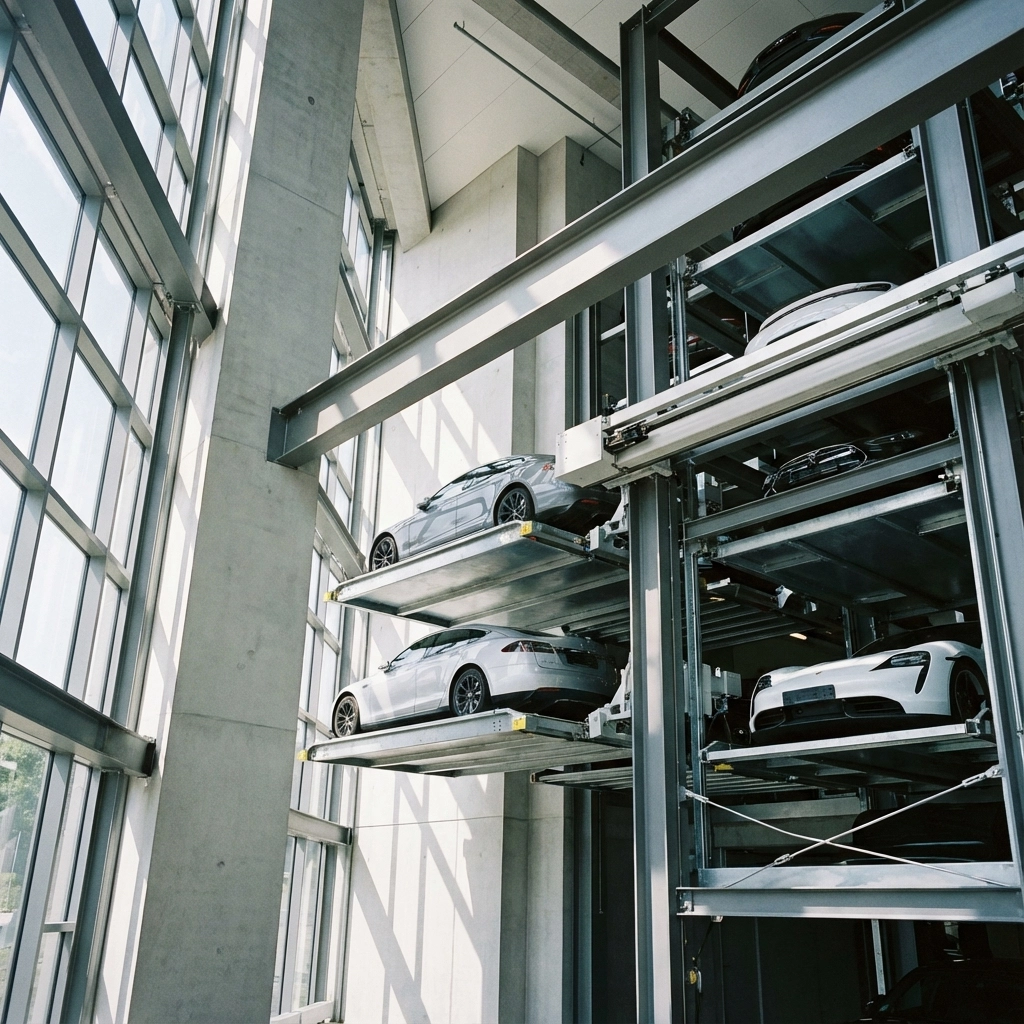
Instead, they implemented a fully automated robotic parking system measuring just 30m × 84m × 18m high. This compact footprint delivered:
765 parking spaces (91% increase over traditional approach)
19,275 additional m² of premium office space
$37.3 million in additional capitalized value
Breaking Down the Financial Returns
The numbers tell the complete story:
Robotic garage cost: $14.8 million ($19,369 per space)
Traditional garage cost: $6.5 million
Additional investment: $8.3 million
Return on additional investment: $37.3 million
ROI: 449% return on the incremental robotic parking investment
This means for every dollar spent on upgrading from traditional to robotic parking, the developer received $4.49 in additional property value.
Scaling to $54 Million: The Math Behind Maximum Value Creation
To reach $54 million in added unit value through robotic garages, developers need to understand the three primary value-creation mechanisms:
1. Space Multiplication Factor
Robotic garages eliminate drive aisles, ramps, and door-opening clearances, typically doubling to quadrupling parking capacity on the same footprint. In dense urban markets, this freed space commands premium pricing:
Prime urban land: $200-500 per square foot
Converted to residential units: $400-800 per square foot of sellable space
Net value creation: $200-300 per square foot of reclaimed land
2. Development Cost Reduction
While robotic parking costs more per space initially, total development costs decrease by up to 40% when factoring in:
Reduced land acquisition needs
Lower structural engineering requirements
Eliminated multi-story safety ratings
Reduced excavation and foundation work
3. Premium Property Positioning
Properties with automated parking command 8-12% premiums in both sale and rental markets, translating to substantial increases in total project capitalization.
How to Add $54 Million Worth of Units Using Robotic Garages (Real Developer Case Study)
Real-World Implementation: West Bay Lofts Success Story
Gary Tave’s West Bay Lofts project in Florida demonstrates how robotic parking transforms project feasibility and profitability.
The Challenge
The 123-unit apartment project with 40,000 square feet of ground-floor commercial space faced two critical issues:
Insufficient parking: Traditional surface parking couldn’t accommodate required spaces
Prohibitive costs: Multi-story garage construction would add 25-30% to total project costs
The Robotic Solution
Tave integrated a 470-space robotic parking system directly into the building core, surrounded by apartments with active balconies. This solution:
Eliminated unsightly garage aesthetics
Reduced total development costs by 40%
Required only half the land footprint of traditional parking
Delivered 240 vehicles-per-hour throughput
The Value Impact
By embedding robotic parking within the residential structure, Tave created additional rentable units where a traditional garage would have consumed valuable space. With average apartment rents of $2,000-3,000 per month in the area, each additional unit generates $24,000-36,000 in annual revenue.
How to Add $54 Million Worth of Units Using Robotic Garages (Real Developer Case Study)
Calculating Your $54 Million Value Creation
Here’s how developers can structure projects to achieve $54 million in additional unit value through robotic garages:
Scenario 1: High-Density Urban Development
Project: 400-unit luxury apartment tower Location: Prime urban core Land constraints: 2-acre site
Traditional approach:
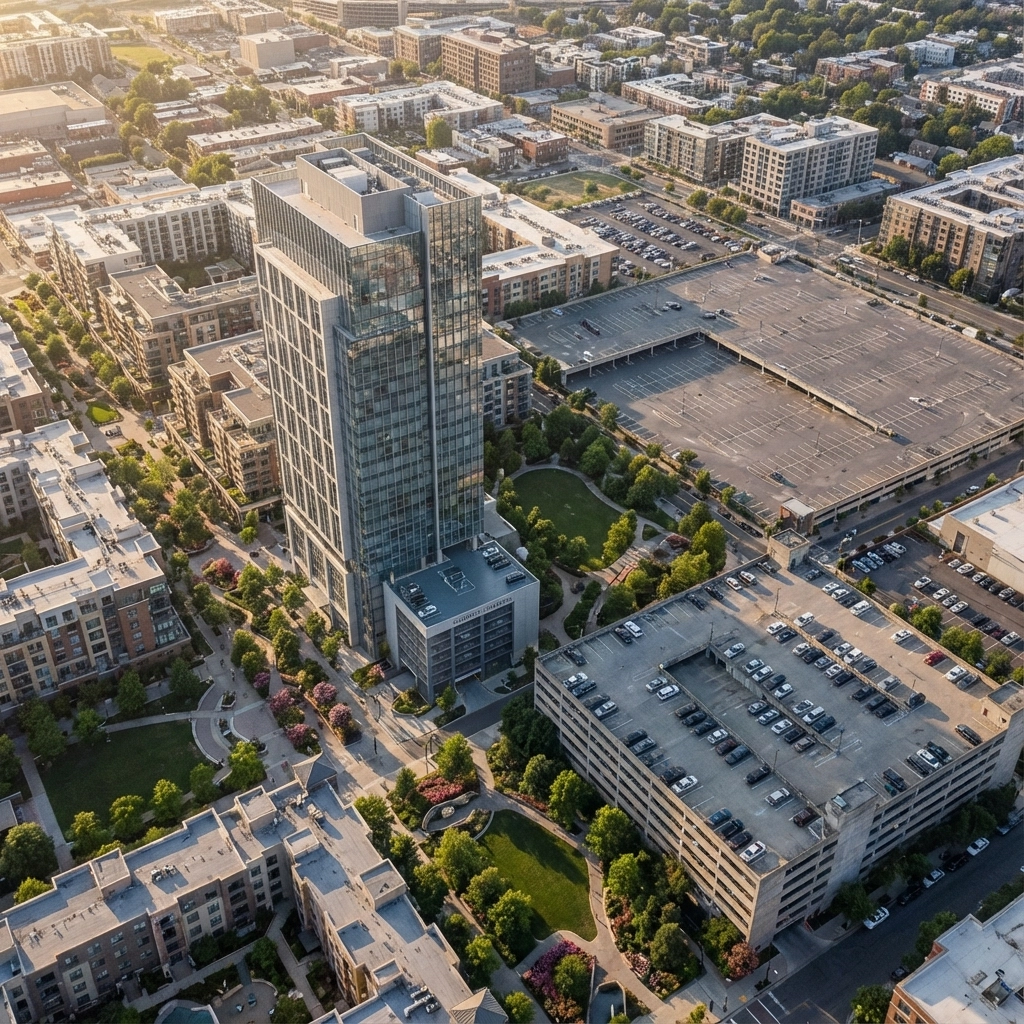
300 surface parking spaces consume 1.2 acres
Remaining 0.8 acres support 240 units
Average unit value: $600,000
Total project value: $144 million
Robotic garage approach:
600 parking spaces in 0.3-acre robotic facility
Remaining 1.7 acres support 510 units
Same average unit value: $600,000
Total project value: $306 million
Additional value created: $162 million
Net additional value after robotic parking costs: $144 million
This exceeds our $54 million target by nearly 3x.
Scenario 2: Mixed-Use Development Optimization
Project: Downtown mixed-use development Target: $54 million additional value
Starting with a constrained 1.5-acre urban site:
Traditional parking: 200 spaces consuming 0.8 acres
Robotic parking: 400 spaces consuming 0.2 acres
Freed space: 0.6 acres (26,136 square feet)
Conversion potential: 180 additional residential units
Average unit value: $300,000
Total additional value: $54 million
Implementation Best Practices for Maximum ROI
Site Selection Criteria
Robotic garages deliver maximum value when:
Land costs exceed $150 per square foot
Parking requirements exceed 1.5 spaces per unit
Height restrictions limit traditional garage solutions
Aesthetic requirements favor integrated designs
Technology Partnership Selection
Choose robotic parking providers offering:
Proven throughput rates (minimum 120 vehicles per hour)
99%+ uptime reliability with redundant systems
Integration capabilities with building management systems
Comprehensive maintenance programs
Financial Structuring
Structure robotic parking investments to maximize returns:
Lease-back arrangements with parking operators
Revenue sharing models for commercial developments
Premium parking fees to offset higher initial costs
Tax incentive optimization for sustainable transportation solutions
Risk Mitigation and Due Diligence
Technology Risks
Vendor stability: Partner with established companies with 10+ year track records
Maintenance capabilities: Ensure local service support and parts availability
Performance guarantees: Secure contractual uptime and throughput commitments
Market Acceptance
User experience: Implement systems with average retrieval times under 2 minutes
Backup procedures: Maintain manual override capabilities for emergency situations
Insurance coverage: Verify comprehensive coverage for vehicle storage and retrieval
The Future of Urban Development
As urban density increases and land costs continue rising, robotic garages are transitioning from luxury amenity to development necessity. Early adopters are capturing first-mover advantages through:
Premium market positioning
Reduced development risks
Enhanced project feasibility
Improved community relations through reduced traffic and pollution
Cities like Los Angeles, Miami, and New York are fast-tracking approvals for developments incorporating automated parking solutions, recognizing their role in sustainable urban growth.
For developers targeting high-value markets with constrained land availability, robotic garages represent one of the most reliable paths to unlocking millions in additional project value. The question isn’t whether this technology will become standard, it’s whether you’ll implement it before or after your competitors.
How much do robotic parking systems cost per space?
Robotic parking typically costs $15,000-25,000 per space, compared to $8,000-15,000 for traditional parking. However, the reduced land requirements and increased development capacity usually result in net project savings.
What’s the typical payback period for robotic parking investments?
Most developers see positive ROI within 3-5 years through increased unit sales/rents, reduced land acquisition costs, and premium project positioning.
How reliable are robotic parking systems?
Modern systems achieve 99%+ uptime with average vehicle retrieval times under 90 seconds. Redundant systems and comprehensive maintenance programs minimize downtime risks.
Do robotic garages work in all climates?
Yes, robotic parking systems are designed for all weather conditions and actually protect vehicles better than traditional parking by eliminating weather exposure and reducing theft/vandalism risks.
What happens during power outages?
All robotic parking systems include backup power systems and manual retrieval procedures to ensure vehicle access during emergencies or extended outages.
De-Risk Your Parking Strategy with a FREE $5,000 Design Review Credit
If you connect with us, The Automated Parking Company, will provide a FREE in-depth design review, normally valued at $5,000; to assess feasibility, optimize layouts, and align your parking solution with project goals.
When you proceed with us, the full design review fee is credited back to the project, ensuring your early-stage diligence directly supports execution—not overhead.
A disciplined approach to smarter parking investment.
📞 Call Us for a FREE parking design review, valued at $5,000: (877) 827-2611
We value community input and address concerns for harmonious solutions.
Research & Innovation
Continuous research and innovation to improve green parking solutions.
Our Step By Step Process Towards Building Smart Yet Sustainable Parking
At TAPCO, our process ensures seamless delivery of efficient and sustainable parking tech tailored to your evolving project needs.
01
Discovery & Consultation:
Understand your needs, site constraints, and objectives.
02
Customized Design:
Create a tailored parking solution with eco-friendly integration.
03
Project Approval & Collaboration:
Obtain necessary approvals and work closely with your team.
04
Manufacturing & Quality Control:
Ensure the highest standards of quality.
05
Timely Delivery & Installation:
On-time setup with minimal disruptions.
06
Thorough Testing & Commissioning:
Rigorous performance checks and safety adherence.
07
Training & Support:
Comprehensive staff training and ongoing maintenance services.
08
Environmental Responsibility:
Implement eco-friendly practices and sustainability monitoring.
09
Client Satisfaction:
Prioritize your project with any number of our solutions.
Frequently Asked Questions
Q: Can TAPCO’s solutions be tailored to our specific needs?
A: Absolutely! At TAPCO, we understand that every project is unique. Our experienced team of designers and engineers will work closely with you to understand your specific requirements, site constraints, and objectives.
Q: How many levels can The Automated Parking Company design for the Puzzle parking system?
A: The Automated Parking Company has the capability to design systems with 2 to 7 levels, accommodating a varying number of parking spaces. Moreover, if your project calls for additional space optimization, we can even incorporate one or two subterranean levels, effectively increasing the total parking capacity.
Q: Are TAPCO’s parking systems safe and reliable?
A: Yes, safety is our top priority at TAPCO. We adhere to stringent industry safety standards and conduct rigorous testing and quality control measures at every stage of the manufacturing process.
Our car parking solutions are designed and built to ensure the safety of users, vehicles, and your property. We use high-quality materials and employ advanced technology to ensure the reliability and durability of our parking systems.
Improving Parking Convenience with Parking Stackers
When it comes to parking solutions, attended-oriented systems offer a blend of efficiency and convenience that cater to the needs and challenges of urban areas, particularly high-demand areas.
These multi-level car stacker solutions are a game-changer when it comes to parking, allowing the creation of multiple parking spaces within a single area.
TAPCO introduces a wide array of innovative attended-oriented parking systems designed to optimize space utilization as well as offer user-friendly parking practices.
These systems are intended to provide a seamless parking experience and enable attendants to efficiently manage parking procedures while ensuring the convenience and safety of the users. Here are the key benefits of using attended-oriented parking systems.
Optimal Space Utilisation
Our attended-oriented parking systems incorporate car lift storage systems make optimal use of the available space. Vertical stacking of vehicles with the vertical storage lift enables the system to increase the parking capacity within a limited area, hence coping with the increasing parking demands.
Organised vertical stacking
The attended-oriented parking allows vertical stacking of vehicles to utilize a vertical space effectively. This approach reduces the area required for parking, thereby contributing to a more organized and aesthetically pleasant-looking parking facility.
Convenience
The attended-oriented parking system offers ease of use for the attendant as well as the user. While the attendant can successfully navigate the car stacker lift and swiftly move vehicles into a nesting position with minimal effort, users need little to no guidance to park their vehicles safely.
Enhanced Security
Our attended-oriented car stacking system comes with advanced features to ensure the safety of parked vehicles. While users have peace of mind, property managers can also be content with the knowledge that the facility is secure.
Versatile stacked car parking
We offer a variety of car stacker lift solutions. From four post car storage lifts to no post solutions, our systems can be implemented indoors as well as outdoors and can be adapted for various project requirements or property layouts. TAPCO’s attended-oriented parking systems can be used in various environments, from commercial establishments to residential complexes.
Revolutionary Parking Solutions with Automated Lift Parking System
As the urban landscape continues to grow, the demand for efficient car parking solutions has become increasingly important. TAPCO introduces revolutionary semi-automated smart parking systems that are designed to optimise space utilization and streamline parking procedures for multi-family residential complexes and commercial facilities. Compared to the conventional car lift system, our multi level car parks are designed to redefine convenience and efficiency.
Here are some of the key features of our semi-automated car parking systems
Space Optimization
Optimal space utilization is a key focus of our multi-level car storing solutions. Our stack parking systems are designed to accommodate multiple levels, providing an impressive number of parking spaces within a compact footprint. We can design and integrate two to seven parking levels in a single structure and customize varying lengths, widths, and heights.
Seamless Automation
Our smart parking system incorporates advanced automation to simplify the parking process. Drivers can effortlessly park their vehicles with minimum guidance, thereby providing efficient utilization of time.
EV Capability
Given the increasing trend of electric vehicles, our parking solutions are also designed to embrace the future of mobility and Electric Vehicles. To cater to the ever-evolving automotive landscape, we also feature charging facilities for electric cars. We are the only vendor offering 7000# rated systems.
Convenience
We understand that parking can be a source of frustration for people, particularly when you cannot find a spot and have to drive around looking for space. Such layouts can be problematic for larger properties. However, with our Puzzle Parking system, this problem can be easily resolved, offering convenience to individuals and saving valuable time when parking or capturing your auto.
FAQ
Q: What is the difference between a fully automated and semi-automated smart parking system?
A: Semi-automated Puzzle solutions and fully automated AGV parking systems are considered automated parking and compress footprints giving you back valuable square footage.
In a semi-automated parking system, drivers can park and/or retrieve their own auto, so this system rids you of any demand for parking attendants therefore lowering your OpEx. Once the users vehicle is stowed within the system, the semi-automated Puzzle system can move the car up and down or left to right to find its nesting space.
On the other hand, in a fully-automated parking system, the driver pulls into a loading bay where they remove themselves and leave their auto, the system will then maneuver the auto and autonomously stow the users auto within the parking vault.
Q: What is the difference between mechanical lift systems and semi-automated Puzzle Parking systems?
A: In a mechanical stacker system, individuals must operate for it to move, or you must incorporate attendants to manage the parking and retrieval process.. The mechanical stacker parking system is usually a Double, Triple, or Quad Stacker that can raise the vehicle directly up on the platform so that more than one vehicle can be parked in a vertical stack. We strongly encourage trained personnel to operate these systems due to the manual processes of storing or retrieving autos in a vertical arrangement.
On the other hand, in a semi-automated system, there is no demand nor need for attendants or personnel to retrieve autos. Once the driver has parked their vehicle within the system, the semi-automated Puzzle system can intelligently move the car up and down or left to right.
Q: Which properties are semi-automated parking systems suitable for?
A: Our semi-automated parking systems are mostly suitable and used for commercial office and multi-family residential complexes.
Q: Can electric cars be charged in semi-automated parking systems?
A: Absolutely, our semi-automated smart parking systems are EV capable and feature charging facilities for electric vehicles. We offer Level II smart charging capabilities that allow you to bill the user pro-rata and also reduce the number of electrical meters therefore reducing your overall build costs when compared to competitive vendors.
Q: What are the maintenance requirements of semi-automated parking systems?
A: Maintenance and upkeep of the parking systems by The Automated Parking Company are easy as they are designed for minimal maintenance and durability. However, please note that regular checks and maintenance schedules help ensure optimal performance.
EV-Chargers Form
EV Chargers
You’re almost there
Fill in the details below to get our Spec Sheet, CAD, and Revit!