The $100k-Per-Spot Trap: Why Vertical Lift Parking Cost Less and is the 1-3 Year Depreciation Play for Smart CRE Investors
Let’s talk numbers. You’re sitting across from your CFO reviewing a $42 million parking structure proposal. Seven levels. 420 spaces. Steel, concrete, rebar, ventilation systems, lighting packages. The math works out to roughly $100,000 per parking spot when you factor in soft costs, urban location premiums, and the inevitable change orders.
Now imagine writing that same parking spot off over 29 years while watching maintenance costs climb annually.
There’s a better play happening right now in commercial real estate, one that flips the traditional parking economics on its head. CRE investors and architects are increasingly turning to vertical lift parking systems, and the depreciation strategy alone is changing pro formas across major metros.
The Conventional Parking Structure Math That Doesn’t Pencil Anymore
Traditional parking structures made sense when land was cheap and parking demand was predictable. Neither of those conditions exists in 2026.
Above-ground parking structures average $50,000 to $65,000 per space in most markets. Go subterranean in places like Los Angeles, San Francisco, or Seattle? You’re looking at $75,000 to $90,000 per space once you account for excavation, waterproofing, and structural engineering complexities.
But here’s where it gets painful: that investment gets depreciated as a building improvement over 29 years under MACRS. That’s nearly three decades before you’ve fully written off the asset for tax purposes. Meanwhile, maintenance costs compound. Concrete cracks. Waterproofing fails. Lighting needs replacement. Security systems become obsolete.
And if your parking demand drops, whether from work-from-home trends, changing zoning requirements, or neighborhood evolution, you’re stuck with an inflexible concrete monument that can’t be repurposed without significant capital investment.
The Vertical Lift Parking Alternative: Equipment, Not Real Estate
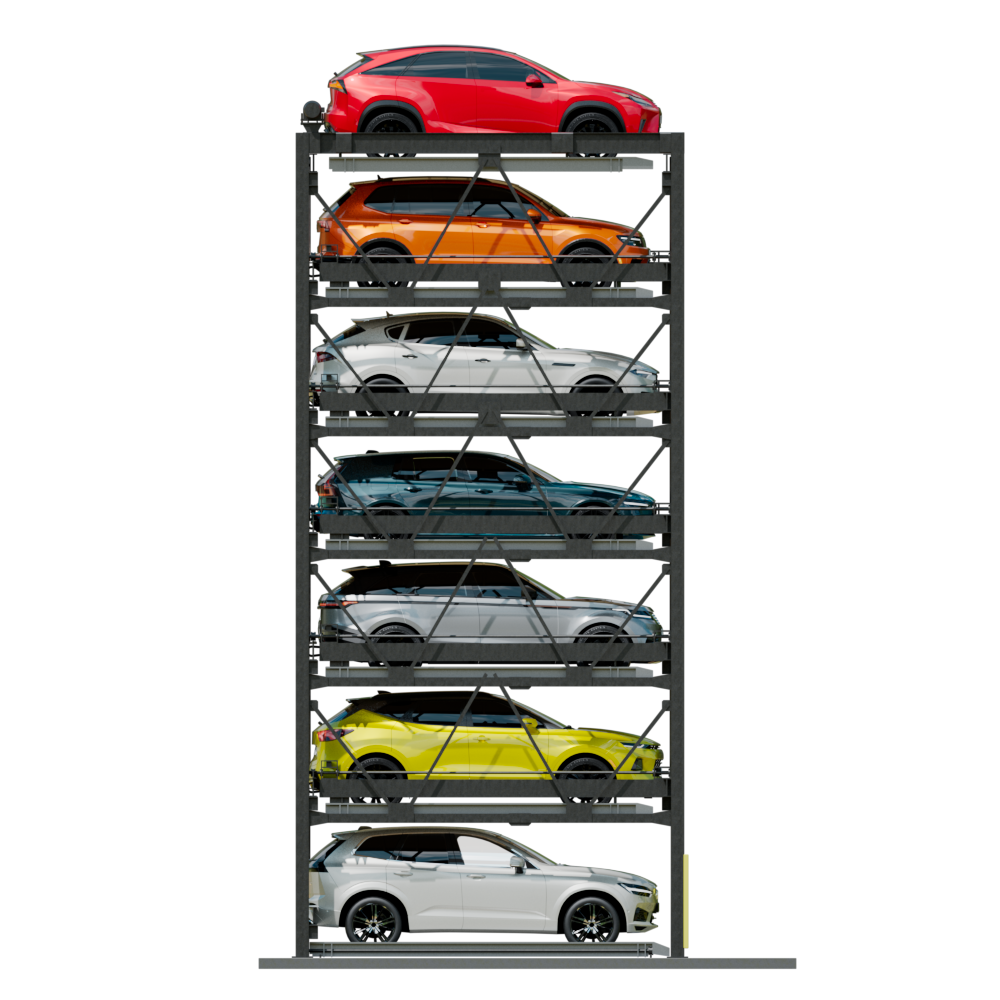
This is where stacked car parking systems, puzzle parking configurations, and robotic garages fundamentally change the conversation.
These aren’t parking structures. They’re equipment installations, and that classification matters enormously for your balance sheet.
Cost Reality Check
Let’s establish real numbers. Depending on system complexity and project scale:
Semi-automated car stackers: $20,000–$30,000 per space
Mechanical puzzle parking systems: $15,000–$25,000 per space for larger installations (100+ vehicles)
Fully automated robotic parking: $25,000–$35,000 per space
Even at the higher end, you’re looking at 50-65% cost savings compared to subterranean conventional parking. And unlike traditional structures, these systems can be installed in spaces where conventional ramps would be impossible, narrow urban lots, beneath buildings, in repurposed loading docks.
The Depreciation Advantage That Changes Everything
Here’s the financial engineering that sophisticated CRE investors are exploiting: vertical lift parking systems qualify as equipment, not building improvements.
That means depreciation over 5 to 7 years instead of 29 years for structures. Some systems even qualify for accelerated depreciation schedules that compress the timeline further.
Let’s model this out:
Scenario A: Conventional Subterranean Parking
100 spaces at $85,000 per space = $8.5M
Depreciation: $293,000 annually over 29 years
Year 5 cumulative depreciation: $1.47M
Scenario B: Mechanical Puzzle Parking System
100 spaces at $25,000 per space = $2.5M
Depreciation: $357,000 annually over 7 years
Year 5 cumulative depreciation: $1.79M
You’ve invested $6 million less upfront and you’re depreciating faster for tax purposes. The cash flow implications are substantial, particularly for value-add investors operating under tight IRR requirements.
The Hidden Cost of the Multi-Vendor Nightmare
But let’s talk about something that doesn’t show up on initial pro formas: vendor fragmentation.
With conventional parking structures, you’re coordinating:
Structural engineers
General contractors
Mechanical/electrical subcontractors
Concrete suppliers
Waterproofing specialists
Lighting and security vendors
Ongoing maintenance contracts with different companies
Each handoff is a potential failure point. Each vendor blames the others when something goes wrong. And when you need service at 2 AM because your parking gate is malfunctioning? Good luck finding someone who knows the entire system.
The Single-OEM Difference
This is where working with an integrated manufacturer like The Automated Parking Company fundamentally changes project execution and long-term operations.
We eliminate your risk when investing in automated parking systems because we are an integrated provider, assistance with permitting, design, manufacturing in our facility, installation, maintenance & service by our team + we own the software and can troubleshoot any issues. One contact for the life of your system. No reselling, no 3rd party installers, no 3rd party maintenance.
Yes, cost matters. But if the system doesn’t work….or can’t be supported…..or wasn’t installed properly: what did saving that money actually buy you?
When you’re working with an OEM that handles everything from initial design through decades of maintenance, you have:
Single-point accountability: No finger-pointing between installers and manufacturers
Software continuity: No orphaned control systems when third-party integrators disappear
Institutional knowledge: The same team that designed your system maintains it
Supply chain reliability: Direct access to replacement parts without markup layers
Upgrade pathways: Clear roadmap for adding features like EV charging integration without system overhaul
Real-World Applications for Architects and Developers
For architects, vertical lift systems solve spatial problems that conventional ramps can’t touch. That corner lot with weird geometry? A robotic garage system can maximize every square foot without requiring circulation space for vehicles.
Mixed-use development with retail on the ground floor? Stack parking above or below without sacrificing street-level activation.
Historic building conversion with protected façades? Automated systems fit behind existing structures without visible ramps or ventilation grilles.
For CRE investors, the advantages compound:
Lower CapEx requirements mean more capital available for value-creation in leasable space. Why spend $8.5M on parking when $2.5M accomplishes the same functional goal: and frees up $6M for additional units, upgraded finishes, or simply better project-level returns?
Faster depreciation accelerates tax benefits and improves cash-on-cash returns in crucial early years.
Reduced operational complexity means lower ongoing management overhead. Annual maintenance typically runs 1-3% of initial system cost: predictable, budgetable, and manageable.
Adaptive reuse potential provides exit strategy flexibility. If parking demand changes, many systems can be relocated or reconfigured. Try doing that with a concrete parking deck.
The 2026 Reality: Zoning Changes and Parking Minimums
We’re also seeing accelerated adoption driven by regulatory changes. Cities from San Francisco to Seattle have eliminated or dramatically reduced parking minimums for new construction. This creates a strategic opportunity: provide exactly the parking your project needs: no more, no less.
A puzzle parking system with 50 spaces costs roughly $1.25M and can be expanded modularly if demand increases. Compare that to building a 100-space conventional structure “just in case” at $3M+ that sits half-empty for years.
The financial discipline of right-sizing parking: enabled by scalable automated systems: is showing up in improved project-level returns across urban infill developments.
Making the Switch: What Smart Money Is Doing
The most sophisticated CRE operators aren’t asking “should we consider automated parking?” They’re asking “which car parking solution best fits our specific project constraints?”
The analysis typically involves:
Site geometry constraints: Can conventional ramps even work here?
Parking demand modeling: What’s realistic occupancy based on use mix?
Development budget pressure: Where can we create value by reducing parking CapEx?
Tax position: How valuable is accelerated depreciation to our investor base?
Long-term flexibility: What happens if parking demand drops in 10 years?
When you run these numbers honestly, vertical lift systems frequently win on multiple dimensions simultaneously.
The Bottom Line for Decision-Makers
Traditional parking structures aren’t going away entirely. Some projects still warrant conventional solutions. But for urban infill, adaptive reuse, mixed-use developments, and high-land-cost markets, the economics of vertical lift parking systems have shifted dramatically in favor of automated solutions.
You’re looking at equipment that depreciates like equipment, costs substantially less than conventional structures, requires dramatically less ongoing vendor coordination, and provides operational flexibility that concrete can’t match.
The question isn’t whether automated parking makes sense. The question is whether your next project can afford to ignore the financial advantages.
Ready to see how a mechanical puzzle parking or robotic garage system could work for your specific project? Connect with our team to discuss site-specific analysis, permitting support, and total cost of ownership modeling.
Because in 2026, the smart money isn’t asking whether to automate parking. They’re asking how quickly they can depreciate it.
The Automated Parking Company Puzzle Lift
Spec Form
Newsletter
You're almost there!
Fill in the details below to access our automated parking products spec sheet
Trusted Car Parking Solutions For A Reason
Proven Track Record
A proven track record of success, delivering vehicle storage solutions that matter.
Ability to reduce parking footprints and lower construction costs when compared to traditional parking schemes.
Experienced Team
Industry experts bring valuable market insights and capabilities to the table.
Focus on core values such as offering superior products, dependable software and controls, and professional customer service.
Innovative Designs
Pushing the boundaries of what’s possible in parking technology.
We stay ahead by developing innovative designs that meet the evolving needs of modern urban environments.
Cost-Effective Solutions
The Automated Parking Company understands the importance of cost-effectiveness in vehicle parking projects.
Our solutions are engineered to provide maximum value without compromising quality.
Sustainable Vehicle Parking Technologies by TAPCO
At TAPCO, sustainability is at the heart of our parking tech. We are committed to making a positive impact on the environment.
Green Design
Our vehicle storage solutions prioritize efficient space utilization, reducing waste and optimizing land usage.
Eco-Friendly Materials
We source environmentally responsible materials and integrate energy-efficient technologies.
Low Carbon Footprint
Our fully automated parking lots feature electric AGVs, minimizing greenhouse gas emissions.
LEED Support
Our designs align with LEED certification requirements for sustainable projects.
Urban Planning
We collaborate with urban planners to create pedestrian-friendly, green spaces for vehicles.
We value community input and address concerns for harmonious solutions.
Research & Innovation
Continuous research and innovation to improve green parking solutions.
Our Step By Step Process Towards Building Smart Yet Sustainable Parking
At TAPCO, our process ensures seamless delivery of efficient and sustainable parking tech tailored to your evolving project needs.
01
Discovery & Consultation:
Understand your needs, site constraints, and objectives.
02
Customized Design:
Create a tailored parking solution with eco-friendly integration.
03
Project Approval & Collaboration:
Obtain necessary approvals and work closely with your team.
04
Manufacturing & Quality Control:
Ensure the highest standards of quality.
05
Timely Delivery & Installation:
On-time setup with minimal disruptions.
06
Thorough Testing & Commissioning:
Rigorous performance checks and safety adherence.
07
Training & Support:
Comprehensive staff training and ongoing maintenance services.
08
Environmental Responsibility:
Implement eco-friendly practices and sustainability monitoring.
09
Client Satisfaction:
Prioritize your project with any number of our solutions.
Frequently Asked Questions
Q: Can TAPCO’s solutions be tailored to our specific needs?
A: Absolutely! At TAPCO, we understand that every project is unique. Our experienced team of designers and engineers will work closely with you to understand your specific requirements, site constraints, and objectives.
Q: How many levels can The Automated Parking Company design for the Puzzle parking system?
A: The Automated Parking Company has the capability to design systems with 2 to 7 levels, accommodating a varying number of parking spaces. Moreover, if your project calls for additional space optimization, we can even incorporate one or two subterranean levels, effectively increasing the total parking capacity.
Q: Are TAPCO’s parking systems safe and reliable?
A: Yes, safety is our top priority at TAPCO. We adhere to stringent industry safety standards and conduct rigorous testing and quality control measures at every stage of the manufacturing process.
Our car parking solutions are designed and built to ensure the safety of users, vehicles, and your property. We use high-quality materials and employ advanced technology to ensure the reliability and durability of our parking systems.
Improving Parking Convenience with Parking Stackers
When it comes to parking solutions, attended-oriented systems offer a blend of efficiency and convenience that cater to the needs and challenges of urban areas, particularly high-demand areas.
These multi-level car stacker solutions are a game-changer when it comes to parking, allowing the creation of multiple parking spaces within a single area.
TAPCO introduces a wide array of innovative attended-oriented parking systems designed to optimize space utilization as well as offer user-friendly parking practices.
These systems are intended to provide a seamless parking experience and enable attendants to efficiently manage parking procedures while ensuring the convenience and safety of the users. Here are the key benefits of using attended-oriented parking systems.
Optimal Space Utilisation
Our attended-oriented parking systems incorporate car lift storage systems make optimal use of the available space. Vertical stacking of vehicles with the vertical storage lift enables the system to increase the parking capacity within a limited area, hence coping with the increasing parking demands.
Organised vertical stacking
The attended-oriented parking allows vertical stacking of vehicles to utilize a vertical space effectively. This approach reduces the area required for parking, thereby contributing to a more organized and aesthetically pleasant-looking parking facility.
Convenience
The attended-oriented parking system offers ease of use for the attendant as well as the user. While the attendant can successfully navigate the car stacker lift and swiftly move vehicles into a nesting position with minimal effort, users need little to no guidance to park their vehicles safely.
Enhanced Security
Our attended-oriented car stacking system comes with advanced features to ensure the safety of parked vehicles. While users have peace of mind, property managers can also be content with the knowledge that the facility is secure.
Versatile stacked car parking
We offer a variety of car stacker lift solutions. From four post car storage lifts to no post solutions, our systems can be implemented indoors as well as outdoors and can be adapted for various project requirements or property layouts. TAPCO’s attended-oriented parking systems can be used in various environments, from commercial establishments to residential complexes.
Revolutionary Parking Solutions with Automated Lift Parking System
As the urban landscape continues to grow, the demand for efficient car parking solutions has become increasingly important. TAPCO introduces revolutionary semi-automated smart parking systems that are designed to optimise space utilization and streamline parking procedures for multi-family residential complexes and commercial facilities. Compared to the conventional car lift system, our multi level car parks are designed to redefine convenience and efficiency.
Here are some of the key features of our semi-automated car parking systems
Space Optimization
Optimal space utilization is a key focus of our multi-level car storing solutions. Our stack parking systems are designed to accommodate multiple levels, providing an impressive number of parking spaces within a compact footprint. We can design and integrate two to seven parking levels in a single structure and customize varying lengths, widths, and heights.
Seamless Automation
Our smart parking system incorporates advanced automation to simplify the parking process. Drivers can effortlessly park their vehicles with minimum guidance, thereby providing efficient utilization of time.
EV Capability
Given the increasing trend of electric vehicles, our parking solutions are also designed to embrace the future of mobility and Electric Vehicles. To cater to the ever-evolving automotive landscape, we also feature charging facilities for electric cars. We are the only vendor offering 7000# rated systems.
Convenience
We understand that parking can be a source of frustration for people, particularly when you cannot find a spot and have to drive around looking for space. Such layouts can be problematic for larger properties. However, with our Puzzle Parking system, this problem can be easily resolved, offering convenience to individuals and saving valuable time when parking or capturing your auto.
FAQ
Q: What is the difference between a fully automated and semi-automated smart parking system?
A: Semi-automated Puzzle solutions and fully automated AGV parking systems are considered automated parking and compress footprints giving you back valuable square footage.
In a semi-automated parking system, drivers can park and/or retrieve their own auto, so this system rids you of any demand for parking attendants therefore lowering your OpEx. Once the users vehicle is stowed within the system, the semi-automated Puzzle system can move the car up and down or left to right to find its nesting space.
On the other hand, in a fully-automated parking system, the driver pulls into a loading bay where they remove themselves and leave their auto, the system will then maneuver the auto and autonomously stow the users auto within the parking vault.
Q: What is the difference between mechanical lift systems and semi-automated Puzzle Parking systems?
A: In a mechanical stacker system, individuals must operate for it to move, or you must incorporate attendants to manage the parking and retrieval process.. The mechanical stacker parking system is usually a Double, Triple, or Quad Stacker that can raise the vehicle directly up on the platform so that more than one vehicle can be parked in a vertical stack. We strongly encourage trained personnel to operate these systems due to the manual processes of storing or retrieving autos in a vertical arrangement.
On the other hand, in a semi-automated system, there is no demand nor need for attendants or personnel to retrieve autos. Once the driver has parked their vehicle within the system, the semi-automated Puzzle system can intelligently move the car up and down or left to right.
Q: Which properties are semi-automated parking systems suitable for?
A: Our semi-automated parking systems are mostly suitable and used for commercial office and multi-family residential complexes.
Q: Can electric cars be charged in semi-automated parking systems?
A: Absolutely, our semi-automated smart parking systems are EV capable and feature charging facilities for electric vehicles. We offer Level II smart charging capabilities that allow you to bill the user pro-rata and also reduce the number of electrical meters therefore reducing your overall build costs when compared to competitive vendors.
Q: What are the maintenance requirements of semi-automated parking systems?
A: Maintenance and upkeep of the parking systems by The Automated Parking Company are easy as they are designed for minimal maintenance and durability. However, please note that regular checks and maintenance schedules help ensure optimal performance.
 ,000 per space in most markets. Go subterranean in places like Los Angeles, San Francisco, or Seattle? You’re looking at $75,000 to $90,000 per space once you account for excavation, waterproofing, and structural engineering complexities.