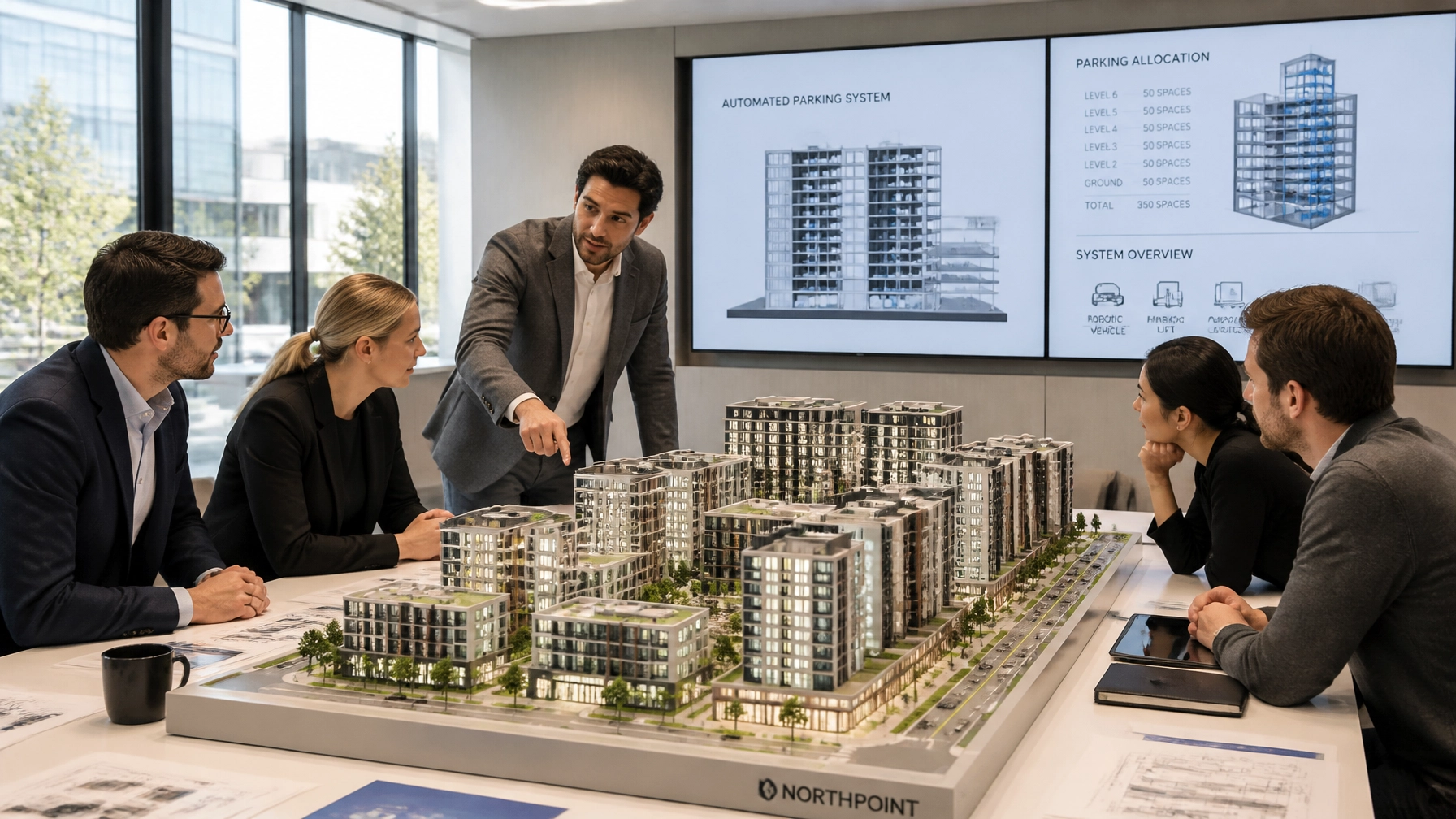
The One Mistake That Costs Developers Millions: Lessons from 300+ Projects
At The Automated Parking Company, we’ve seen it all. From tight urban infill sites in Los Angeles to sprawling mixed-use developments in the Pacific Northwest, we’ve been on the front lines of over 300 major parking projects.
Through those experiences, we’ve noticed one common, recurring pattern. It’s a mistake that doesn’t just complicate a project: it actively drains millions of dollars in potential value.
The mistake isn’t about choosing the wrong concrete or hiring the wrong contractor. It’s much simpler: Parking is treated as an afterthought.
Most developers believe their biggest hurdle is a lack of physical space. But after 300+ projects, we can tell you with certainty: Most parking challenges don’t happen because there isn’t enough space. They happen because parking wasn’t considered early enough.
The “Afterthought” Trap: Why Finalized Designs Are Dangerous
In many projects, parking only enters the conversation after the building design is finalized. The architects have finished the massing, the structural grid is set, and the footprint is locked in. It’s only then that someone asks, “Now, where do we put the cars?”
By the time you reach this stage, your options are already severely limited. You are no longer designing a solution; you are managing a crisis.
When parking is squeezed into a pre-existing design, a domino effect of compromises begins:
Valuable square footage is lost to inefficient drive aisles and ramps.
Unit counts are slashed because the “leftover” space can’t meet minimum stall requirements.
Construction costs skyrocket as you’re forced into expensive deep excavation or complex structural workarounds to fit traditional parking into a tight corner.
The projects that achieve the best outcomes: those that stay on budget and maximize leasable area: usually do one thing differently: They plan parking from the beginning. Not at the end.
The Financial Reality: Quantifying the Cost
Let’s look at the numbers. Parking often represents 10–18% of total building development costs. In some metropolitan areas, a single underground parking stall can cost upwards of $34,000 to $50,000 just to construct.
When you wait until the design is finalized to solve your parking, you lose the ability to choose the most cost-effective typology. You might find yourself forced into a multi-level underground garage simply because the building’s foundation was designed without considering a more efficient semi-automated puzzle parking system.
By integrating parking strategy into the concept and schematic design phases, you can:
Avoid Deep Excavation: Early planning allows you to evaluate if mechanical stackers can reduce the number of subterranean levels required, saving millions in dirt-moving and shoring costs.
Right-Size Your Supply: Instead of overbuilding based on outdated ratios, early analysis helps you design for actual need, freeing up capital for revenue-generating amenities.
Increase Net Leasable Area: A smaller parking footprint means more room for units. Even a 10% reduction in parking volume can translate into several additional units: which, over the life of a project, represents a massive increase in ROI.
Flexibility Through Innovation: Our Solutions
When you plan early, you open the door to a range of smart parking solutions that traditional designs simply can’t accommodate. At The Automated Parking Company, we provide turnkey solutions that turn parking from a “necessary evil” into a strategic advantage.
1. Mechanical Stackers (Double, Triple, and Quad)
If your goal is purely to increase density within a standard ceiling height, mechanical stackers are the gold standard. They allow you to stack two, three, or even four cars in the footprint of one. This is often the difference between meeting your parking minimums and having to go back to the drawing board to cut units
2. Hybrid Puzzle Parking Systems
Our semi-automated puzzle systems are incredibly popular for multi-family and commercial projects. They utilize a combination of vertical and horizontal movement to allow independent access to every vehicle. Because they don’t require the massive drive aisles and ramps of a traditional garage, they can shrink the parking volume by up to 50%.
3. Fully Automated Robotic Solutions (AGVs)
For top-tier luxury developments and high-density commercial hubs, we offer fully automated robotic solutions. Powered by Volley Automation, these Autonomous Guided Vehicles (AGVs) eliminate the need for human drivers to enter the garage entirely. This allows for ultra-tight packing and a premium, “valet-style” experience for tenants without the ongoing cost of human staff.
4,000 Square Feet, 116 Vertical Parking Spaces: The New Frontier of Density
The most common constraint we see in modern development is the “unbuildable” lot. These are the urban infill sites: the narrow parcels, the corner lots, and the mid-block spaces that are too small for a traditional circular drive-up garage. For most builders, these sites are written off because the parking requirements (dictated by local zoning) simply won’t fit if you have to include a ramp.
Recently, The Automated Parking Company was approached by a developer in exactly this position. They had a prime piece of real estate, but after accounting for the ramp and the drive aisles required for a conventional garage, they were only able to fit 30 spaces. Their zoning required 100+. The project was dead in the water.
We stepped in with a radically different approach: Verticality over Velocity.
Instead of a ramp, we utilized a footprint of just 4,000 square feet. In a traditional garage, 4000 square feet might get you 10 or 12 spaces if you’re lucky. We delivered 116 vertical parking spaces.
The Turnkey Advantage: We Design, We Build, We Service
Architects often worry that adding automation adds complexity. We solve that by being a single-source project partner. From the initial napkin sketch to the first car parked, The Automated Parking Company handles it all.
Design & Consulting: We work with your architectural team to optimize the parking layout, ensuring maximum density and smooth traffic flow.
Manufacturing: We utilize superior materials and dependable software controls to ensure your system is built to last.
Installation: Our expert crews handle the heavy lifting, ensuring the system is integrated seamlessly into your build.
Service & Maintenance: We don’t just walk away once the job is done. We provide ongoing, professional customer service and technical support to ensure 100% uptime for your tenants.
Why Architects are Rethinking the Conventional
We often work closely with design teams to show why architects are rethinking conventional parking. When an architect understands the technical specifications of automated systems early on, they can design a building that is more efficient, more sustainable, and more profitable.
Integrating parking into the planning stage gives developers:
Better Space Utilization: You stop paying to house “empty air” in vast drive aisles.
Design Flexibility: Automated systems can fit into irregular shapes and tight corners that would be impossible for a traditional ramped garage.
Sustainability: Reduced excavation and smaller footprints lead to a lower carbon footprint for the entire project.
The Takeaway: Good Parking is Planned, Not Added
If there’s one lesson we want you to take from our work on 300+ parking projects, it’s this: Good parking isn’t added later. It’s planned early.
Waiting until the end of the design process to think about parking is a gamble: one that usually ends with a higher construction bill and a lower-value building. Whether you are developing a boutique multi-family project or a massive commercial complex, the “all-in” cost of your parking solution is significantly lower when it is part of the original vision.
At The Automated Parking Company, we are here to help you navigate these choices. We provide the technical specifications and design expertise to ensure your project pencils out from day one.
📩 Planning a project? Don’t wait until the design is locked in. Connect with The Automated Parking Company today to explore the right parking solution for your development and maximize your project’s true potential.
8,000 LBS Rated Puzzle Parking Semi-Automated System In The United States
The Automated Parking Company Is installing The First Ever 8,000 Pound Rated Semi-Automated Puzzle Parking System In The United States. Soon We Will Be Rolling Out The First Ever In The World, A 9,000 Pound Lifting Capacity Semi-Automated Parking System In The 4th Quarter of 2026. Stay Tuned! Ready to see how much space (and money) you can save on your next project? Contact The Automated Parking Company today for a custom density analysis.
De-Risk Your Parking Strategy with a FREE $5,000 Design Review Credit
If you connect with us, The Automated Parking Company, will provide a FREE in-depth design review, normally valued at $5,000; to assess feasibility, optimize layouts, and align your parking solution with project goals.
When you proceed with us, the full design review fee is credited back to the project, ensuring your early-stage diligence directly supports execution—not overhead.
A disciplined approach to smarter parking investment.
📞 Call Us for a FREE parking design review, valued at $5,000: (877) 827-2611
We value community input and address concerns for harmonious solutions.
Research & Innovation
Continuous research and innovation to improve green parking solutions.
Our Step By Step Process Towards Building Smart Yet Sustainable Parking
At TAPCO, our process ensures seamless delivery of efficient and sustainable parking tech tailored to your evolving project needs.
01
Discovery & Consultation:
Understand your needs, site constraints, and objectives.
02
Customized Design:
Create a tailored parking solution with eco-friendly integration.
03
Project Approval & Collaboration:
Obtain necessary approvals and work closely with your team.
04
Manufacturing & Quality Control:
Ensure the highest standards of quality.
05
Timely Delivery & Installation:
On-time setup with minimal disruptions.
06
Thorough Testing & Commissioning:
Rigorous performance checks and safety adherence.
07
Training & Support:
Comprehensive staff training and ongoing maintenance services.
08
Environmental Responsibility:
Implement eco-friendly practices and sustainability monitoring.
09
Client Satisfaction:
Prioritize your project with any number of our solutions.
Frequently Asked Questions
Q: Can TAPCO’s solutions be tailored to our specific needs?
A: Absolutely! At TAPCO, we understand that every project is unique. Our experienced team of designers and engineers will work closely with you to understand your specific requirements, site constraints, and objectives.
Q: How many levels can The Automated Parking Company design for the Puzzle parking system?
A: The Automated Parking Company has the capability to design systems with 2 to 7 levels, accommodating a varying number of parking spaces. Moreover, if your project calls for additional space optimization, we can even incorporate one or two subterranean levels, effectively increasing the total parking capacity.
Q: Are TAPCO’s parking systems safe and reliable?
A: Yes, safety is our top priority at TAPCO. We adhere to stringent industry safety standards and conduct rigorous testing and quality control measures at every stage of the manufacturing process.
Our car parking solutions are designed and built to ensure the safety of users, vehicles, and your property. We use high-quality materials and employ advanced technology to ensure the reliability and durability of our parking systems.
Improving Parking Convenience with Parking Stackers
When it comes to parking solutions, attended-oriented systems offer a blend of efficiency and convenience that cater to the needs and challenges of urban areas, particularly high-demand areas.
These multi-level car stacker solutions are a game-changer when it comes to parking, allowing the creation of multiple parking spaces within a single area.
TAPCO introduces a wide array of innovative attended-oriented parking systems designed to optimize space utilization as well as offer user-friendly parking practices.
These systems are intended to provide a seamless parking experience and enable attendants to efficiently manage parking procedures while ensuring the convenience and safety of the users. Here are the key benefits of using attended-oriented parking systems.
Optimal Space Utilisation
Our attended-oriented parking systems incorporate car lift storage systems make optimal use of the available space. Vertical stacking of vehicles with the vertical storage lift enables the system to increase the parking capacity within a limited area, hence coping with the increasing parking demands.
Organised vertical stacking
The attended-oriented parking allows vertical stacking of vehicles to utilize a vertical space effectively. This approach reduces the area required for parking, thereby contributing to a more organized and aesthetically pleasant-looking parking facility.
Convenience
The attended-oriented parking system offers ease of use for the attendant as well as the user. While the attendant can successfully navigate the car stacker lift and swiftly move vehicles into a nesting position with minimal effort, users need little to no guidance to park their vehicles safely.
Enhanced Security
Our attended-oriented car stacking system comes with advanced features to ensure the safety of parked vehicles. While users have peace of mind, property managers can also be content with the knowledge that the facility is secure.
Versatile stacked car parking
We offer a variety of car stacker lift solutions. From four post car storage lifts to no post solutions, our systems can be implemented indoors as well as outdoors and can be adapted for various project requirements or property layouts. TAPCO’s attended-oriented parking systems can be used in various environments, from commercial establishments to residential complexes.
Revolutionary Parking Solutions with Automated Lift Parking System
As the urban landscape continues to grow, the demand for efficient car parking solutions has become increasingly important. TAPCO introduces revolutionary semi-automated smart parking systems that are designed to optimise space utilization and streamline parking procedures for multi-family residential complexes and commercial facilities. Compared to the conventional car lift system, our multi level car parks are designed to redefine convenience and efficiency.
Here are some of the key features of our semi-automated car parking systems
Space Optimization
Optimal space utilization is a key focus of our multi-level car storing solutions. Our stack parking systems are designed to accommodate multiple levels, providing an impressive number of parking spaces within a compact footprint. We can design and integrate two to seven parking levels in a single structure and customize varying lengths, widths, and heights.
Seamless Automation
Our smart parking system incorporates advanced automation to simplify the parking process. Drivers can effortlessly park their vehicles with minimum guidance, thereby providing efficient utilization of time.
EV Capability
Given the increasing trend of electric vehicles, our parking solutions are also designed to embrace the future of mobility and Electric Vehicles. To cater to the ever-evolving automotive landscape, we also feature charging facilities for electric cars. We are the only vendor offering 7000# rated systems.
Convenience
We understand that parking can be a source of frustration for people, particularly when you cannot find a spot and have to drive around looking for space. Such layouts can be problematic for larger properties. However, with our Puzzle Parking system, this problem can be easily resolved, offering convenience to individuals and saving valuable time when parking or capturing your auto.
FAQ
Q: What is the difference between a fully automated and semi-automated smart parking system?
A: Semi-automated Puzzle solutions and fully automated AGV parking systems are considered automated parking and compress footprints giving you back valuable square footage.
In a semi-automated parking system, drivers can park and/or retrieve their own auto, so this system rids you of any demand for parking attendants therefore lowering your OpEx. Once the users vehicle is stowed within the system, the semi-automated Puzzle system can move the car up and down or left to right to find its nesting space.
On the other hand, in a fully-automated parking system, the driver pulls into a loading bay where they remove themselves and leave their auto, the system will then maneuver the auto and autonomously stow the users auto within the parking vault.
Q: What is the difference between mechanical lift systems and semi-automated Puzzle Parking systems?
A: In a mechanical stacker system, individuals must operate for it to move, or you must incorporate attendants to manage the parking and retrieval process.. The mechanical stacker parking system is usually a Double, Triple, or Quad Stacker that can raise the vehicle directly up on the platform so that more than one vehicle can be parked in a vertical stack. We strongly encourage trained personnel to operate these systems due to the manual processes of storing or retrieving autos in a vertical arrangement.
On the other hand, in a semi-automated system, there is no demand nor need for attendants or personnel to retrieve autos. Once the driver has parked their vehicle within the system, the semi-automated Puzzle system can intelligently move the car up and down or left to right.
Q: Which properties are semi-automated parking systems suitable for?
A: Our semi-automated parking systems are mostly suitable and used for commercial office and multi-family residential complexes.
Q: Can electric cars be charged in semi-automated parking systems?
A: Absolutely, our semi-automated smart parking systems are EV capable and feature charging facilities for electric vehicles. We offer Level II smart charging capabilities that allow you to bill the user pro-rata and also reduce the number of electrical meters therefore reducing your overall build costs when compared to competitive vendors.
Q: What are the maintenance requirements of semi-automated parking systems?
A: Maintenance and upkeep of the parking systems by The Automated Parking Company are easy as they are designed for minimal maintenance and durability. However, please note that regular checks and maintenance schedules help ensure optimal performance.
EV-Chargers Form
EV Chargers
You’re almost there
Fill in the details below to get our Spec Sheet, CAD, and Revit!