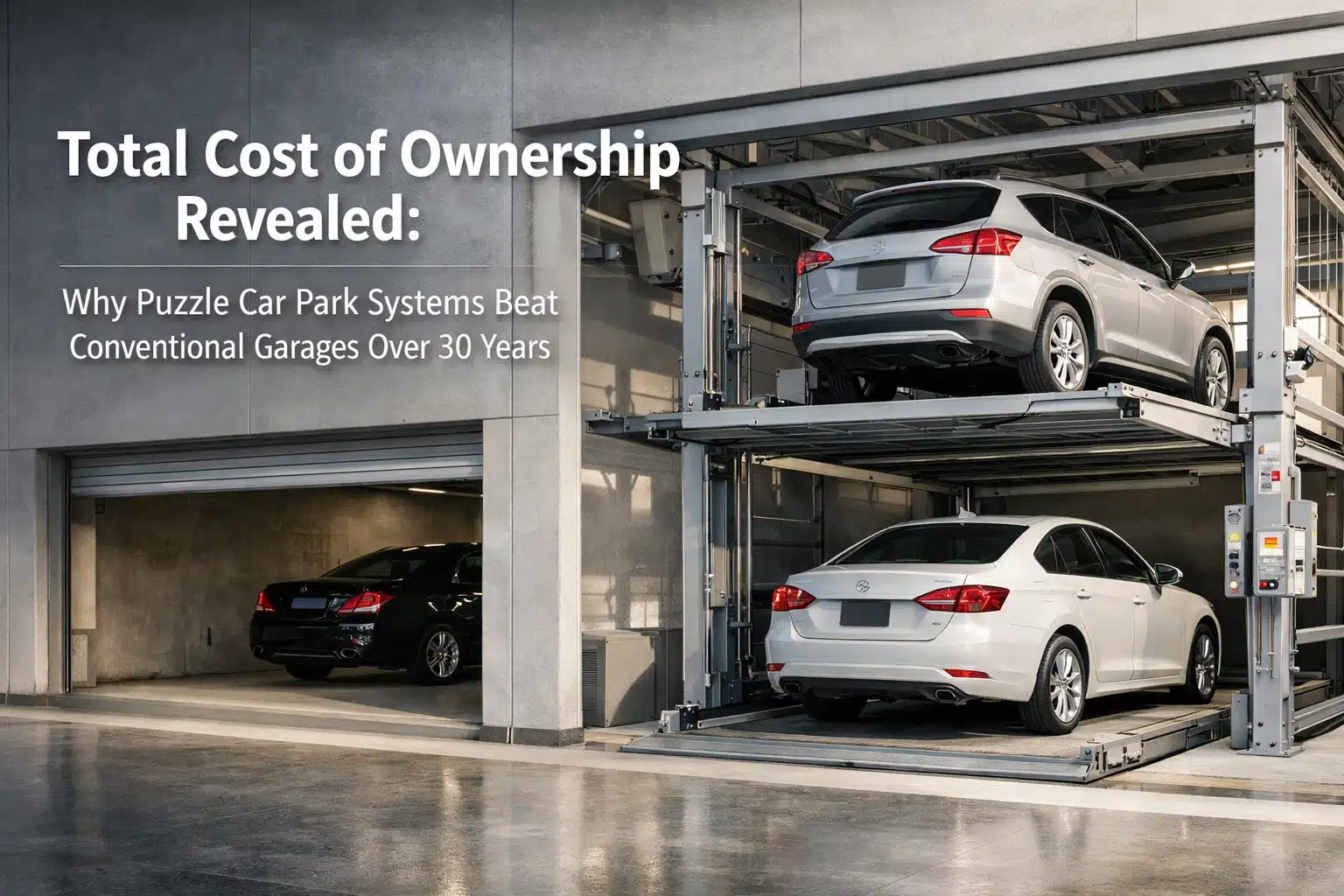
Total Cost of Ownership Revealed: Why Puzzle Car Park Systems Beat Conventional Garages Over 30 Years
If you’re a developer, you’ve probably had this conversation a dozen times: Your finance team sees the upfront cost of a conventional parking garage and immediately feels comfortable. It’s familiar. It’s what everyone does. But here’s the thing, what looks cheaper on day one can bleed money for three decades.
When you’re evaluating parking solutions for multifamily, mixed-use, hotel, or CRE projects, the real question isn’t “What’s cheapest to build?” It’s “What costs the least to own, operate, and maintain over the life of the building?” That’s where Total Cost of Ownership (TCO) comes in, and where puzzle car park systems completely flip the script on conventional wisdom.
Let’s break down the numbers over a 30-year timeline and see why automated parking garage solutions are increasingly the smarter financial play.
The Upfront Cost Story: It’s Not What You Think
Yes, conventional concrete ramp garages feel safe because they’re a known quantity. You’re looking at roughly $50,000 to $100,000 per parking space depending on your market, site conditions, and whether you’re going above-grade or digging down. In dense urban areas where excavation and structural requirements get complex, you’re almost always trending toward the higher end of that range.
Now compare that to a puzzle parking system, which typically runs $2,000 to $15,000 per space for the equipment itself. Installation adds another 15–30% on top, but even at the high end, you’re talking about $20,000 per space, still competitive with or below conventional construction costs in most urban markets. And here’s the kicker: that’s before you factor in everything a puzzle system doesn’t require.
With a puzzle car park, you eliminate massive concrete pours, extensive steel framework, interior ramps that eat up valuable square footage, and the ventilation infrastructure needed to handle carbon monoxide from running vehicles. You’re not building a multi-story monument to cars, you’re installing a compact, engineered system that does one thing extremely well.
Space Efficiency = Revenue Opportunity
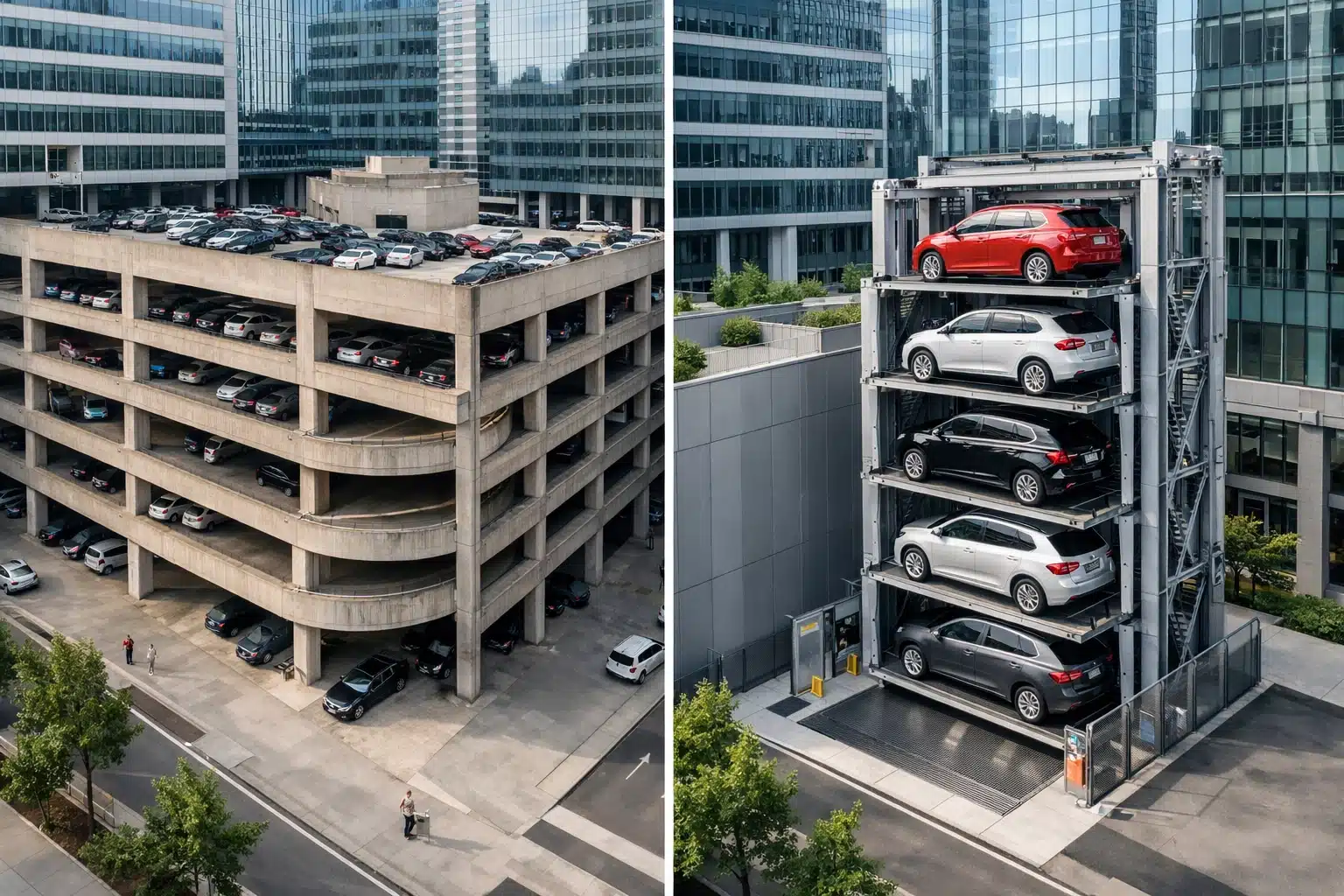
Here’s where the TCO math gets really interesting. Puzzle parking systems can deliver 2x to 4x the parking capacity in the same physical footprint as a traditional garage. That’s not marketing fluff, that’s geometry and engineering.
What does that mean in real dollars? Let’s say you’re developing a mixed-use project in a high-demand urban area. You’ve got limited land, and every square foot counts. With a conventional garage, you might dedicate 20,000 square feet to accommodate 60 cars. With a puzzle system, you could fit those same 60 cars into 5,000–10,000 square feet.
Now you’ve got 10,000–15,000 square feet to play with. That’s space you can convert into rentable residential units, retail storefronts, or additional hotel rooms. In markets where you’re getting $3–$5 per square foot monthly in rent, that’s an extra $30,000 to $75,000 in revenue every month. Over 30 years, we’re talking about $10.8 million to $27 million in additional revenue that a conventional garage just can’t generate.
Even if you only reclaim enough space for one or two additional residential units, that’s hundreds of thousands of dollars in asset value and ongoing cash flow that directly impacts your project’s ROI.
Operational Costs: Where Conventional Garages Burn Cash
Traditional parking garages are expensive to run. You need lighting 24/7. You need heavy-duty ventilation systems to manage vehicle exhaust. In many cases, you’re staffing attendants or security. Energy costs compound year after year, and when utility rates increase, so does your operational burden.
A puzzle parking system operates on a fundamentally different model. Because cars aren’t running inside the system and drivers aren’t navigating ramps, you need minimal ventilation, sometimes none at all depending on configuration. Lighting requirements drop dramatically since there’s no need to illuminate multiple levels of driving surfaces.
The staffing story is even better. After initial setup, puzzle systems require minimal ongoing labor. There’s no need for attendants to manage traffic flow or deal with daily operations. The system is automated, and users interact with a simple interface. Over 30 years, that labor cost savings alone can run into hundreds of thousands of dollars.
Let’s be conservative and estimate you’re saving $2,000 per month on combined utilities and labor compared to a conventional garage. That’s $24,000 annually, or $720,000 over 30 years. And that’s a modest estimate, many projects see significantly higher operational savings.
Maintenance Reality Check
Here’s where you need to be honest: puzzle parking systems do require regular maintenance. They’re mechanical systems with moving parts, and like any engineered solution, they need professional servicing to stay reliable.
But here’s what developers often miss, conventional garages aren’t maintenance-free either. Concrete cracks. Rebar corrodes. Drainage systems fail. Lighting fixtures burn out (repeatedly). Structural repairs on aging concrete structures can run into six or seven figures, especially in climates with freeze-thaw cycles or coastal salt exposure.
At The Automated Parking Company, we take a turnkey approach to maintenance. We’re not just selling you equipment and wishing you luck. We provide ongoing maintenance support, parts availability, and technical expertise to keep your system running efficiently for decades. This predictable maintenance model helps you budget accurately and avoid the surprise $500,000 structural repair bill that can hit conventional garages in year 15 or 20.
Yes, you’ll have annual service contracts with a puzzle system. But you’re getting predictability, professional support, and a system designed for longevity. Compare that to the uncertainty and escalating repair costs of aging concrete infrastructure.
The Environmental and Insurance Angle
This one’s a bit more subtle but increasingly important: insurance and environmental compliance costs.
Conventional parking garages come with environmental challenges. Stormwater runoff from hundreds of cars contains oil, fluids, and particulates that require management and treatment systems. Many jurisdictions are tightening regulations around parking facility runoff, which means retrofitting conventional garages with better drainage and filtration: another unexpected cost down the road.
Puzzle systems minimize these issues because vehicles aren’t dripping fluids across multiple levels of concrete. The environmental footprint is smaller, and compliance is simpler.
On the insurance side, some developers are seeing reduced liability premiums with automated systems because there’s no pedestrian-vehicle interaction inside the parking structure. Fewer car accidents, no drivers speeding through garage levels, reduced theft and vandalism potential: all factors that insurance underwriters appreciate.
Energy Efficiency That Compounds Over Time
Let’s talk kilowatt-hours. A conventional parking garage with full lighting, ventilation fans, and elevator systems can consume enormous amounts of energy. As electricity rates increase over 30 years (and they will), that energy consumption becomes an increasingly expensive line item.
Automated parking garage systems run on dramatically less power. You’re operating motors only when cars are being retrieved or stored: not running lights and fans continuously. Over three decades, as energy costs rise, this efficiency gap widens. What might be a modest savings in year one becomes substantial by year 20.
Some projects pair their puzzle parking systems with solar panels or integrate them into broader energy management systems, further reducing operating costs and improving the building’s overall sustainability profile: something that matters to both tenants and financing partners.
The 30-Year TCO Picture
When you add it all up, here’s what a 30-year TCO comparison actually looks like for a 60-car facility:
Conventional Garage:
Initial construction: $15M–$30M
Operational costs (utilities, labor): $720K–$1.2M
Major maintenance/repairs: $300K–$800K
Lost opportunity cost (foregone rental revenue): $10M–$27M
Total: $26M–$59M
Puzzle Car Park System:
Initial installation: $600K–$1.2M
Operational costs: $200K–$400K
Maintenance contracts: $400K–$600K
Reclaimed space revenue: +$10M–$27M
Net position: Profit of $8.8M–$25.2M
The numbers speak for themselves. Even with conservative estimates and accounting for ongoing maintenance, the puzzle parking system delivers millions of dollars in superior value over the building’s life-cycle.
Making the Smart Choice
Look, we get it. Change is uncomfortable, especially when you’re deploying millions in capital. But the developers who are winning in today’s competitive markets aren’t the ones playing it safe with conventional solutions: they’re the ones doing the math and making decisions based on 30-year realities, not 30-day comfort levels.
At The Automated Parking Company, we’ve helped developers across the country navigate this transition. We don’t just drop off equipment: we partner with you through design, installation, permitting, and decades of operation to ensure your puzzle parking system delivers the TCO advantages you’re counting on.
The question isn’t whether you can afford to invest in a puzzle car park. It’s whether you can afford not to.
De-Risk Your Parking Strategy with a FREE $5,000 Design Review Credit
If you connect with us, The Automated Parking Company, will provide a FREE in-depth design review, normally valued at $5,000; to assess feasibility, optimize layouts, and align your parking solution with project goals.
When you proceed with us, the full design review fee is credited back to the project, ensuring your early-stage diligence directly supports execution—not overhead.
A disciplined approach to smarter parking investment.
📞 Call Us for a FREE parking design review, valued at $5,000: (877) 827-2611
We value community input and address concerns for harmonious solutions.
Research & Innovation
Continuous research and innovation to improve green parking solutions.
Our Step By Step Process Towards Building Smart Yet Sustainable Parking
At TAPCO, our process ensures seamless delivery of efficient and sustainable parking tech tailored to your evolving project needs.
01
Discovery & Consultation:
Understand your needs, site constraints, and objectives.
02
Customized Design:
Create a tailored parking solution with eco-friendly integration.
03
Project Approval & Collaboration:
Obtain necessary approvals and work closely with your team.
04
Manufacturing & Quality Control:
Ensure the highest standards of quality.
05
Timely Delivery & Installation:
On-time setup with minimal disruptions.
06
Thorough Testing & Commissioning:
Rigorous performance checks and safety adherence.
07
Training & Support:
Comprehensive staff training and ongoing maintenance services.
08
Environmental Responsibility:
Implement eco-friendly practices and sustainability monitoring.
09
Client Satisfaction:
Prioritize your project with any number of our solutions.
Frequently Asked Questions
Q: Can TAPCO’s solutions be tailored to our specific needs?
A: Absolutely! At TAPCO, we understand that every project is unique. Our experienced team of designers and engineers will work closely with you to understand your specific requirements, site constraints, and objectives.
Q: How many levels can The Automated Parking Company design for the Puzzle parking system?
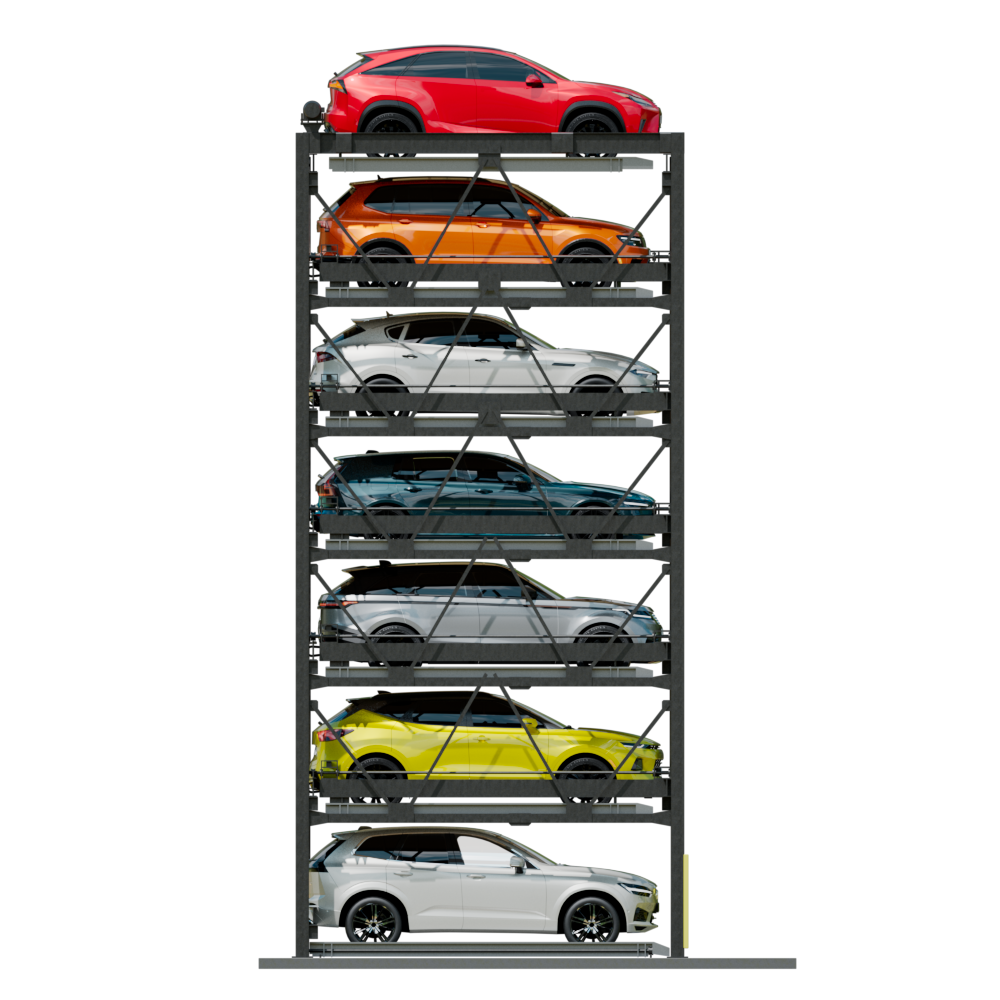
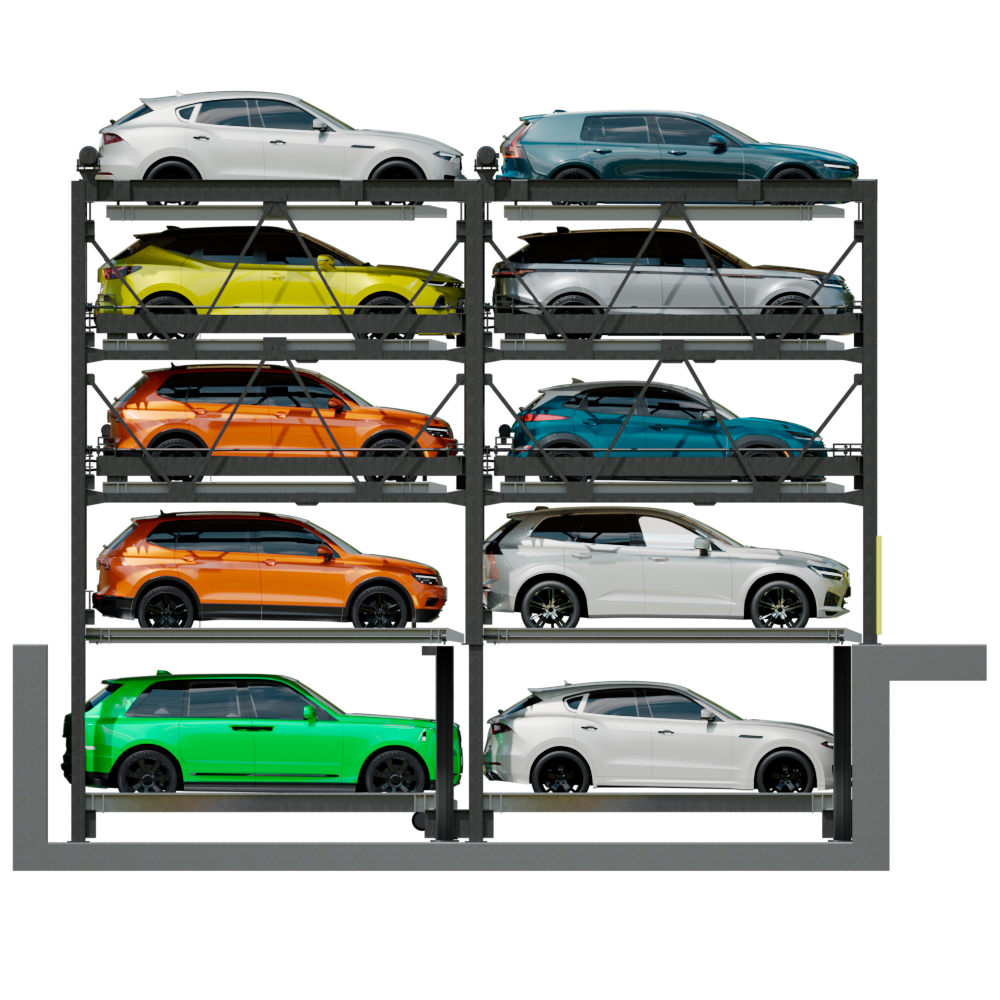
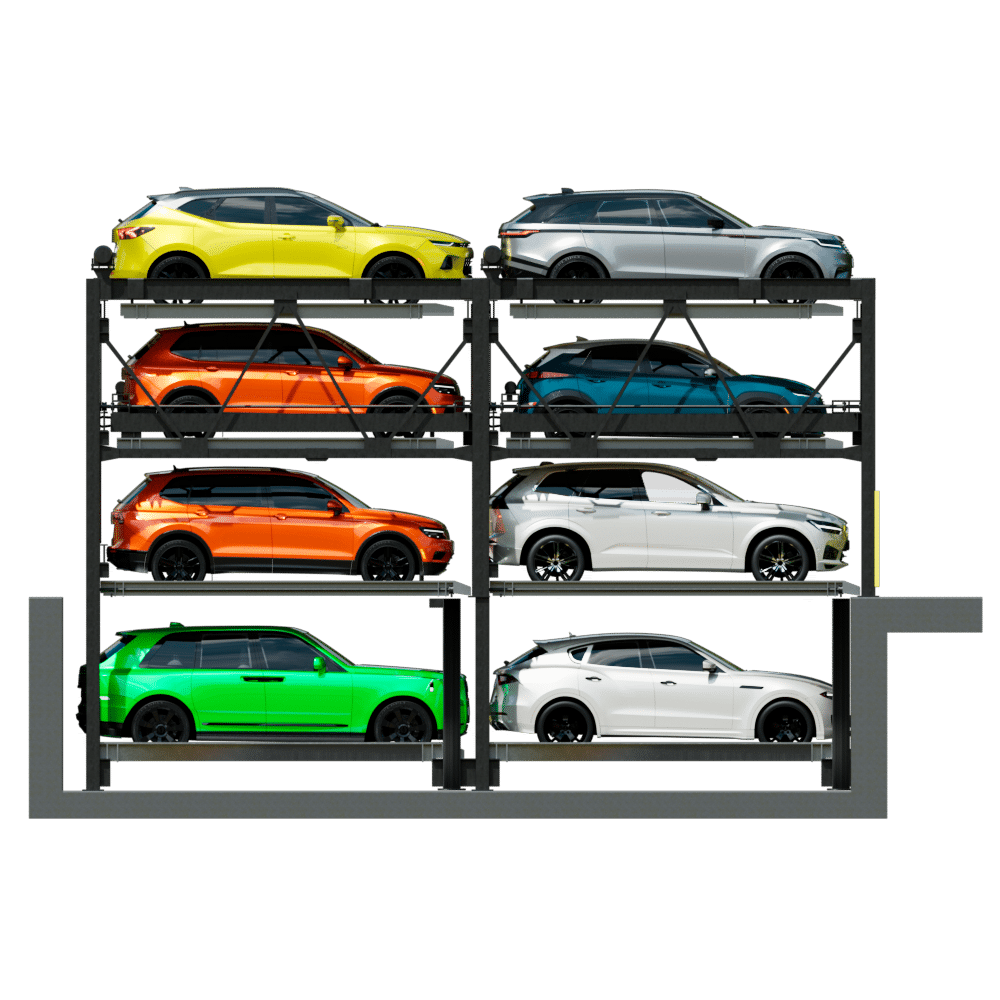
A: The Automated Parking Company has the capability to design systems with 2 to 7 levels, accommodating a varying number of parking spaces. Moreover, if your project calls for additional space optimization, we can even incorporate one or two subterranean levels, effectively increasing the total parking capacity.
Q: Are TAPCO’s parking systems safe and reliable?
A: Yes, safety is our top priority at TAPCO. We adhere to stringent industry safety standards and conduct rigorous testing and quality control measures at every stage of the manufacturing process.
Our car parking solutions are designed and built to ensure the safety of users, vehicles, and your property. We use high-quality materials and employ advanced technology to ensure the reliability and durability of our parking systems.
Improving Parking Convenience with Parking Stackers
When it comes to parking solutions, attended-oriented systems offer a blend of efficiency and convenience that cater to the needs and challenges of urban areas, particularly high-demand areas.
These multi-level car stacker solutions are a game-changer when it comes to parking, allowing the creation of multiple parking spaces within a single area.
TAPCO introduces a wide array of innovative attended-oriented parking systems designed to optimize space utilization as well as offer user-friendly parking practices.
These systems are intended to provide a seamless parking experience and enable attendants to efficiently manage parking procedures while ensuring the convenience and safety of the users. Here are the key benefits of using attended-oriented parking systems.
Optimal Space Utilisation
Our attended-oriented parking systems incorporate car lift storage systems make optimal use of the available space. Vertical stacking of vehicles with the vertical storage lift enables the system to increase the parking capacity within a limited area, hence coping with the increasing parking demands.
Organised vertical stacking
The attended-oriented parking allows vertical stacking of vehicles to utilize a vertical space effectively. This approach reduces the area required for parking, thereby contributing to a more organized and aesthetically pleasant-looking parking facility.
Convenience
The attended-oriented parking system offers ease of use for the attendant as well as the user. While the attendant can successfully navigate the car stacker lift and swiftly move vehicles into a nesting position with minimal effort, users need little to no guidance to park their vehicles safely.
Enhanced Security
Our attended-oriented car stacking system comes with advanced features to ensure the safety of parked vehicles. While users have peace of mind, property managers can also be content with the knowledge that the facility is secure.
Versatile stacked car parking
We offer a variety of car stacker lift solutions. From four post car storage lifts to no post solutions, our systems can be implemented indoors as well as outdoors and can be adapted for various project requirements or property layouts. TAPCO’s attended-oriented parking systems can be used in various environments, from commercial establishments to residential complexes.
Revolutionary Parking Solutions with Automated Lift Parking System
As the urban landscape continues to grow, the demand for efficient car parking solutions has become increasingly important. TAPCO introduces revolutionary semi-automated smart parking systems that are designed to optimise space utilization and streamline parking procedures for multi-family residential complexes and commercial facilities. Compared to the conventional car lift system, our multi level car parks are designed to redefine convenience and efficiency.
Here are some of the key features of our semi-automated car parking systems
Space Optimization
Optimal space utilization is a key focus of our multi-level car storing solutions. Our stack parking systems are designed to accommodate multiple levels, providing an impressive number of parking spaces within a compact footprint. We can design and integrate two to seven parking levels in a single structure and customize varying lengths, widths, and heights.
Seamless Automation
Our smart parking system incorporates advanced automation to simplify the parking process. Drivers can effortlessly park their vehicles with minimum guidance, thereby providing efficient utilization of time.
EV Capability
Given the increasing trend of electric vehicles, our parking solutions are also designed to embrace the future of mobility and Electric Vehicles. To cater to the ever-evolving automotive landscape, we also feature charging facilities for electric cars. We are the only vendor offering 7000# rated systems.
Convenience
We understand that parking can be a source of frustration for people, particularly when you cannot find a spot and have to drive around looking for space. Such layouts can be problematic for larger properties. However, with our Puzzle Parking system, this problem can be easily resolved, offering convenience to individuals and saving valuable time when parking or capturing your auto.
FAQ
Q: What is the difference between a fully automated and semi-automated smart parking system?
A: Semi-automated Puzzle solutions and fully automated AGV parking systems are considered automated parking and compress footprints giving you back valuable square footage.
In a semi-automated parking system, drivers can park and/or retrieve their own auto, so this system rids you of any demand for parking attendants therefore lowering your OpEx. Once the users vehicle is stowed within the system, the semi-automated Puzzle system can move the car up and down or left to right to find its nesting space.
On the other hand, in a fully-automated parking system, the driver pulls into a loading bay where they remove themselves and leave their auto, the system will then maneuver the auto and autonomously stow the users auto within the parking vault.
Q: What is the difference between mechanical lift systems and semi-automated Puzzle Parking systems?
A: In a mechanical stacker system, individuals must operate for it to move, or you must incorporate attendants to manage the parking and retrieval process.. The mechanical stacker parking system is usually a Double, Triple, or Quad Stacker that can raise the vehicle directly up on the platform so that more than one vehicle can be parked in a vertical stack. We strongly encourage trained personnel to operate these systems due to the manual processes of storing or retrieving autos in a vertical arrangement.
On the other hand, in a semi-automated system, there is no demand nor need for attendants or personnel to retrieve autos. Once the driver has parked their vehicle within the system, the semi-automated Puzzle system can intelligently move the car up and down or left to right.
Q: Which properties are semi-automated parking systems suitable for?
A: Our semi-automated parking systems are mostly suitable and used for commercial office and multi-family residential complexes.
Q: Can electric cars be charged in semi-automated parking systems?
A: Absolutely, our semi-automated smart parking systems are EV capable and feature charging facilities for electric vehicles. We offer Level II smart charging capabilities that allow you to bill the user pro-rata and also reduce the number of electrical meters therefore reducing your overall build costs when compared to competitive vendors.
Q: What are the maintenance requirements of semi-automated parking systems?
A: Maintenance and upkeep of the parking systems by The Automated Parking Company are easy as they are designed for minimal maintenance and durability. However, please note that regular checks and maintenance schedules help ensure optimal performance.
EV-Chargers Form
EV Chargers
You’re almost there
Fill in the details below to get our Spec Sheet, CAD, and Revit!