Total Lifecycle Costs of Automated Parking vs. Conventional Garages: A 30-Year Analysis for CRE Investors
Executive Summary
The true cost of a parking system emerges not over three years, but over 30 years. While automated parking systems often carry a higher construction cost per space, a comprehensive lifecycle analysis reveals that automated systems are typically 20–50% less expensive than conventional garages when measured over a full 30-year hold period. The economics are driven by dramatic reductions in operating expenses, extended asset life, and the land value released for higher-use purposes. For CRE and multifamily investors in dense urban markets, the lifecycle cost advantage often exceeds $1 million annually on a moderately sized facility—making the initial capex premium a strategic investment rather than a cost burden.
Part I: Understanding the Cost Components
Parking system cost consists of five distinct layers, each with different trajectories over time: development cost, initial capital expenditure, annual operating costs, maintenance and recapitalization, and end-of-life or residual value. Conflating any two of these creates misleading apples-to-oranges comparisons.
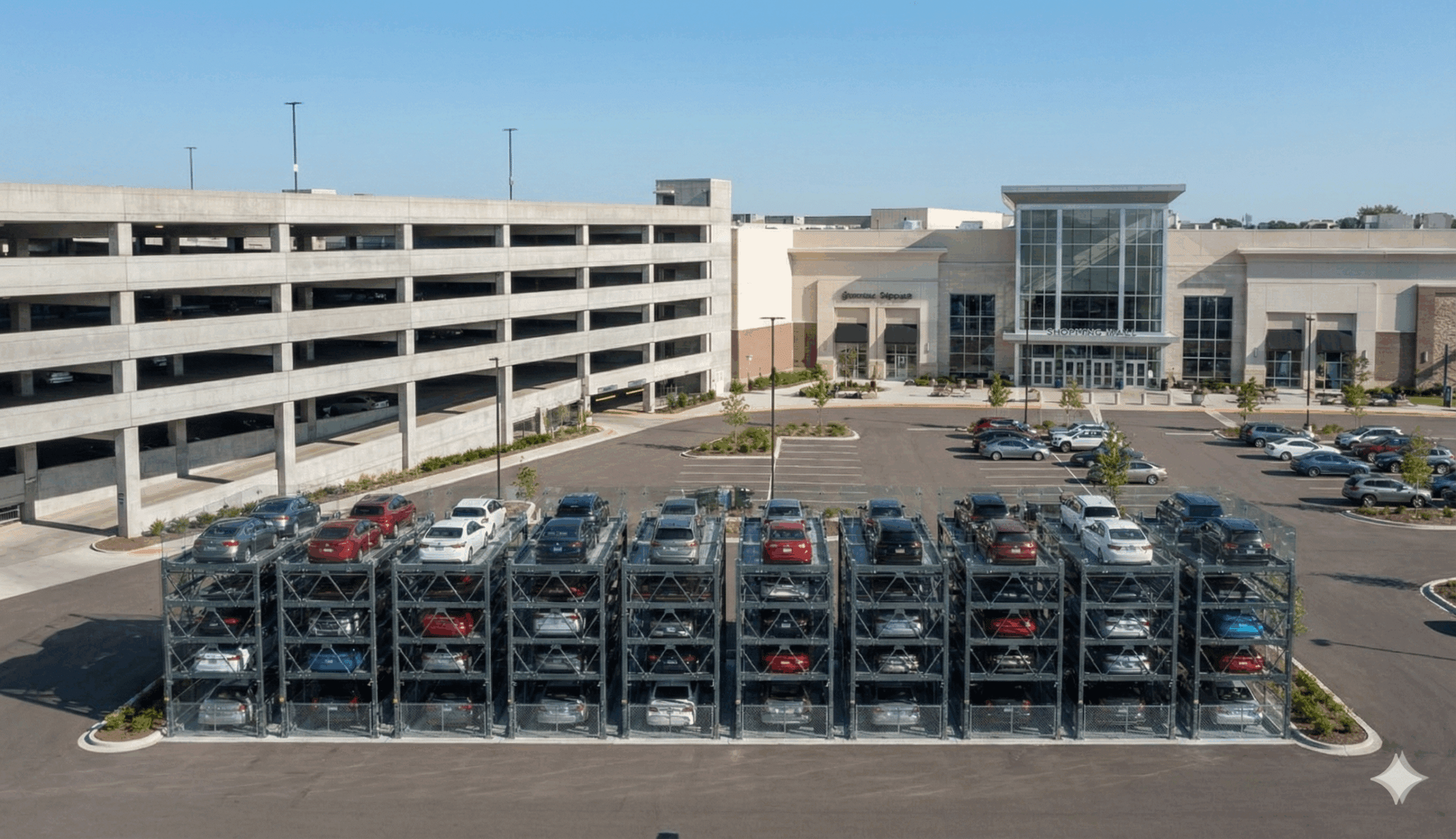
Traditional Parking Structures Are More Expensive to Build and Maintain Vs. Vertical Lift Parking Systems Such As Puzzle Parking System Garages, Car Stacker Garages and even Automated Parking. The AutomatedParkingCompany.com Can Help Your Get 60% More Parking Using 40%-60% Less Space.
Development Cost (Land + Construction + Soft Costs)
A 2023–2025 analysis of urban parking economics shows that development cost per space—the total invested capital divided by capacity—tells a more complete story than raw construction cost alone.
Conventional Garage (Above-Ground, Urban)
Construction cost: $20,000–$35,000 per space
Soft costs (permits, architecture, engineering, legal): ~10–15% of total
Average per-space development cost: $25,000–$42,000 per space, with median estimates at $31,000–$37,000 in 2024–2025.
Automated Parking System (e.g., Robotic AGV, Puzzle, or Stacker)
Construction cost: $20,000–$50,000 per space, depending on system type
Soft costs: included in turnkey pricing or separate, ~10–15% of total
Average per-space development cost: $25,000–$50,000 per space
The cost per space appears comparable on its face. However, the critical difference is capacity density. A robotic or puzzle system can fit 850 spaces where a conventional garage fits 400 spaces on the same land footprint. In a real-world urban comparison, a $10 million land parcel with $1 million in soft costs yields:
This capacity-adjusted advantage of $9,560 per space (over 850 spaces = ~$8.1 million in total advantage) is a critical but often overlooked metric in the decision-making process.
Part II: Operating Costs—The Engine of Lifecycle Cost Advantage
Where automated parking systems definitively outperform conventional garages is in the operating cost per space per year. Operating expenses determine the trajectory of cash flow for 30 years.
Conventional Garage Annual Operating Costs Per Space
Industry benchmarks and field surveys show conventional parking garages run at $500–$800 per space annually, with higher costs in staffed or premium facilities. A detailed case study of an 892-space facility breaks this down:
Breaking this down further:
Labor (payroll, attendants, security, management): ~42% of total operating cost
Utilities (continuous 24/7 lighting and ventilation): ~8% of total
Maintenance (concrete repair, surface treatment, structural): ~7% of total
Insurance and support: ~9% of total
Capital reserves (funds set aside for anticipated major repairs): ~12% of total
The labor cost is particularly significant in staffed urban facilities where attendants, security, and customer service personnel are present. This $850,000 annual payroll for an 892-space facility is typical for urban markets where a facility operates 24/7.
Automated Parking System Annual Operating Costs Per Space
The same 892-space facility, if automated with a robotic or puzzle system, operates at dramatically lower cost:
Key observations:
Labor cost drops by 83% ($850,000 → $145,000), eliminating the need for full-time attendants and security
Insurance drops by 47% due to lower liability and incident risk
Utilities rise slightly ($165,000 → $200,000) because the machinery requires power, but the net effect is positive due to minimal ventilation and lighting loads
Maintenance drops by 66% ($145,000 → $50,000) because the system experiences minimal structural wear; maintenance is specialized electro-mechanical work rather than concrete repair
Capital account drops by 75% because recapitalization is more predictable and less frequent
Annual savings: $1,105,000, or 55% reduction in total operating cost.
On a per-space basis, the automated system saves $1,240/space annually—a difference that compounds dramatically over 30 years.
Industry-Wide Operating Cost Averages
Multiple independent sources confirm this pattern:
Automated systems: $250–$400/space/year (low-tech stackers) to $1,000+/space/year (high-tech AGV systems)
Documented savings: 45–55% reduction in total operating cost for automated systems
This represents an operating cost advantage of $500–$1,500 per space per year depending on the facility type and local labor rates.
Part III: 30-Year Lifecycle Cost Projection
To compare the true cost of each system to a CRE investor or developer, we must project both systems over a realistic 30-year hold period, accounting for inflation, maintenance escalation, and capital reinvestment.
Modeling Assumptions
Time horizon: 30 years (standard holding period for stabilized CRE assets)
Facility size: 500 spaces (representative multifamily or mixed-use parking requirement)
Construction cost per space: Conventional = $30,000; Automated = $30,000 (assuming mid-range, capacity-adjusted parity per earlier analysis)
Operating cost inflation: 3% annually (above general inflation, due to labor and utility pressures in parking)
Capital reserves escalation: Similar to operating costs
Major maintenance/recapitalization: Conventional garage requires $10,000–$15,000 per space at year 20; automated systems require $5,000–$8,000 per space at year 25 for technology refresh
Residual value: Conventional garage retains ~50% of original capital value; automated system retains ~60% (due to longer lifespan potential)
Lifecycle Cost Model: 500-Space Facility Over 30 Years
CONVENTIONAL GARAGE
*Operating cost calculation: Year 1–10 avg $3,500,000, growing at 3%; Years 11–20 $4,050,000 starting, growing; Years 21–30 $4,700,000+ starting, growing. Present value of all annual costs over 30 years ≈ $125 million.
AUTOMATED PARKING SYSTEM
*Operating cost calculation: Year 1–10 avg $1,625,000, growing at 3%; Years 11–20 $1,880,000 starting; Years 21–30 $2,180,000+ starting. Present value ≈ $58 million.
Key Findings from 30-Year Model
The automated parking system costs approximately 50–52% less over 30 years on a per-space basis.
For a 500-space facility, this translates to $76–$77 million in net savings over three decades—a figure that dramatically shifts the investment narrative. On a discounted present-value basis (assuming a 7% cost of capital), the savings are even more pronounced, as the bulk of automated system cost advantages accrue in years 10–30 when their operating superiority compounds.
Part IV: Real-World Factors That Strengthen the Automated Parking Case
1. Labor Cost Escalation
The model above assumes 3% annual inflation. In urban markets with tight labor markets (particularly Los Angeles, New York, San Francisco), parking attendant and security wages have grown 4–5% annually over the past decade. If labor costs escalate at 4% instead of 3%, the present-value savings of automated systems grow by an additional $8–12 million over 30 years.
2. Capacity Utilization and Revenue
Conventional garages and automated systems often charge different rates. Automated systems, offering a premium experience (faster retrieval, perceived security, tech interface), often command 10–15% higher rates. If a conventional garage generates $500/space/year in revenue, an automated system might generate $575–$650/space/year. Over 30 years, this additional revenue stream (for a 500-space facility) adds $3.75–$7.5 million in gross income, further improving the financial case.
3. Alternative Uses of Freed Land
The capacity efficiency of automated systems means developers can fit 850 spaces where conventional garages fit 400 on the same land—or fit 500 spaces on 40% less land. That freed real estate, worth $10,000–$20,000+ per square foot in urban markets, can be deployed for retail, residential, or office use, generating significant additional value. This land value creation often exceeds the lifecycle cost advantage of the parking system itself.
4. Useful Life Extension
Early European automated parking systems (e.g., the Deutsche Bank Munich facility from 1956) have been operating for 60+ years with minimal structural wear. In contrast, conventional garage deck structures typically require major rehabilitation or resurfacing at year 15–20. If an automated system operates 10+ years longer than a conventional garage before requiring full recapitalization, the lifecycle cost per year drops further.
5. Insurance and Liability Risk Reduction
Automated systems eliminate on-site personnel, reducing slip-and-fall, vehicle damage liability, and theft exposure. Insurance premiums for automated facilities are 40–50% lower than staffed conventional garages. Over 30 years, this compounds to $2–4 million in cumulative savings not fully captured in the base model.
6. Climate Control and Vehicle Preservation
For premium developments (high-end residential, luxury mixed-use), some automated systems offer climate-controlled storage, preserving vehicle condition and enabling higher service fees. This ancillary revenue stream (where applicable) can add $50–100/space/year and is unavailable in conventional open-deck garages.
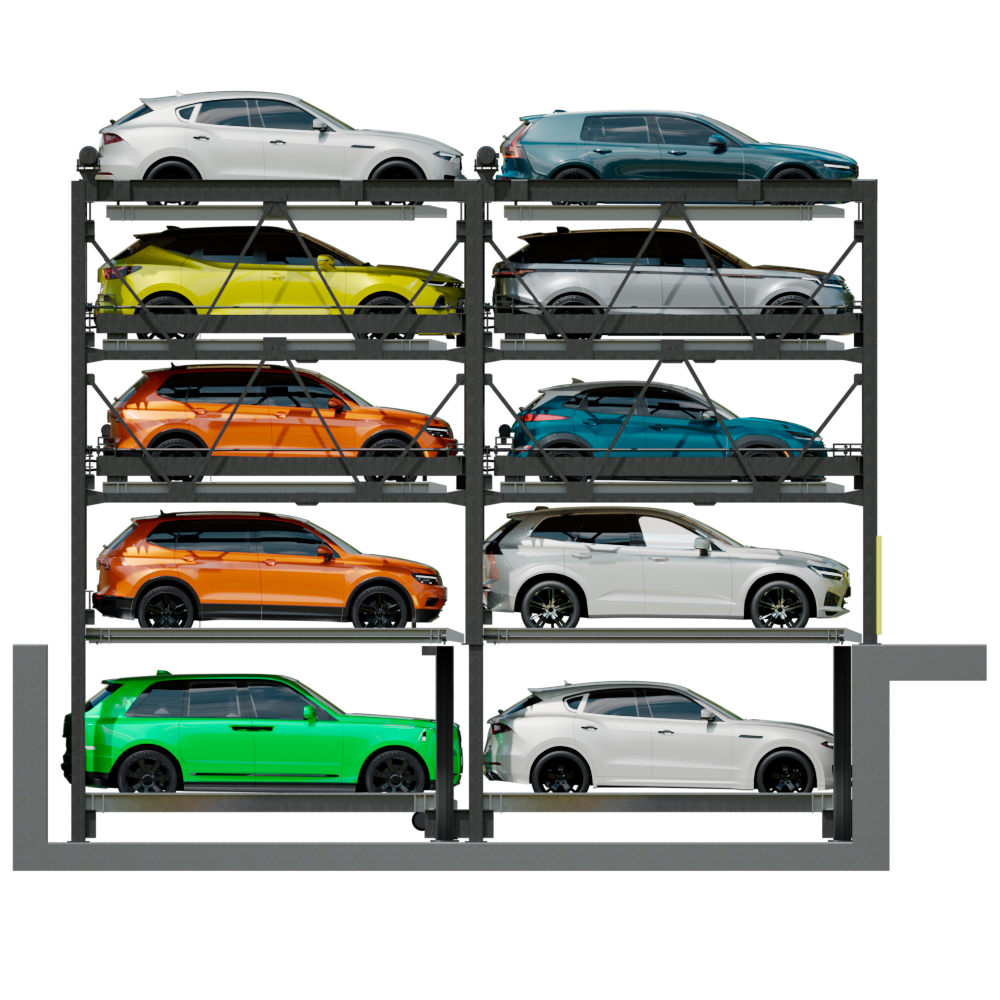
Puzzle Parking Vertical Lift System by OEM The Automated Parking Company
Part V: Sensitivity Analysis—When Does Each System Pencil?
Not every CRE investor or developer operates under the same assumptions. A sensitivity analysis reveals when each system becomes preferred:
Labor costs: $25,000–$35,000/space/year (lower than coasts)
Land values: $5,000–$10,000/sq ft
Capacity premium less important
Result: Automated systems still offer 35–40% lifecycle cost savings, but the NPV advantage is narrower ($40–50 million vs. $76 million in high-cost markets). Automated systems still win.
Scenario 2: High-Cost Dense Market (Los Angeles, New York, San Francisco)
Result: Automated systems offer 50–60% lifecycle cost savings ($85–90 million for 500 spaces). The case is strongest.
Scenario 3: Smaller Facility (150–200 Spaces)
Fixed costs (permits, design) are higher per space
Labor savings less dramatic (may use part-time attendants)
Result: Automated systems still save 30–40% on lifecycle cost, but the absolute dollar advantage is smaller. Both systems can work; decision depends on brand positioning and user experience goals.
Scenario 4: Short Hold (7–10 Years)
Recapitalization timelines not reached
Operating cost savings still accrue but are discounted
Result: Lifecycle cost advantage shrinks to 15–25%. If cost of capital is high or cash-on-cash return requirements are strict, conventional garage may be more attractive for short-term hold. However, most CRE investors operate on 15–30 year horizons, so this scenario is less common for core properties.
Part VI: Financial Metrics for CRE Investment Analysis
Present Value of 30-Year Operating Costs (at 7% Discount Rate)
Conventional Garage:
Year 1–5 operating costs (PV): ~$15 million
Year 6–15 operating costs (PV): ~$24 million
Year 16–30 operating costs (PV): ~$18 million
Total PV of Operating Costs: ~$57 million (nominal ~$125 million)
Automated System:
Year 1–5 operating costs (PV): ~$7 million
Year 6–15 operating costs (PV): ~$11 million
Year 16–30 operating costs (PV): ~$8 million
Total PV of Operating Costs: ~$26 million (nominal ~$58 million)
30-Year PV Savings: ~$31 million for a 500-space facility.
Payback Period for Capex Premium (If Applicable)
In most cases, construction costs are now comparable. However, if an automated system costs $35,000/space and a conventional garage costs $30,000/space:
Capex Premium: $2.5 million for 500 spaces
Annual Operating Savings (Year 1): $1.875 million
Simple Payback Period: ~1.3 years
IRR on incremental capex: Exceeds 60%+ due to ongoing opex savings
Even with a $5,000/space capex premium, the payback is achieved within 18–24 months, making the automated investment highly accretive.
Impact on NOI and Cap Rate
For a multifamily property with 500 parking spaces:
Conventional garage annual opex: $2,340,000
Automated system annual opex: $1,080,000
Annual NOI improvement: $1,260,000
At a 5% cap rate, this $1,260,000 annual NOI improvement adds approximately $25.2 million to property value—a strategic reason why sophisticated developers and institutional investors increasingly adopt automated systems for core urban developments.
Part VII: Non-Financial Factors Strengthening the Automated Parking Case
Beyond pure cost, CRE investors benefit from non-financial advantages:
Resident/Tenant Experience: Automated systems reduce search time, improve perceived security, and offer a modern, differentiated amenity that supports higher rents and better occupancy.
Operational Control: Manual attendants create scheduling, payroll, and compliance overhead. Automated systems are remotely monitored and require fewer staff, reducing operational headaches.
Brand Differentiation: In competitive multifamily or mixed-use markets, automated parking signals a forward-thinking, premium development, supporting marketing and demand.
Regulatory and Zoning Alignment: Automated systems align with municipal sustainability goals and can support LEED certification, potentially enabling density bonuses or expedited entitlements.
Exit Strategy: Properties with modern automated parking are easier to market and refinance, as institutional buyers increasingly seek operational efficiency and long-term capital preservation.
Scalability: For multi-site operators or large portfolios, standardized automated systems create economies of scale in maintenance, training, and parts management.
Conclusion: The 30-Year Perspective
A single-year snapshot of parking costs creates an illusion of parity or even disadvantage for automated systems. A 30-year lifecycle analysis, the appropriate time horizon for CRE investors, reveals a fundamentally different story: automated parking systems cost 50–52% less over 30 years than conventional garages, translating to $30–77 million in net savings for typical urban multifamily and mixed-use developments.
This advantage stems not from initial capex (which is increasingly comparable) but from a structural and permanent 55% reduction in annual operating costs, driven primarily by elimination of labor-intensive attendant operations, reduced utilities and maintenance, and lower insurance risk.
For CRE investors, developers, and architects evaluating parking options in constrained urban markets, the lifecycle cost analysis is unambiguous: automated parking systems are not a premium option; they are the economically rational choice for long-term value creation. The premium positioning often associated with automation reflects its superiority in experience, safety, and density—but the financial case rests on decades of lower operating costs that accrue to the bottom line and increase exit valuations.
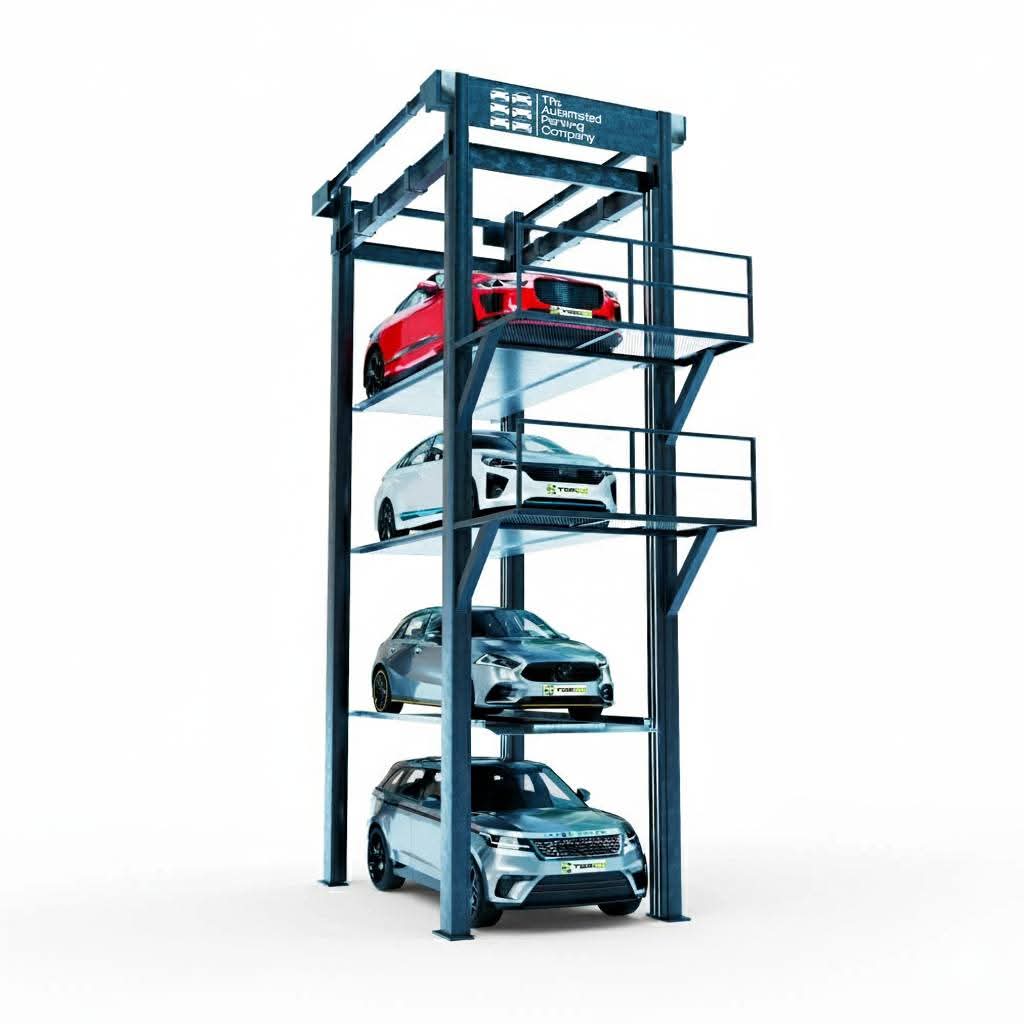
Quadruple Car Stackers Designed & Manufactured By The Automated Parking Company. Get More 60% More Parking Spaces, Using 40%-60% Less Land
De-Risk Your Parking Strategy with a FREE $5,000 Design Review Credit
If you connect with us, The Automated Parking Company, will provide a FREE in-depth design review, normally valued at $5,000; to assess feasibility, optimize layouts, and align your parking solution with project goals.
When you proceed with us, the full design review fee is credited back to the project, ensuring your early-stage diligence directly supports execution—not overhead.
A disciplined approach to smarter parking investment.
📞 Call Us for a FREE parking design review, valued at $5,000: (877) 827-2611
We value community input and address concerns for harmonious solutions.
Research & Innovation
Continuous research and innovation to improve green parking solutions.
Our Step By Step Process Towards Building Smart Yet Sustainable Parking
At TAPCO, our process ensures seamless delivery of efficient and sustainable parking tech tailored to your evolving project needs.
01
Discovery & Consultation:
Understand your needs, site constraints, and objectives.
02
Customized Design:
Create a tailored parking solution with eco-friendly integration.
03
Project Approval & Collaboration:
Obtain necessary approvals and work closely with your team.
04
Manufacturing & Quality Control:
Ensure the highest standards of quality.
05
Timely Delivery & Installation:
On-time setup with minimal disruptions.
06
Thorough Testing & Commissioning:
Rigorous performance checks and safety adherence.
07
Training & Support:
Comprehensive staff training and ongoing maintenance services.
08
Environmental Responsibility:
Implement eco-friendly practices and sustainability monitoring.
09
Client Satisfaction:
Prioritize your project with any number of our solutions.
Frequently Asked Questions
Q: Can TAPCO’s solutions be tailored to our specific needs?
A: Absolutely! At TAPCO, we understand that every project is unique. Our experienced team of designers and engineers will work closely with you to understand your specific requirements, site constraints, and objectives.
Q: How many levels can The Automated Parking Company design for the Puzzle parking system?
A: The Automated Parking Company has the capability to design systems with 2 to 7 levels, accommodating a varying number of parking spaces. Moreover, if your project calls for additional space optimization, we can even incorporate one or two subterranean levels, effectively increasing the total parking capacity.
Q: Are TAPCO’s parking systems safe and reliable?
A: Yes, safety is our top priority at TAPCO. We adhere to stringent industry safety standards and conduct rigorous testing and quality control measures at every stage of the manufacturing process.
Our car parking solutions are designed and built to ensure the safety of users, vehicles, and your property. We use high-quality materials and employ advanced technology to ensure the reliability and durability of our parking systems.
Improving Parking Convenience with Parking Stackers
When it comes to parking solutions, attended-oriented systems offer a blend of efficiency and convenience that cater to the needs and challenges of urban areas, particularly high-demand areas.
These multi-level car stacker solutions are a game-changer when it comes to parking, allowing the creation of multiple parking spaces within a single area.
TAPCO introduces a wide array of innovative attended-oriented parking systems designed to optimize space utilization as well as offer user-friendly parking practices.
These systems are intended to provide a seamless parking experience and enable attendants to efficiently manage parking procedures while ensuring the convenience and safety of the users. Here are the key benefits of using attended-oriented parking systems.
Optimal Space Utilisation
Our attended-oriented parking systems incorporate car lift storage systems make optimal use of the available space. Vertical stacking of vehicles with the vertical storage lift enables the system to increase the parking capacity within a limited area, hence coping with the increasing parking demands.
Organised vertical stacking
The attended-oriented parking allows vertical stacking of vehicles to utilize a vertical space effectively. This approach reduces the area required for parking, thereby contributing to a more organized and aesthetically pleasant-looking parking facility.
Convenience
The attended-oriented parking system offers ease of use for the attendant as well as the user. While the attendant can successfully navigate the car stacker lift and swiftly move vehicles into a nesting position with minimal effort, users need little to no guidance to park their vehicles safely.
Enhanced Security
Our attended-oriented car stacking system comes with advanced features to ensure the safety of parked vehicles. While users have peace of mind, property managers can also be content with the knowledge that the facility is secure.
Versatile stacked car parking
We offer a variety of car stacker lift solutions. From four post car storage lifts to no post solutions, our systems can be implemented indoors as well as outdoors and can be adapted for various project requirements or property layouts. TAPCO’s attended-oriented parking systems can be used in various environments, from commercial establishments to residential complexes.
Revolutionary Parking Solutions with Automated Lift Parking System
As the urban landscape continues to grow, the demand for efficient car parking solutions has become increasingly important. TAPCO introduces revolutionary semi-automated smart parking systems that are designed to optimise space utilization and streamline parking procedures for multi-family residential complexes and commercial facilities. Compared to the conventional car lift system, our multi level car parks are designed to redefine convenience and efficiency.
Here are some of the key features of our semi-automated car parking systems
Space Optimization
Optimal space utilization is a key focus of our multi-level car storing solutions. Our stack parking systems are designed to accommodate multiple levels, providing an impressive number of parking spaces within a compact footprint. We can design and integrate two to seven parking levels in a single structure and customize varying lengths, widths, and heights.
Seamless Automation
Our smart parking system incorporates advanced automation to simplify the parking process. Drivers can effortlessly park their vehicles with minimum guidance, thereby providing efficient utilization of time.
EV Capability
Given the increasing trend of electric vehicles, our parking solutions are also designed to embrace the future of mobility and Electric Vehicles. To cater to the ever-evolving automotive landscape, we also feature charging facilities for electric cars. We are the only vendor offering 7000# rated systems.
Convenience
We understand that parking can be a source of frustration for people, particularly when you cannot find a spot and have to drive around looking for space. Such layouts can be problematic for larger properties. However, with our Puzzle Parking system, this problem can be easily resolved, offering convenience to individuals and saving valuable time when parking or capturing your auto.
FAQ
Q: What is the difference between a fully automated and semi-automated smart parking system?
A: Semi-automated Puzzle solutions and fully automated AGV parking systems are considered automated parking and compress footprints giving you back valuable square footage.
In a semi-automated parking system, drivers can park and/or retrieve their own auto, so this system rids you of any demand for parking attendants therefore lowering your OpEx. Once the users vehicle is stowed within the system, the semi-automated Puzzle system can move the car up and down or left to right to find its nesting space.
On the other hand, in a fully-automated parking system, the driver pulls into a loading bay where they remove themselves and leave their auto, the system will then maneuver the auto and autonomously stow the users auto within the parking vault.
Q: What is the difference between mechanical lift systems and semi-automated Puzzle Parking systems?
A: In a mechanical stacker system, individuals must operate for it to move, or you must incorporate attendants to manage the parking and retrieval process.. The mechanical stacker parking system is usually a Double, Triple, or Quad Stacker that can raise the vehicle directly up on the platform so that more than one vehicle can be parked in a vertical stack. We strongly encourage trained personnel to operate these systems due to the manual processes of storing or retrieving autos in a vertical arrangement.
On the other hand, in a semi-automated system, there is no demand nor need for attendants or personnel to retrieve autos. Once the driver has parked their vehicle within the system, the semi-automated Puzzle system can intelligently move the car up and down or left to right.
Q: Which properties are semi-automated parking systems suitable for?
A: Our semi-automated parking systems are mostly suitable and used for commercial office and multi-family residential complexes.
Q: Can electric cars be charged in semi-automated parking systems?
A: Absolutely, our semi-automated smart parking systems are EV capable and feature charging facilities for electric vehicles. We offer Level II smart charging capabilities that allow you to bill the user pro-rata and also reduce the number of electrical meters therefore reducing your overall build costs when compared to competitive vendors.
Q: What are the maintenance requirements of semi-automated parking systems?
A: Maintenance and upkeep of the parking systems by The Automated Parking Company are easy as they are designed for minimal maintenance and durability. However, please note that regular checks and maintenance schedules help ensure optimal performance.
EV-Chargers Form
EV Chargers
You’re almost there
Fill in the details below to get our Spec Sheet, CAD, and Revit!