Why Walkable Density Is Key to Thriving Cities — and How The Automated Parking Company Accelerates High-Density Urban Development
Why Walkable Density Is Key to Thriving Cities — and How The Automated Parking Company Accelerates High-Density Urban Development
Executive Overview
Walkable density represents a pivotal shift in urban planning. It merges high land-use efficiency with improved livability, reduced emissions, and enhanced economic output. For cities, developers, and investors, walkable urbanism offers elevated tax revenues, higher property values, and robust investment returns. However, achieving this density is often constrained by parking requirements and land shortages. The Automated Parking Company provides innovative solutions that unlock land potential and expedite approvals, enabling dense, sustainable projects to proceed faster.
Why Walkable Density Is Key to Thriving Cities — and How The Automated Parking Company Accelerates High-Density Urban Development
The Case for Walkable Density
Walkable density allows people to live, work, and socialize within compact, pedestrian-oriented environments. Contemporary studies show that walkable neighborhoods correlate directly with increased physical activity, better public health, and thriving local economies. A Stanford-led study revealed that residents relocating to walkable areas walk 1,100 more steps per day, supporting both physical and mental
well-being.
From an environmental perspective, walkable neighborhoods reduce vehicle dependence, yielding fewer carbon emissions and quieter, cleaner environments. The cumulative effect is a public health dividend through reduced chronic diseases and improved air quality.
Economic Benefits for Cities
Walkable urban areas are the most economically efficient land use pattern. They generate multiples in tax revenue compared to suburban sprawl while being up to 20 times cheaper to maintain. Cities benefit through:
● Increased tax revenue from dense, mixed-use developments due to higher property and business valuations.
● Reduced infrastructure costs for roads, utilities, and emergency services by concentrating development footprints.
● Boosted tourism and investment appeal, as vibrant city cores attract visitors and skilled workers.
Moreover, compact neighborhoods support small businesses through localized consumer bases, adding economic resilience.
Why Walkable Density Is Key to Thriving Cities — and How The Automated Parking Company Accelerates High-Density Urban Development
Economic Benefits for Architects and Developers
Architects and developers gain from walkable density via elevated project margins and design flexibility. Walkable projects achieve higher rent and sale premiums—77% greater rents in walkable downtowns like Charlotte—demonstrating market preference for pedestrian-friendly environments. The integration of mixed uses (residential, retail, office) increases site ROI while aligning with evolving zoning priorities for sustainable urban core growth.
Walkability also empowers design innovation—less space devoted to parking, more to communal amenities and green infrastructure. As infrastructure shifts toward “car-lite” paradigms, compact sites provide creative freedom in form and façade, optimizing both function and aesthetics.
Economic Benefits for Investors
For real estate investors, walkable density translates to premium asset performance. Properties in high-walkability zones consistently outperform auto-oriented counterparts in occupancy, appreciation, and long-term rent growth. The “High Line effect” in New York illustrates this power: a $115 million public pedestrian park spurred over $2 billion in private development, doubling surrounding property values and creating 12,000 jobs.
Investor return profiles also benefit through reduced risks of obsolescence. As younger demographics gravitate toward transit-oriented, environmentally responsible neighborhoods, investment portfolios containing walkable assets hedge against regulatory and market volatility.
Why Walkable Density Is Key to Thriving Cities — and How The Automated Parking Company Accelerates High-Density Urban Development
The Parking Bottleneck in Urban Density
Despite clear benefits, one of the primary obstacles to walkable density remains parking requirements. Conventional surface or multi-story garages consume valuable land, impose design constraints, and inflate development costs. They also delay approvals where zoning codes mandate minimum parking ratios incompatible with compact, sustainable development.
Traditional parking adds no social or economic vibrancy to cities—it occupies prime ground that could house residents, parks, or commerce. Developers face a paradox: to create walkable density, they must simultaneously accommodate vehicles.
How The Automated Parking Company Accelerates High-Density Development
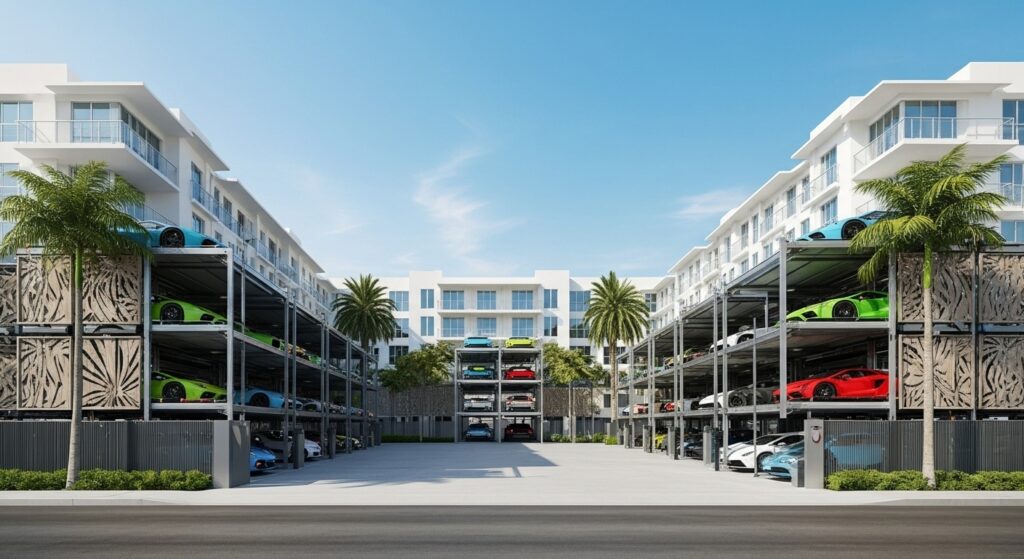
The Automated Parking Company offers a bridge between sustainable urbanism and development practicality through Automated Parking Systems (APS)—robotic, space-efficient parking that requires up to 70% less area than traditional garages.
Key Benefits:
● Space optimization: Automated Parking Vertical Systems enables denser, vertical developments with smaller footprints. Freed land can host retail, housing, or green space—adding revenue-generating leasable area.
● Faster approvals: Compact Automated Parking Vertical Systems solutions align with zoning and sustainability goals, helping developers present compliant, high-density proposals that meet municipal parking standards while promoting walkable design.
● Environmental efficiency: Automated systems reduce idling emissions, energy use, and construction material volume.
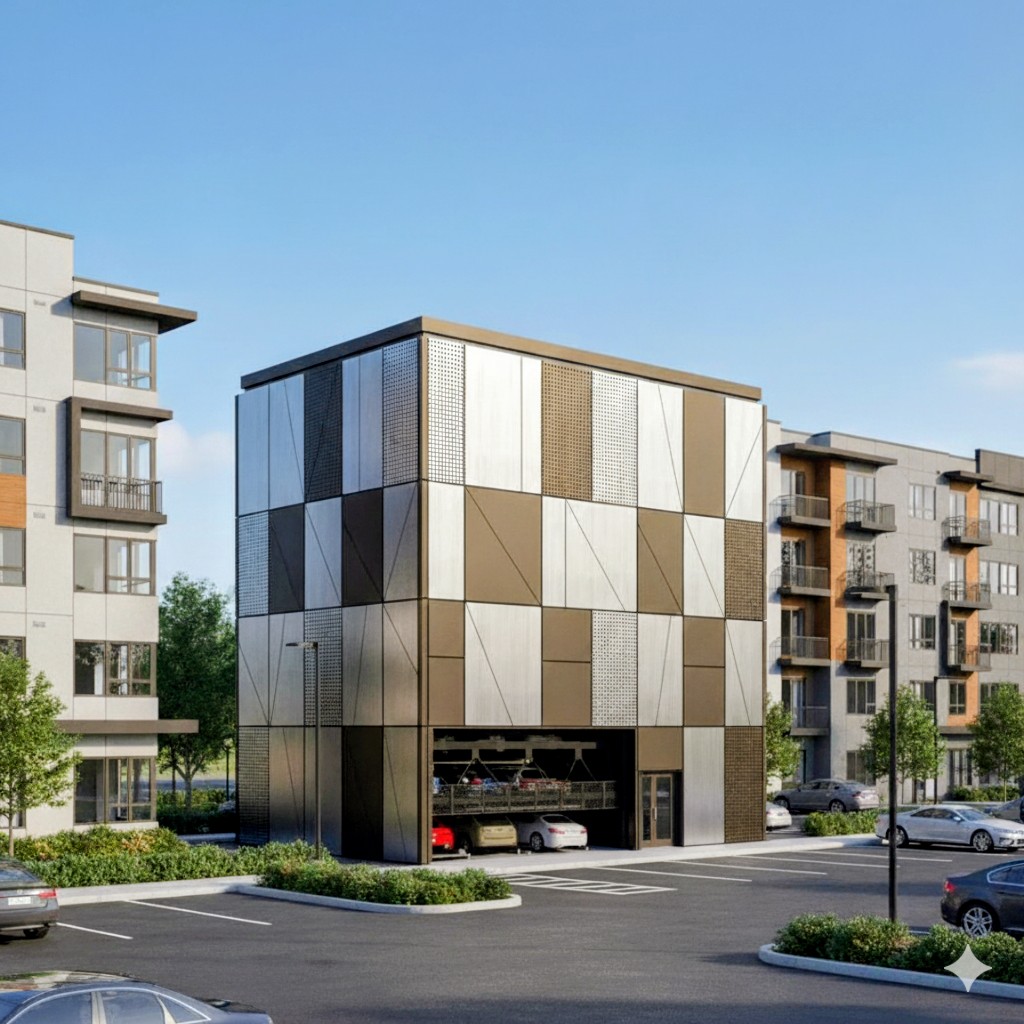
● Integration flexibility: Systems can be retrofitted within existing buildings or integrated below-grade, preserving urban façades and pedestrian character.
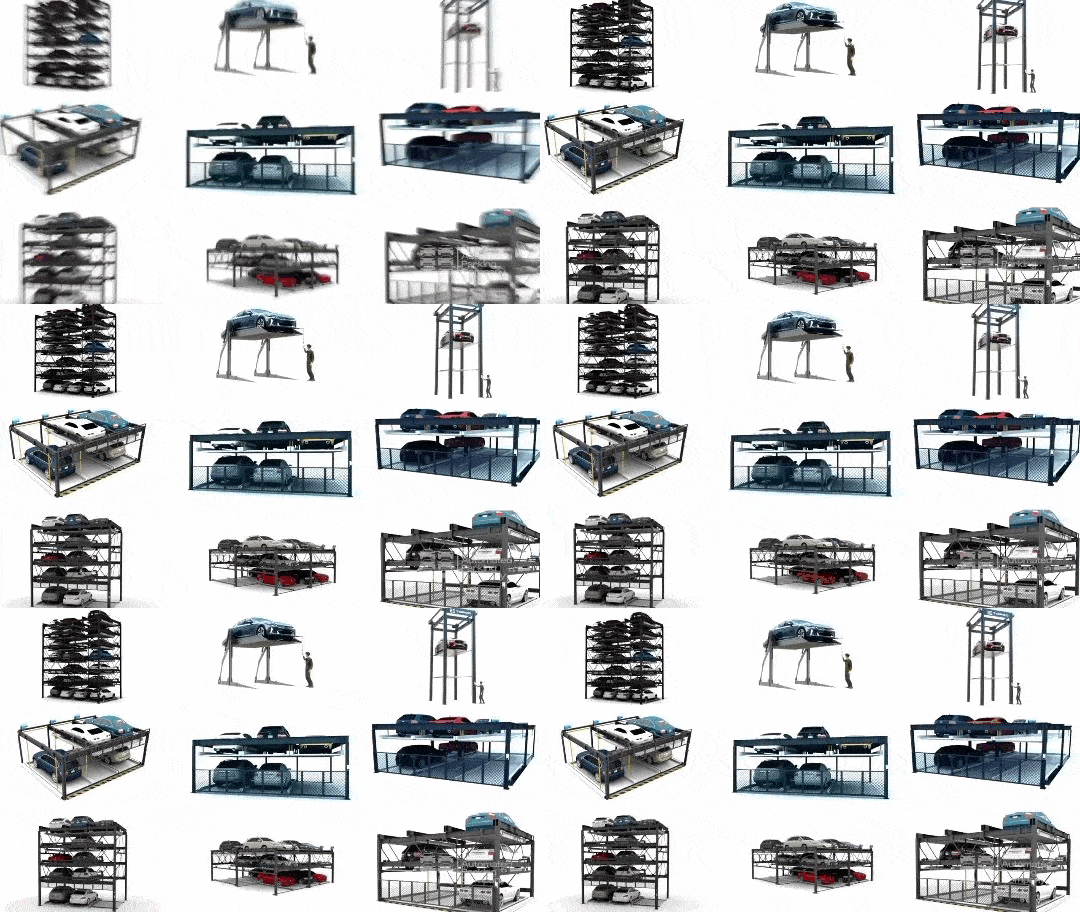
The company’s modular parking configurations—Double, Triple, and Quad Stackers—allow scalable adoption for developments across residential and commercial sectors.
Accelerating Approvals and City Collaboration
One of the less recognized but significant contributions of automated parking is expedited regulatory compliance. By solving for parking without requiring additional land dedication or setback variances, developers can fast-track entitlement and zoning approvals. Planners view APS installations as progressive technology supporting smart growth, aligning with urban design objectives and sustainability benchmarks.
This alignment also strengthens public-private partnerships, promoting innovation-driven development. Municipalities can approve high-density mixed-use projects with confidence that mobility, emissions, and accessibility concerns are effectively managed.
Socioeconomic Multiplier Effects
Walkable density coupled with automated parking creates a compounding cycle of socioeconomic growth. As dense nodes develop:
● Residents walk more, improving health and reducing strain on healthcare systems.
● Businesses experience increased foot traffic and sales volumes.
● Cities benefit from circular reinvestments of tax revenue into local infrastructure and public spaces.
● Developers and architects realize successive design efficiencies with replicable smart-block templates.
Why Walkable Density Is Key to Thriving Cities — and How The Automated Parking Company Accelerates High-Density Urban Development
Conclusion
Walkable density is not just a planning principle—it is a city’s economic engine. For cities striving to balance livability, sustainability, and economic vitality, embracing walkable urban models is imperative. The Automated Parking Company positions itself as a strategic innovation partner in this transformation, helping architects, investors, and municipalities overcome parking constraints that hinder progress.
By reimagining parking as an integrated, automated service rather than a spatial burden, cities can unlock new density—faster, smarter, and more resilient than before. In essence, walkable density drives prosperity; The Automated Parking Company makes it buildable.
The Automated Parking Company is Raising Parking Solutions to New Heights
Automated & Innovative Parking Solutions
The Automated Parking Company is a US based turnkey firm that designs, manufactures, installs, and services a full suite of products: automated, semi-automated, and attendant oriented solutions. Our design solutions have proven to reduce parking footprints and lower build cost when compared to traditional parking schemes.
The Automated Parking Company has assembled the most recognized and advanced team found in the industry, all possessing the insight and capabilities to focus on core values such as: offering superior products, integrating dependable software and controls, professional customer service, timely deliverables, efficient practices, innovative designs, cost effective solutions, and superior service post installation.
Mechanical stackers parking solutions
The Automated Parking Company furnishes and installs Double Stackers, Triple Stackers, and Quad Stackers. These are mechanical and hydraulic driven systems that can be installed indoor and/or outdoor.
Hybrid design parking lot solutions
The Automated Parking Company offers a semi-automated Puzzle parking solution offering independent access by the user, so no attendants are required with this solution. This solution fits well with office and multifamily property uses. The Automated Parking Company can design 2 levels to 7 levels and also incorporate one or even two subterranean levels depending on the solution.
Automated parking solutions Robotic Valets
The Automated Parking Company furnishes a robotic Autonomous Guided Vehicle (powered by Volley Automation) that is omni-directional, fully automated, battery operated AGVs that precisely maneuver vehicles or other payloads into space efficient configurations.
Why Walkable Density Is Key to Thriving Cities — and How The Automated Parking Company Accelerates High-Density Urban Development
Why Walkable Density Is Key to Thriving Cities — and How The Automated Parking Company Accelerates High-Density Urban Development
De-Risk Your Parking Strategy with a FREE $5,000 Design Review Credit
If you connect with us, The Automated Parking Company, will provide a FREE in-depth design review, normally valued at $5,000; to assess feasibility, optimize layouts, and align your parking solution with project goals.
When you proceed with us, the full design review fee is credited back to the project, ensuring your early-stage diligence directly supports execution—not overhead.
A disciplined approach to smarter parking investment.
📞 Call Us for a FREE parking design review, valued at $5,000: (877) 827-2611
We value community input and address concerns for harmonious solutions.
Research & Innovation
Continuous research and innovation to improve green parking solutions.
Our Step By Step Process Towards Building Smart Yet Sustainable Parking
At TAPCO, our process ensures seamless delivery of efficient and sustainable parking tech tailored to your evolving project needs.
01
Discovery & Consultation:
Understand your needs, site constraints, and objectives.
02
Customized Design:
Create a tailored parking solution with eco-friendly integration.
03
Project Approval & Collaboration:
Obtain necessary approvals and work closely with your team.
04
Manufacturing & Quality Control:
Ensure the highest standards of quality.
05
Timely Delivery & Installation:
On-time setup with minimal disruptions.
06
Thorough Testing & Commissioning:
Rigorous performance checks and safety adherence.
07
Training & Support:
Comprehensive staff training and ongoing maintenance services.
08
Environmental Responsibility:
Implement eco-friendly practices and sustainability monitoring.
09
Client Satisfaction:
Prioritize your project with any number of our solutions.
Frequently Asked Questions
Q: Can TAPCO’s solutions be tailored to our specific needs?
A: Absolutely! At TAPCO, we understand that every project is unique. Our experienced team of designers and engineers will work closely with you to understand your specific requirements, site constraints, and objectives.
Q: How many levels can The Automated Parking Company design for the Puzzle parking system?
A: The Automated Parking Company has the capability to design systems with 2 to 7 levels, accommodating a varying number of parking spaces. Moreover, if your project calls for additional space optimization, we can even incorporate one or two subterranean levels, effectively increasing the total parking capacity.
Q: Are TAPCO’s parking systems safe and reliable?
A: Yes, safety is our top priority at TAPCO. We adhere to stringent industry safety standards and conduct rigorous testing and quality control measures at every stage of the manufacturing process.
Our car parking solutions are designed and built to ensure the safety of users, vehicles, and your property. We use high-quality materials and employ advanced technology to ensure the reliability and durability of our parking systems.
Improving Parking Convenience with Parking Stackers
When it comes to parking solutions, attended-oriented systems offer a blend of efficiency and convenience that cater to the needs and challenges of urban areas, particularly high-demand areas.
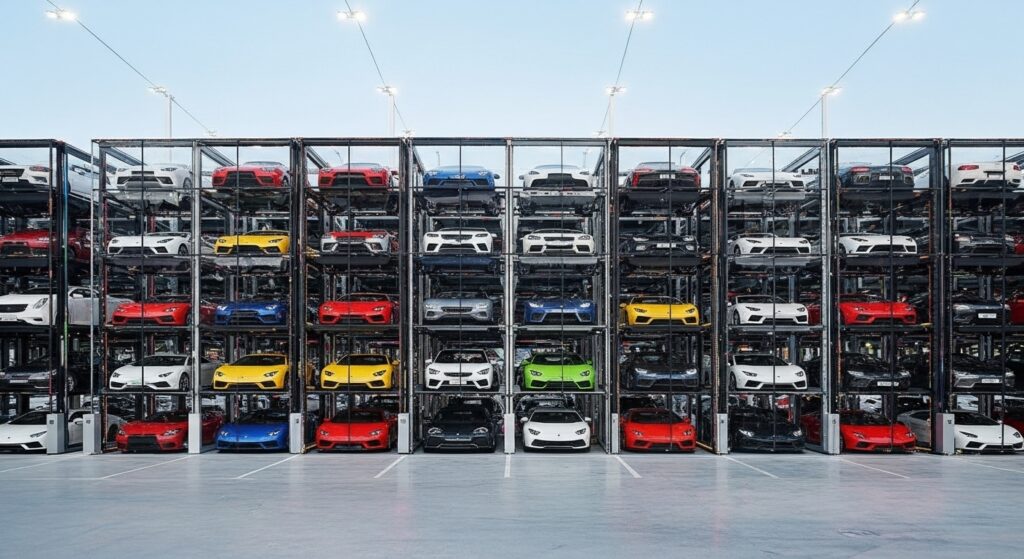
These multi-level car stacker solutions are a game-changer when it comes to parking, allowing the creation of multiple parking spaces within a single area.
TAPCO introduces a wide array of innovative attended-oriented parking systems designed to optimize space utilization as well as offer user-friendly parking practices.
These systems are intended to provide a seamless parking experience and enable attendants to efficiently manage parking procedures while ensuring the convenience and safety of the users. Here are the key benefits of using attended-oriented parking systems.
Optimal Space Utilisation
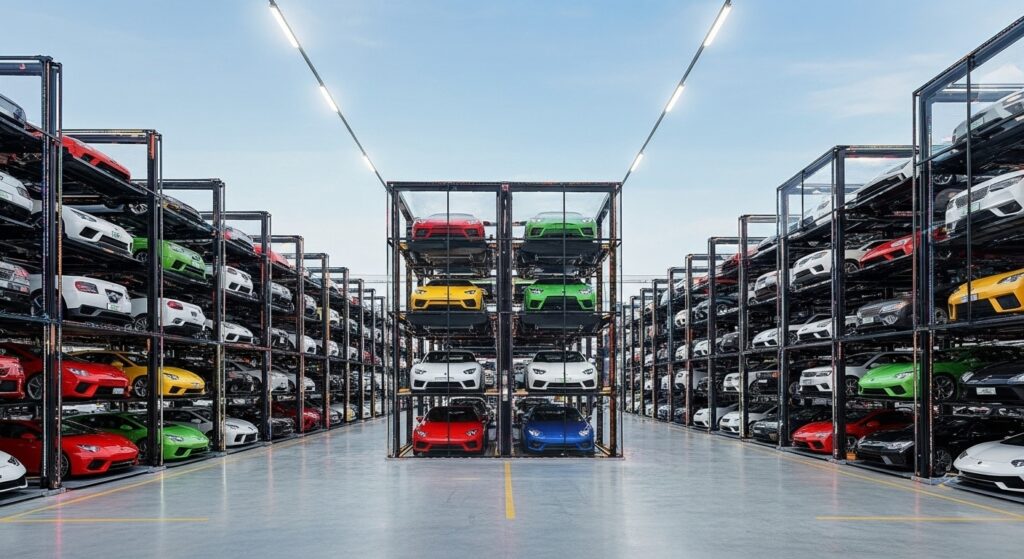
Our attended-oriented parking systems incorporate car lift storage systems make optimal use of the available space. Vertical stacking of vehicles with the vertical storage lift enables the system to increase the parking capacity within a limited area, hence coping with the increasing parking demands.
Organised vertical stacking
The attended-oriented parking allows vertical stacking of vehicles to utilize a vertical space effectively. This approach reduces the area required for parking, thereby contributing to a more organized and aesthetically pleasant-looking parking facility.
Convenience
The attended-oriented parking system offers ease of use for the attendant as well as the user. While the attendant can successfully navigate the car stacker lift and swiftly move vehicles into a nesting position with minimal effort, users need little to no guidance to park their vehicles safely.
Enhanced Security
Our attended-oriented car stacking system comes with advanced features to ensure the safety of parked vehicles. While users have peace of mind, property managers can also be content with the knowledge that the facility is secure.
Versatile stacked car parking
We offer a variety of car stacker lift solutions. From four post car storage lifts to no post solutions, our systems can be implemented indoors as well as outdoors and can be adapted for various project requirements or property layouts. TAPCO’s attended-oriented parking systems can be used in various environments, from commercial establishments to residential complexes.
Revolutionary Parking Solutions with Automated Lift Parking System
As the urban landscape continues to grow, the demand for efficient car parking solutions has become increasingly important. TAPCO introduces revolutionary semi-automated smart parking systems that are designed to optimise space utilization and streamline parking procedures for multi-family residential complexes and commercial facilities. Compared to the conventional car lift system, our multi level car parks are designed to redefine convenience and efficiency.
Here are some of the key features of our semi-automated car parking systems
Space Optimization
Optimal space utilization is a key focus of our multi-level car storing solutions. Our stack parking systems are designed to accommodate multiple levels, providing an impressive number of parking spaces within a compact footprint. We can design and integrate two to seven parking levels in a single structure and customize varying lengths, widths, and heights.
Seamless Automation
Our smart parking system incorporates advanced automation to simplify the parking process. Drivers can effortlessly park their vehicles with minimum guidance, thereby providing efficient utilization of time.
EV Capability
Given the increasing trend of electric vehicles, our parking solutions are also designed to embrace the future of mobility and Electric Vehicles. To cater to the ever-evolving automotive landscape, we also feature charging facilities for electric cars. We are the only vendor offering 7000# rated systems.
Convenience
We understand that parking can be a source of frustration for people, particularly when you cannot find a spot and have to drive around looking for space. Such layouts can be problematic for larger properties. However, with our Puzzle Parking system, this problem can be easily resolved, offering convenience to individuals and saving valuable time when parking or capturing your auto.
FAQ
Q: What is the difference between a fully automated and semi-automated smart parking system?
A: Semi-automated Puzzle solutions and fully automated AGV parking systems are considered automated parking and compress footprints giving you back valuable square footage.
In a semi-automated parking system, drivers can park and/or retrieve their own auto, so this system rids you of any demand for parking attendants therefore lowering your OpEx. Once the users vehicle is stowed within the system, the semi-automated Puzzle system can move the car up and down or left to right to find its nesting space.
On the other hand, in a fully-automated parking system, the driver pulls into a loading bay where they remove themselves and leave their auto, the system will then maneuver the auto and autonomously stow the users auto within the parking vault.
Q: What is the difference between mechanical lift systems and semi-automated Puzzle Parking systems?
A: In a mechanical stacker system, individuals must operate for it to move, or you must incorporate attendants to manage the parking and retrieval process.. The mechanical stacker parking system is usually a Double, Triple, or Quad Stacker that can raise the vehicle directly up on the platform so that more than one vehicle can be parked in a vertical stack. We strongly encourage trained personnel to operate these systems due to the manual processes of storing or retrieving autos in a vertical arrangement.
On the other hand, in a semi-automated system, there is no demand nor need for attendants or personnel to retrieve autos. Once the driver has parked their vehicle within the system, the semi-automated Puzzle system can intelligently move the car up and down or left to right.
Q: Which properties are semi-automated parking systems suitable for?
A: Our semi-automated parking systems are mostly suitable and used for commercial office and multi-family residential complexes.
Q: Can electric cars be charged in semi-automated parking systems?
A: Absolutely, our semi-automated smart parking systems are EV capable and feature charging facilities for electric vehicles. We offer Level II smart charging capabilities that allow you to bill the user pro-rata and also reduce the number of electrical meters therefore reducing your overall build costs when compared to competitive vendors.
Q: What are the maintenance requirements of semi-automated parking systems?
A: Maintenance and upkeep of the parking systems by The Automated Parking Company are easy as they are designed for minimal maintenance and durability. However, please note that regular checks and maintenance schedules help ensure optimal performance.
EV-Chargers Form
EV Chargers
You’re almost there
Fill in the details below to get our Spec Sheet, CAD, and Revit!