How to Choose the Best Automated Parking Garage (Compared): Mechanical Stackers vs Puzzle Systems vs Robotic Solutions
How to Choose the Best Automated Parking Garage (Compared): Mechanical Stackers vs Puzzle Systems vs Robotic Solutions
Choosing the right automated parking solution or vertical lift parking system can make or break your development project. With urban land prices soaring and parking requirements consuming valuable real estate, developers are increasingly turning to automated systems, puzzle vertical lift parking system or car stackers that can double or triple parking capacity in the same footprint. However, not all automated parking systems are created equal.
How to Choose the Best Automated Parking Garage (Compared): Mechanical Stackers vs Puzzle Systems vs Robotic Solutions
Understanding the Three Main Categories
Mechanical Stackers: The Budget-Friendly Foundation
Mechanical stackers represent the most cost-effective entry point into automated parking. These systems use simple vertical stacking mechanisms to create double, triple, or quad-level configurations without complex horizontal movement.
The technology is straightforward: vehicles are placed on platforms that lift vertically to create multiple parking levels. Most stackers require valet attendance, making them popular in controlled environments like hotels, airports, and auto dealerships where staff can manage the system efficiently.
Key advantages include:
Minimal excavation requirements
Fastest installation timeline
Lower upfront investment
Suitable for both indoor and outdoor applications
Proven reliability with simple mechanical components
Light Duty Double Pit Car Stacker Designer and Installer OEM The Automated Parking Company
Puzzle Systems: The Flexible Middle Ground
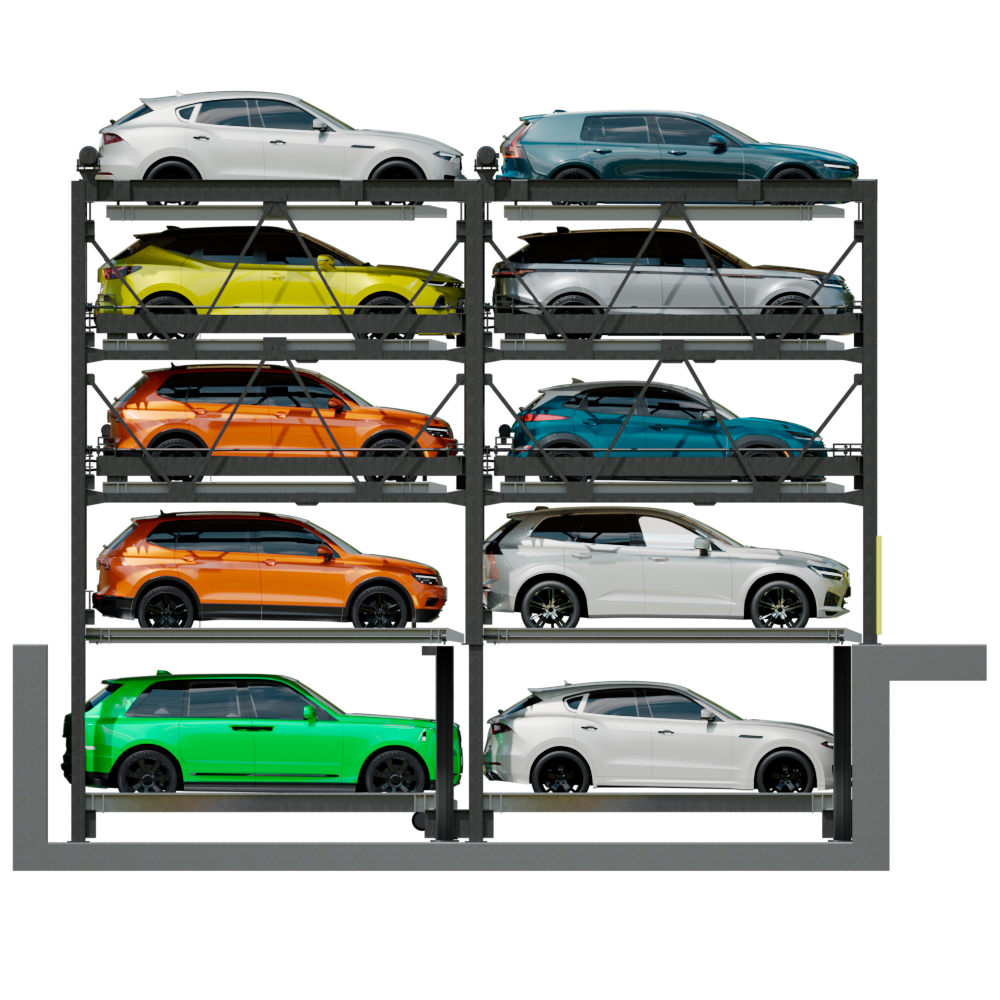
Puzzle systems, also known as combilifts, represent a semi-automated solution that moves vehicles both vertically and horizontally using a grid-based approach. Like a sliding puzzle, these systems shift cars in multiple directions to access any vehicle in the storage matrix.
This flexibility makes puzzle systems particularly valuable for irregular or constrained urban parcels where traditional garage designs won’t fit efficiently. The modular design allows architects to configure systems around building constraints rather than forcing buildings around parking requirements.
Semi-Automated Parking Systems Designed and Installed by OEM The Automated Parking Company
Primary benefits include:
No pit excavation typically required
Flexible configuration for irregular floor plates
Can double or triple parking capacity
Semi-automated operation reduces staffing needs
Modular expansion capability
Fully Automated Parking System Robotic Valet & Semi-Automated Parking Systems Designed and Installed by OEM TheAutomatedParkingCompany.com
Fully Automated Robotic Systems: The Premium Solution
Fully automated systems represent the most sophisticated option, using robots, shuttles, conveyors, or Automated Guided Vehicles (AGVs) to handle all parking operations without human intervention. Drivers simply leave their vehicles at a loading bay, and the system handles everything from scanning and transport to retrieval via smartphone apps.
These systems offer maximum space efficiency because they eliminate the need for driving lanes, ramps, and human access within storage areas. Vehicle retrieval typically takes under a minute, and the sealed storage environment provides enhanced security and protection from weather and theft.
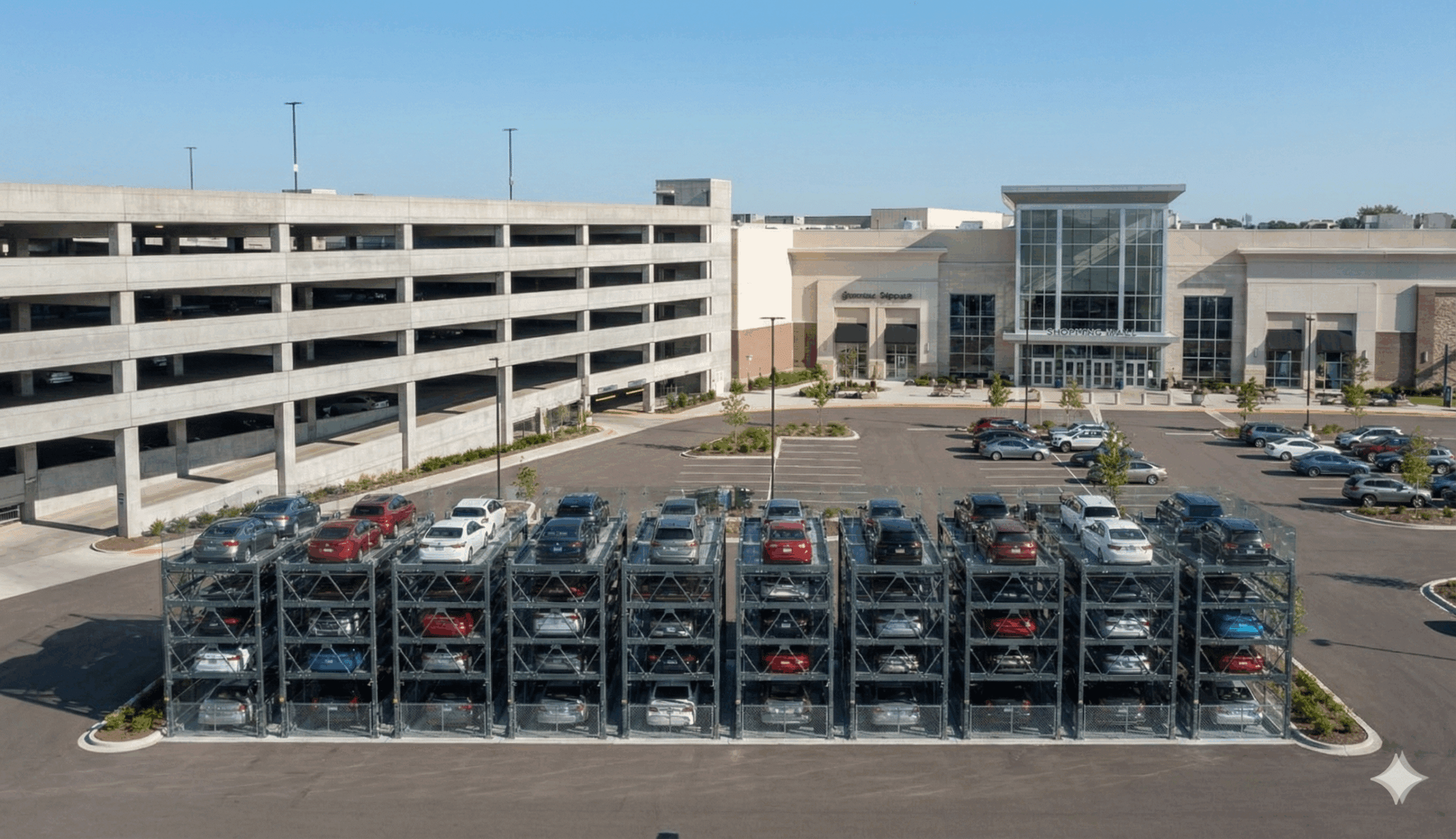
Quadruple Car Stackers Designed and Installed By OEM TheAutomatedParkingCompany.com
Detailed Comparison Analysis
Cost Considerations
Initial Investment: Mechanical stackers require the lowest upfront cost, making them accessible for budget-conscious projects. Puzzle systems fall into the moderate range, while fully automated solutions command premium pricing due to their sophisticated technology and installation requirements.
Operating Costs: Stackers typically require valet staffing, creating ongoing labor costs. Puzzle systems reduce but don’t eliminate staffing needs. Fully automated systems have the lowest operating costs once installed, requiring only routine maintenance.
Long-term Value: While robotic systems have higher initial costs, they often provide better return on investment over time through reduced labor costs and maximum space utilization.
Space Efficiency and Capacity
Footprint Optimization: Stackers provide modest space savings through vertical stacking. Puzzle systems can double or triple capacity in the same footprint by combining vertical and horizontal movement. Fully automated systems achieve the highest density by eliminating human access requirements.
Height Considerations: Stackers work well with standard ceiling heights. Puzzle systems adapt to various height constraints through their modular design. Automated systems can maximize vertical space most efficiently due to compact vehicle storage configurations.
Irregular Sites: Puzzle systems excel on constrained urban parcels with unusual shapes or dimensions. Their flexibility allows optimization around existing structural elements and property boundaries.
User Experience and Operations
Access Speed: Stackers require valet assistance and can have slower access times. Puzzle systems offer moderate retrieval speeds with semi-automated operation. Fully automated systems provide the fastest access, typically under 60 seconds via smartphone apps.
Security: Valet-attended stackers provide basic security through staff oversight. Puzzle systems offer improved security with controlled access points. Automated systems deliver maximum security since the public never accesses storage areas.
Weather Protection: Indoor stackers protect vehicles from elements. Puzzle systems can be enclosed for weather protection. Automated systems provide complete environmental protection in sealed storage areas.
Selection Framework by Project Type
When to Choose Mechanical Stackers
Stackers work best for projects prioritizing immediate cost savings over long-term optimization. They’re ideal for:
Budget-constrained developments
Retrofit projects with limited modification capability
Hospitality and commercial applications with available valet services
Projects requiring fast implementation timelines
Sites with moderate space constraints but adequate operational space
When Puzzle Systems Make Sense
Choose puzzle systems for projects requiring flexibility and moderate automation without premium costs:
Mixed-use developments with irregular floor plates
Urban infill projects with shape constraints
Multifamily, office, and student housing developments
Projects seeking space efficiency improvements without full automation
Developments requiring expansion capability
When Fully Automated Systems Excel
Automated systems justify their premium cost in specific scenarios:
High-density urban environments with extreme land costs
Luxury residential and commercial developments
Projects requiring maximum space efficiency
Smart building developments with integrated technology
Sites with severe space or access constraints
High-security applications
Implementation and Technical Considerations
Installation Requirements
Site Preparation: Stackers require minimal site preparation and fastest installation. Puzzle systems need moderate preparation for their modular components. Automated systems require the most extensive preparation including utilities, controls, and safety systems.
Utility Needs: All systems require electrical power, but automated solutions need additional IT infrastructure for controls and user interfaces. Consider data connectivity for remote monitoring and smartphone integration.
System Complexity: Stackers have fewer moving parts and simpler maintenance requirements. Puzzle systems require moderate maintenance for their mechanical components. Automated systems need specialized technical support but offer predictive maintenance capabilities.
Downtime Impact: Consider how system maintenance affects parking availability. Stackers can often operate partially during maintenance. Puzzle systems may require temporary access restrictions. Automated systems typically include redundancy to minimize service interruptions.
Making Your Decision
The optimal automated parking solution depends on balancing three key factors: budget constraints, space requirements, and desired automation level.
Start by evaluating your project’s primary constraints. If immediate cost control is paramount, stackers provide proven value. For sites with irregular shapes or moderate space pressure, puzzle systems offer the best balance of flexibility and efficiency. When maximum space utilization and premium user experience justify higher investment, fully automated systems deliver unmatched performance.
Consider your target market and long-term objectives. Budget developments benefit from stackers’ simplicity. Mixed-use projects leverage puzzle systems’ adaptability. Luxury developments and smart buildings maximize value through automated systems’ sophistication.
The most successful automated parking projects align system selection with project goals rather than choosing based on technology appeal alone. Whether you need cost-effective vertical stacking, flexible puzzle movement, or fully automated efficiency, the right choice is the one that best serves your specific development objectives and constraints.
De-Risk Your Parking Strategy with a FREE $5,000 Design Review Credit
If you connect with us, The Automated Parking Company, will provide a FREE in-depth design review, normally valued at $5,000; to assess feasibility, optimize layouts, and align your parking solution with project goals.
When you proceed with us, the full design review fee is credited back to the project, ensuring your early-stage diligence directly supports execution—not overhead.
A disciplined approach to smarter parking investment.
📞 Call Us for a FREE parking design review, valued at $5,000: (877) 827-2611
We value community input and address concerns for harmonious solutions.
Research & Innovation
Continuous research and innovation to improve green parking solutions.
Our Step By Step Process Towards Building Smart Yet Sustainable Parking
At TAPCO, our process ensures seamless delivery of efficient and sustainable parking tech tailored to your evolving project needs.
01
Discovery & Consultation:
Understand your needs, site constraints, and objectives.
02
Customized Design:
Create a tailored parking solution with eco-friendly integration.
03
Project Approval & Collaboration:
Obtain necessary approvals and work closely with your team.
04
Manufacturing & Quality Control:
Ensure the highest standards of quality.
05
Timely Delivery & Installation:
On-time setup with minimal disruptions.
06
Thorough Testing & Commissioning:
Rigorous performance checks and safety adherence.
07
Training & Support:
Comprehensive staff training and ongoing maintenance services.
08
Environmental Responsibility:
Implement eco-friendly practices and sustainability monitoring.
09
Client Satisfaction:
Prioritize your project with any number of our solutions.
Frequently Asked Questions
Q: Can TAPCO’s solutions be tailored to our specific needs?
A: Absolutely! At TAPCO, we understand that every project is unique. Our experienced team of designers and engineers will work closely with you to understand your specific requirements, site constraints, and objectives.
Q: How many levels can The Automated Parking Company design for the Puzzle parking system?
A: The Automated Parking Company has the capability to design systems with 2 to 7 levels, accommodating a varying number of parking spaces. Moreover, if your project calls for additional space optimization, we can even incorporate one or two subterranean levels, effectively increasing the total parking capacity.
Q: Are TAPCO’s parking systems safe and reliable?
A: Yes, safety is our top priority at TAPCO. We adhere to stringent industry safety standards and conduct rigorous testing and quality control measures at every stage of the manufacturing process.
Our car parking solutions are designed and built to ensure the safety of users, vehicles, and your property. We use high-quality materials and employ advanced technology to ensure the reliability and durability of our parking systems.
Improving Parking Convenience with Parking Stackers
When it comes to parking solutions, attended-oriented systems offer a blend of efficiency and convenience that cater to the needs and challenges of urban areas, particularly high-demand areas.
These multi-level car stacker solutions are a game-changer when it comes to parking, allowing the creation of multiple parking spaces within a single area.
TAPCO introduces a wide array of innovative attended-oriented parking systems designed to optimize space utilization as well as offer user-friendly parking practices.
These systems are intended to provide a seamless parking experience and enable attendants to efficiently manage parking procedures while ensuring the convenience and safety of the users. Here are the key benefits of using attended-oriented parking systems.
Optimal Space Utilisation
Our attended-oriented parking systems incorporate car lift storage systems make optimal use of the available space. Vertical stacking of vehicles with the vertical storage lift enables the system to increase the parking capacity within a limited area, hence coping with the increasing parking demands.
Organised vertical stacking
The attended-oriented parking allows vertical stacking of vehicles to utilize a vertical space effectively. This approach reduces the area required for parking, thereby contributing to a more organized and aesthetically pleasant-looking parking facility.
Convenience
The attended-oriented parking system offers ease of use for the attendant as well as the user. While the attendant can successfully navigate the car stacker lift and swiftly move vehicles into a nesting position with minimal effort, users need little to no guidance to park their vehicles safely.
Enhanced Security
Our attended-oriented car stacking system comes with advanced features to ensure the safety of parked vehicles. While users have peace of mind, property managers can also be content with the knowledge that the facility is secure.
Versatile stacked car parking
We offer a variety of car stacker lift solutions. From four post car storage lifts to no post solutions, our systems can be implemented indoors as well as outdoors and can be adapted for various project requirements or property layouts. TAPCO’s attended-oriented parking systems can be used in various environments, from commercial establishments to residential complexes.
Revolutionary Parking Solutions with Automated Lift Parking System
As the urban landscape continues to grow, the demand for efficient car parking solutions has become increasingly important. TAPCO introduces revolutionary semi-automated smart parking systems that are designed to optimise space utilization and streamline parking procedures for multi-family residential complexes and commercial facilities. Compared to the conventional car lift system, our multi level car parks are designed to redefine convenience and efficiency.
Here are some of the key features of our semi-automated car parking systems
Space Optimization
Optimal space utilization is a key focus of our multi-level car storing solutions. Our stack parking systems are designed to accommodate multiple levels, providing an impressive number of parking spaces within a compact footprint. We can design and integrate two to seven parking levels in a single structure and customize varying lengths, widths, and heights.
Seamless Automation
Our smart parking system incorporates advanced automation to simplify the parking process. Drivers can effortlessly park their vehicles with minimum guidance, thereby providing efficient utilization of time.
EV Capability
Given the increasing trend of electric vehicles, our parking solutions are also designed to embrace the future of mobility and Electric Vehicles. To cater to the ever-evolving automotive landscape, we also feature charging facilities for electric cars. We are the only vendor offering 7000# rated systems.
Convenience
We understand that parking can be a source of frustration for people, particularly when you cannot find a spot and have to drive around looking for space. Such layouts can be problematic for larger properties. However, with our Puzzle Parking system, this problem can be easily resolved, offering convenience to individuals and saving valuable time when parking or capturing your auto.
FAQ
Q: What is the difference between a fully automated and semi-automated smart parking system?
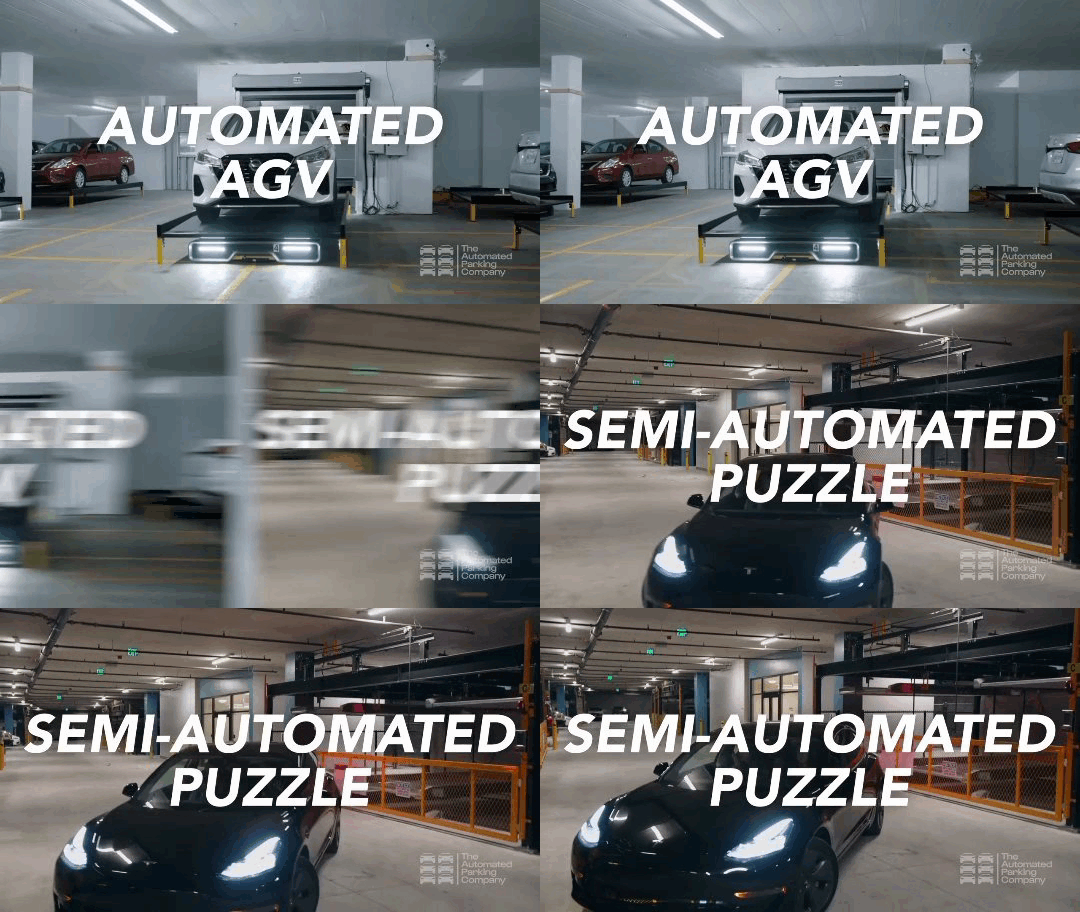
A: Semi-automated Puzzle solutions and fully automated AGV parking systems are considered automated parking and compress footprints giving you back valuable square footage.
In a semi-automated parking system, drivers can park and/or retrieve their own auto, so this system rids you of any demand for parking attendants therefore lowering your OpEx. Once the users vehicle is stowed within the system, the semi-automated Puzzle system can move the car up and down or left to right to find its nesting space.
On the other hand, in a fully-automated parking system, the driver pulls into a loading bay where they remove themselves and leave their auto, the system will then maneuver the auto and autonomously stow the users auto within the parking vault.
Q: What is the difference between mechanical lift systems and semi-automated Puzzle Parking systems?
A: In a mechanical stacker system, individuals must operate for it to move, or you must incorporate attendants to manage the parking and retrieval process.. The mechanical stacker parking system is usually a Double, Triple, or Quad Stacker that can raise the vehicle directly up on the platform so that more than one vehicle can be parked in a vertical stack. We strongly encourage trained personnel to operate these systems due to the manual processes of storing or retrieving autos in a vertical arrangement.
On the other hand, in a semi-automated system, there is no demand nor need for attendants or personnel to retrieve autos. Once the driver has parked their vehicle within the system, the semi-automated Puzzle system can intelligently move the car up and down or left to right.
Q: Which properties are semi-automated parking systems suitable for?
A: Our semi-automated parking systems are mostly suitable and used for commercial office and multi-family residential complexes.
Q: Can electric cars be charged in semi-automated parking systems?
A: Absolutely, our semi-automated smart parking systems are EV capable and feature charging facilities for electric vehicles. We offer Level II smart charging capabilities that allow you to bill the user pro-rata and also reduce the number of electrical meters therefore reducing your overall build costs when compared to competitive vendors.
Q: What are the maintenance requirements of semi-automated parking systems?
A: Maintenance and upkeep of the parking systems by The Automated Parking Company are easy as they are designed for minimal maintenance and durability. However, please note that regular checks and maintenance schedules help ensure optimal performance.
EV-Chargers Form
EV Chargers
You’re almost there
Fill in the details below to get our Spec Sheet, CAD, and Revit!