Revolutionizing Urban Development: The Strategic Case for Vertical Lift Parking Systems
TheAutomatedParkingCompany.com
Revolutionizing Urban Development: The Strategic Case for Vertical Lift Parking Systems
– A Comprehensive Guide for Architects, Developers, Municipalities, and Investors
By The Automated Parking Company Innovation in Parking Technology October 2025
Executive Summary
Urban development faces an unprecedented crisis: land scarcity, soaring real estate costs, and growing environmental pressures are fundamentally reshaping how we approach parking infrastructure. In high-density metropolitan areas, traditional parking solutions consume up to 30% of urban land while generating significant environmental impact through construction materials, energy consumption, and vehicular emissions.
Vertical lift parking technology represents a paradigm shift in urban space utilization, offering architects, developers, municipalities, and investors a strategic advantage in competitive markets. These automated systems can increase parking capacity by up to 700% while reducing land requirements by 50%, transforming the economics of urban development.
Key Strategic Benefits:
Space Optimization: 2-7 level systems maximize vertical space utilization
Cost Reduction: Up to 40% reduction in excavation costs, 50% reduction in land requirements
Sustainability: Reduced carbon footprint, LEED certification support, smart city integration
Market Differentiation: Premium positioning for multi-family, commercial, hospitality, and medical properties
With the automated parking systems market projected to grow from $2.37 billion in 2024 to $7.84 billion by 2030 at a 19.9% CAGR, early adoption provides competitive advantage and positions stakeholders at the forefront of urban innovation.
Revolutionizing Urban Development: The Strategic Case for Vertical Lift Parking Systems
The Urban Parking Challenge
Urban centers worldwide face an escalating parking crisis that threatens sustainable development and economic growth. The statistics paint a stark picture of inefficiency and environmental impact:
Critical Urban Parking Statistics
Land Consumption: Traditional parking occupies 30% of urban land in major metropolitan areas
Market Value: The U.S. parking sector reached $121 billion in 2022, projected to $144 billion by 2030
Cost Escalation: Construction costs for traditional structured parking increase 8-12% annually
Space Inefficiency: Conventional parking structures require 300-400 sq ft per vehicle including circulation space
Environmental Impact: Traditional parking generates 2.2 tons of CO2 per space annually through construction and operation
Rising Land Costs in Metropolitan Areas create unprecedented pressure on development economics. In major cities, land costs can represent 40-60% of total project costs, making efficient space utilization critical for project viability. Traditional parking infrastructure exacerbates this challenge by consuming premium real estate for low-revenue generating uses.
Traditional Parking Infrastructure Limitations include:
Inefficient space utilization due to required vehicle circulation areas
Structural requirements for ramps and traffic flow consume 25-30% of total floor area
Limited flexibility for future repurposing or adaptive use
High ongoing maintenance costs for lighting, ventilation, and security systems
Weather exposure and security vulnerabilities
Environmental Impact extends beyond construction to ongoing operations, including energy consumption for lighting and ventilation, storm water runoff management, and heat island effects that contribute to urban temperature increases.
Mechanical Car Stacker Designers & Manufacturers
Understanding Vertical Lift Parking Technology
Vertical lift parking systems represent sophisticated engineering solutions that maximize space efficiency through automated vehicle storage and retrieval. These systems eliminate traditional parking inefficiencies by storing vehicles in compact, multi-level configurations.
How Vertical Lift Systems Work
The fundamental principle involves mechanical and hydraulic-driven platforms that move vehicles vertically and horizontally to optimize storage density. Users drive vehicles onto designated platforms, exit the vehicle, and activate the system through simple controls. The automated system then positions the vehicle in the optimal storage location, eliminating human error and maximizing space utilization.
Types of Systems Available
Double Car Stackers:The entry-level solution that doubles parking capacity by stacking vehicles vertically. Ideal for residential applications and smaller commercial properties where space optimization is critical but complexity must remain manageable. Double Pit Car Stackers available.
Light Duty Double Pit Car Stacker
Triple Car Stackers: Three-level systems that triple parking capacity while maintaining reasonable access times. Perfect for medium-density applications including multi-family residential and commercial office buildings.
Quadruple Car Stackers: Four-level systems offering maximum capacity for high-density applications. Suitable for urban commercial developments, hotels, and large residential complexes where space premiums justify advanced automation.
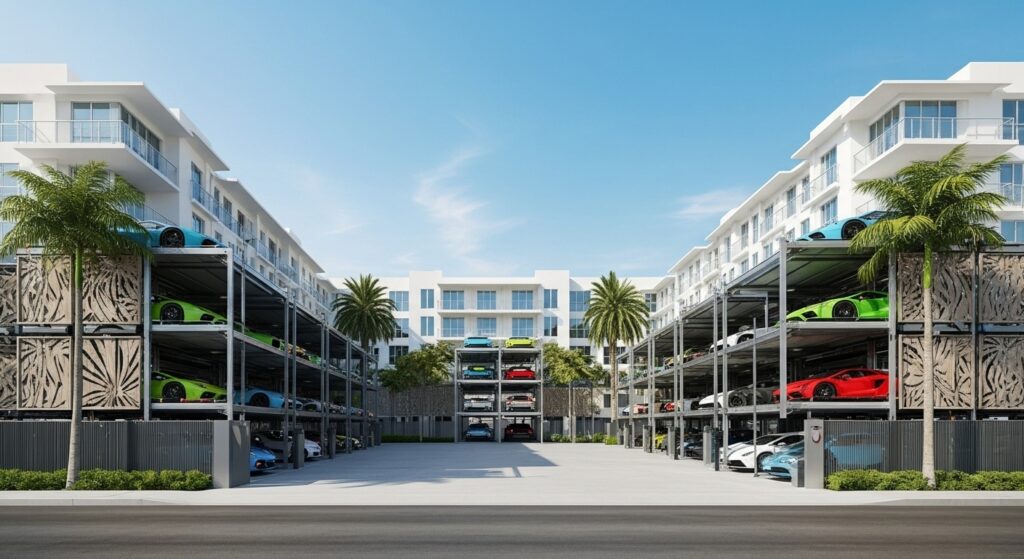
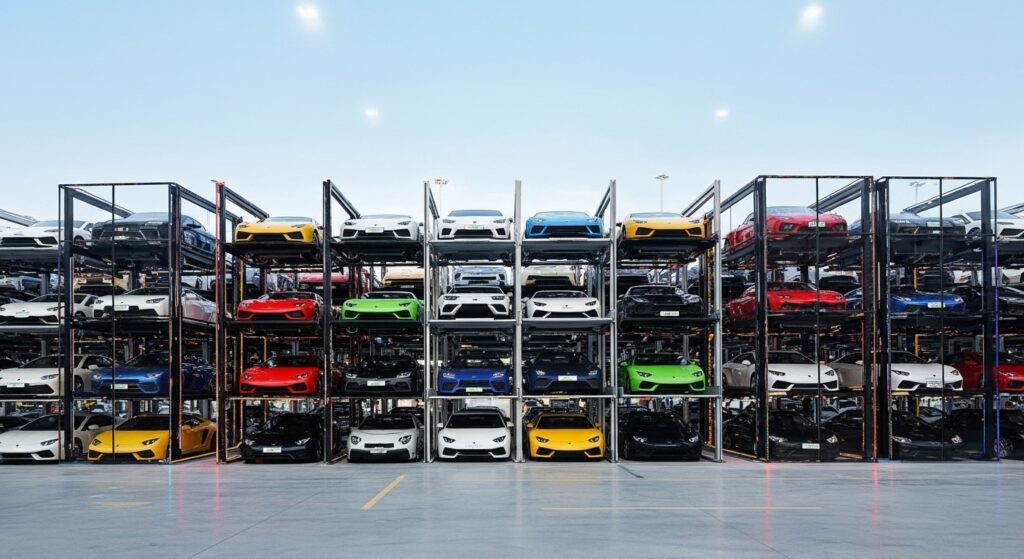
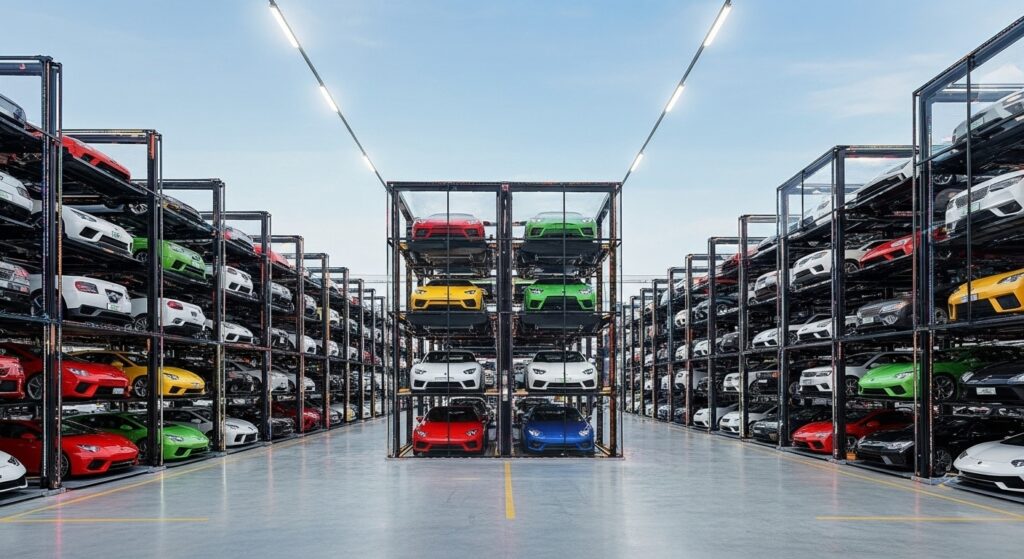
Puzzle Parking Systems (2-7 Levels): The most sophisticated solution offering 2-7 level configurations with optional subterranean levels. These systems can increase parking capacity by up to 700% while occupying minimal ground area.
Automated Parking Systems: Fully Automated Parking Systems – AGV Autonomous Guided Vehicle Robotic Valet is a fully automated robotic parking & EV charging system using advanced software and AGVs to densify a garage by up to 2x, operate with zero emissions, and provide a safer and more convenient patron experience.
The Automated Parking Company provides an Automated Guided Vehicle (AGV) parking system.
Technical Specifications and Capabilities
Vehicle Compatibility: Accommodates vehicles up to 6,500 lbs with dimensions up to 16′ length, 6.5′ width, 6′ height
Access Time: Average retrieval time of 60-120 seconds depending on system complexity
Operating Temperature: Functions in temperatures from -20°F to 120°F
Power Requirements: Standard 220V electrical service with emergency backup capabilities
Control Systems: Smart card access, mobile app integration, remote monitoring capabilities
Safety Features and Reliability Standards
Safety represents the paramount concern in vertical lift parking design. Systems incorporate multiple redundant safety mechanisms including:
Weight sensors and vehicle positioning verification
Emergency stop systems and manual override capabilities
Structural load testing exceeding 150% of rated capacity
Fire suppression system integration
Seismic design compliance for earthquake-prone regions
24/7 remote monitoring and diagnostic capabilities
Integration with Smart Building Systems
Modern vertical lift parking systems seamlessly integrate with building management systems, offering:
IoT connectivity for predictive maintenance
Integration with building security and access control
Energy management optimization
Real-time occupancy monitoring and reporting
Mobile application user interfaces
Financial Benefits and ROI
The financial advantages of vertical lift parking systems extend far beyond initial cost savings, creating multiple revenue streams and operational efficiencies that enhance project economics throughout the building lifecycle.
Land Cost Reduction Analysis
Up to 50% Space Savings: Vertical lift systems require significantly less ground area compared to traditional parking structures:
Traditional Parking: 300-400 sq ft per vehicle (including circulation)
Vertical Lift Systems: 150-200 sq ft per vehicle (no circulation required)
Result: 100-150 sq ft savings per parking space
Construction Cost Comparisons demonstrate significant advantages over conventional parking structures:
Cost Per Parking Space Comparison
Surface Parking: $3,000-$5,000 per space (excluding land costs)
Traditional Structure: $15,000-$25,000 per space
Underground Parking: $25,000-$40,000 per space
Vertical Lift Systems: $12,000-$20,000 per space
Excavation Cost Reduction: Systems requiring minimal excavation can reduce underground construction costs by up to 40%, particularly valuable in markets with expensive labor or soil remediation challenges.
Operating Cost Efficiencies
Reduced Lighting: 60-70% reduction in lighting requirements due to compact design
Minimal HVAC: No ventilation requirements for enclosed systems
Lower Insurance: Reduced theft and damage claims due to secure storage
Premium Parking Rates: 20-30% premium pricing for automated, secure parking
Additional Developable Space: Freed land area can accommodate revenue-generating uses
Increased Unit Density: More residential or commercial units per acre
EV Charging Integration: Additional revenue from electric vehicle charging services
Market Growth Statistics
The automated parking systems market demonstrates exceptional growth potential:
2024 Market Size: $2.37 billion globally
Projected 2030 Size: $7.84 billion
CAGR: 19.9% compound annual growth rate
North America Growth: Expected to reach $2.1 billion by 2030
Property Value Enhancement
Studies indicate that properties with automated parking systems command premium valuations:
Residential Properties: 8-12% premium in sale/rental rates
Commercial Properties: 10-15% increase in lease rates
Hotel Properties: 15-20% premium positioning capability
Medical Facilities: Enhanced patient satisfaction scores correlating to increased utilization
Maximize Parking Capacity, Innovative Urban Density Parking Solutions Technology By The Automated Parking Company
Application Across Property Types
Multi-Family Residential
Multi-family residential development faces unique challenges in high-density urban markets where parking ratios can determine project feasibility. Vertical lift parking systems provide strategic advantages that enhance both development economics and resident satisfaction.
Space Optimization for Urban Apartments:
Maximize unit count per acre by reducing parking footprint
Enable development on smaller, irregularly shaped lots
Create opportunities for amenity spaces (courtyards, recreation areas)
Preserve ground-level space for retail or community uses
Resident Satisfaction and Convenience:
Weather-protected vehicle storage
Enhanced security reducing theft and vandalism
Elimination of parking space hunting and disputes
Mobile app integration for seamless access
EV charging capability for future-ready living
“I’m now working on my second ground up development project with The Automated Parking Company as a single source project partner for our automated house designs, installations, and on-going maintenance for a multitude of systems helps create certainty in an emerging market.” – Anthony Jansen, Cascade Ridge Partners
Competitive Advantage in Real Estate Market:
Premium positioning with unique amenity offering
Higher rental rates justified by enhanced convenience
Reduced turnover through improved resident satisfaction
Marketing differentiation in competitive markets
Commercial Real Estate
Commercial properties benefit significantly from vertical lift parking through enhanced space utilization and tenant satisfaction. The technology enables developers to maximize leasable square footage while providing premium parking amenities.
Maximizing Leasable Space:
Convert traditional parking areas to revenue-generating office space
Increase building density within zoning constraints
Create flexible spaces that can adapt to changing tenant needs
Enhance building efficiency ratios
Professional Building Amenities:
Executive-level parking experience
Reserved parking assignments with guaranteed availability
Integration with building access control systems
Visitor parking management capabilities
Employee and Tenant Satisfaction:
Reduced commute stress through guaranteed parking
Weather protection and enhanced security
Time savings through efficient vehicle retrieval
Support for electric vehicle adoption
Hospitality Industry
Hotels and hospitality properties leverage vertical lift parking to enhance guest experience while optimizing valuable urban real estate for revenue-generating uses.
Hotel Guest Experience Enhancement:
Valet-quality service without labor costs
Elimination of parking availability uncertainty
Premium positioning for luxury properties
Integration with hotel concierge services
Valet-Free Automated Parking:
24/7 operation without staffing requirements
Consistent service quality regardless of occupancy
Reduced labor costs and management complexity
Enhanced security through automated systems
Premium Service Positioning:
Differentiation in competitive hospitality markets
Support for higher average daily rates (ADR)
Enhanced guest satisfaction scores
Marketing advantage for technology-forward properties
Medical Facilities
Healthcare facilities face unique parking challenges with diverse user groups including patients, visitors, and staff requiring different access patterns and duration needs.
Patient and Visitor Convenience:
Reduced stress for patients with mobility challenges
Weather protection particularly valuable for medical visits
Guaranteed parking availability during peak hours
Simplified wayfinding and access
Staff Parking Efficiency:
Dedicated staff parking zones with shift-based access
Long-term storage capabilities for staff vehicles
Integration with employee ID systems
Reduced parking disputes and administrative burden
Emergency Access Optimization:
Priority access protocols for emergency personnel
Rapid vehicle retrieval capabilities
Integration with hospital emergency systems
Backup power systems ensuring continuous operation
Hospital Implementation Benefits
Recent implementations at medical facilities demonstrate measurable improvements in patient satisfaction scores, with 23% reduction in parking-related complaints and 15% improvement in overall facility ratings. Staff satisfaction increased through guaranteed parking availability, reducing tardiness and improving shift transition efficiency.
Sustainability and Smart City Integration
Vertical lift parking systems align with global sustainability initiatives and smart city development goals, providing measurable environmental benefits while supporting advanced urban infrastructure integration.
Reduced Carbon Footprint
The elimination of vehicle circulation within parking structures creates significant environmental advantages:
No Idling Emissions: Vehicles are immediately stored upon entry, eliminating parking search time
Reduced Construction Materials: 40-50% reduction in concrete and steel requirements compared to traditional structures
Lower Embodied Carbon: Simplified construction processes reduce manufacturing and transportation emissions
Operational Efficiency: Reduced lighting and ventilation requirements decrease ongoing energy consumption
Energy Efficiency Comparison
Traditional Parking Garage: 2.5-4.0 kWh per parking space per day
Vertical Lift Systems: 0.8-1.5 kWh per parking space per day
Energy Savings: 60-70% reduction in daily energy consumption
Annual CO2 Reduction: 1.3-1.8 tons per parking space per year
EV Charging Integration Capabilities
Vertical lift parking systems provide ideal platforms for electric vehicle charging infrastructure:
Stationary Charging: Vehicles remain stationary during storage, optimizing charging efficiency
Load Management: Intelligent charging scheduling based on grid demand and electricity pricing
Infrastructure Efficiency: Centralized electrical distribution reduces installation costs
Future Flexibility: Easy retrofit capability as EV adoption increases
Grid Integration: Potential for vehicle-to-grid (V2G) technology implementation
Get More Parking, Using Less Space. Maximizes Parking Capacity With Urban High Density Parking Solutions From The Automated Parking Company.
LEED and Green Building Certification Contributions
Vertical lift parking systems support multiple LEED certification criteria:
Sustainable Sites: Reduced development footprint and heat island effect
Water Efficiency: Minimized stormwater runoff from reduced paved surfaces
Energy and Atmosphere: Lower operational energy requirements
Materials and Resources: Reduced material consumption and waste generation
Innovation: Points for advanced parking technology implementation
Smart City Infrastructure Compatibility
Integration capabilities support broader smart city initiatives:
IoT Connectivity: Real-time occupancy data for citywide parking management
Data Analytics: Usage patterns inform urban planning decisions
Emergency Response: Integration with emergency services for rapid access
Air Quality Monitoring: Sensors can monitor local air quality improvements
Urban Land Preservation
By maximizing parking efficiency, vertical lift systems preserve urban land for higher-value uses:
Green Space Creation: Convert parking areas to parks and recreation facilities
Mixed-Use Development: Enable more diverse urban environments
Historic Preservation: Retrofit solutions for landmark buildings
Affordable Housing: Free land for community development priorities
Reduced Heat Island Effect
Compact parking structures with reduced surface area contribute to urban temperature management:
Less Asphalt: Reduced paved surface area decreases heat absorption
Vertical Design: Minimized ground-level thermal mass
Green Roof Potential: Compact structures enable rooftop vegetation
Shade Creation: Multi-level structures provide beneficial shading
Case Studies and Real-World Implementations
Case Study 1: Multi-Family Development – Cascade Ridge Partners
Developer: Anthony Jansen, Cascade Ridge Partners
Project Challenge: High-density residential development in constrained urban lot requiring maximum unit count while meeting parking requirements.
Solution Implemented: Triple stacker puzzle parking system with 5-level configuration
Results Achieved:
Increased unit count by 28% through parking footprint reduction
Reduced construction costs by $1.2M compared to traditional structured parking
Created additional amenity space valued at $300K in increased sales potential.
Achieved 15% premium pricing on units with automated parking access
ROI and Timeline: Project achieved 18-month payback period with ongoing operational savings of $45K annually. Construction timeline reduced by 6 weeks compared to conventional parking structure.
“Working on my second ground up development project with The Automated Parking Company as a single source project partner for our automated systems helps create certainty in an emerging market.” – Anthony Jansen, Cascade Ridge Partners
Case Study 2: Commercial Parking Partnership – Diamond Parking
Partner: Patrick Steward, Diamond Parking
Implementation Details: Multi-location deployment of automated parking systems for commercial parking management
Operational Benefits:
Reduced staffing requirements by 60% through automation
Increased parking density by 180% in existing footprint
Enhanced security reducing insurance claims by 45%
Improved customer satisfaction scores by 35%
Generated 25% increase in revenue per square foot
“I have worked with the team at The Automated Parking Company on several projects and they are responsive and professional every time.” – Patrick Steward, Diamond Parking
Case Study 3: Urban Space Optimization – Puzzle Parking Implementation
Project Scope: Downtown commercial development with severe space Constraints
Challenge: Zoning required 150 parking spaces on 0.75-acre lot
Solution: 7-level puzzle parking system with subterranean components
Results:
Space Efficiency: Achieved 7X parking capacity increase
Land Use Optimization: 85% of lot available for primary building use
Cost Savings: $2.8M savings compared to traditional parking structure
Timeline: 40% faster installation than conventional construction
Land Use Efficiency Metrics:
Traditional approach: 45% of lot for parking, 55% for building
Vertical lift solution: 15% of lot for parking, 85% for building
Net gain: 30% increase in developable area
The Automated Parking Company is a Designer, Manufacturer & Installer of Vertical Lift Parking Solutions That Saves You Space and Gives You More Parking
Case Study 4: Underground/Below-Grade Solutions – International Implementation
Location: Taipei Urban Development
Innovation: Converting single parking spot to four underground spaces while preserving rooftop gardens
Implementation Details:
Integrated hydraulic lift system with 4-level underground storage
Preserved existing landscape and rooftop amenities
Minimal disruption to building operations during installation
Benefits Realized:
300% increase in parking capacity per footprint
Maintained green space and building aesthetics
Reduced environmental impact compared to excavation alternatives
Enhanced property value through dual-use optimization
Rooftop Preservation Benefits:
Maintained storm water management systems
Preserved insulation and energy efficiency benefits
Continued access to outdoor amenity spaces
Protected existing landscaping investment
Decision Framework – Is Vertical Lift Parking Right for Your Project?
New Light Duty Double Pit Car Stackers Turn One Parking Space Into Two Parking Spaces For Your Indoor Luxury Parking or Car Storage Garage
Key Evaluation Criteria
Site Constraints and Dimensions
Lot size smaller than 2 acres with high parking requirements
Irregular lot shape limiting traditional parking efficiency
Soil conditions making excavation expensive or problematic
Height restrictions limiting traditional structured parking
Underground utilities complicating traditional construction
Adjacent building proximity requiring compact solutions
Project Density Requirements
Parking ratio exceeding 1.5 spaces per residential unit
Commercial parking requirement exceeding 3 spaces per 1,000 sq ft
Mixed-use development with varying peak parking demands
Zoning requirements that are difficult to meet with surface parking
Municipal density bonuses available for innovative parking solutions
Budget Considerations
Land costs exceeding $50 per square foot
Traditional structured parking costs exceeding $20,000 per space
Project pro forma requiring maximum unit density for viability
Available financing favoring innovative/sustainable technologies
Long-term ownership model benefiting from operational savings
Timeline Constraints
Accelerated development schedule requiring fast parking solution
Phased development requiring flexible parking implementation
Weather constraints limiting traditional construction windows
Permit approval advantages for innovative technologies
Target Market Expectations
Luxury or premium market positioning
Technology-forward target demographic
Security-conscious user base
Environmental sustainability as market differentiator
Urban professionals valuing convenience and efficiency
Sustainability Goals
LEED certification targeted
Corporate sustainability mandates
Municipal green building requirements
EV charging infrastructure planned
Carbon neutrality goals
Municipal Requirements
Smart city initiatives supporting advanced parking technology
Traffic congestion reduction mandates
Storm water management requirements
Historic district design constraints
Economic development incentives for innovative technologies
Decision Matrix Scoring
Scoring Guide: Rate each category from 1-5 (5 being most favorable for vertical lift parking)
Below 15 points: Traditional parking solutions may be more appropriate
Additional Considerations:
User Education: Plan for resident/tenant orientation on system operation
Maintenance Planning: Establish relationship with qualified service provider
Insurance Coordination: Verify coverage for automated parking systems
Future Flexibility: Consider system expandability for changing needs
Integration Planning: Coordinate with building management and security systems
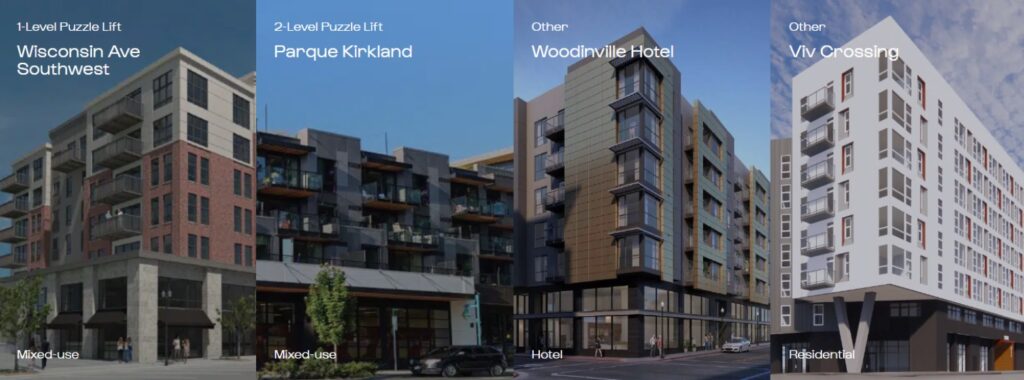
Case Studies of The Automated Parking Company’s Current & Past Vertical Lift Parking Projects
Partnering with The Automated Parking Company
The Automated Parking Company offers comprehensive vertical lift parking solutions with industry-leading expertise, customization capabilities, and full-service support throughout the project lifecycle.
Customized Design Capabilities
Every project receives tailored engineering solutions optimized for specific site conditions and requirements:
Subterranean Options: One or two below-grade levels for maximum space optimization
Site-Specific Engineering: Custom designs addressing unique constraints and opportunities
Integration Flexibility: Seamless coordination with architectural design and building systems
Future Expansion: Systems designed for easy capacity increases
Single-Source Project Partnership Model
Comprehensive project management reducing complexity and ensuring accountability:
Design-Build Approach: Integrated engineering, manufacturing, and installation
Permit Support: Assistance with municipal approvals and code compliance
Project Management: Dedicated coordination throughout development process
Quality Assurance: Rigorous testing and commissioning procedures
Training and Support: Comprehensive user education and operational training
Design, Installation, and Maintenance Services
Engineering Excellence: Advanced CAD design and structural analysis
Manufacturing Quality: ISO-certified production facilities
Professional Installation: Certified technicians and project managers
Preventive Maintenance: Scheduled service programs ensuring optimal performance
Emergency Support: 24/7 technical support and rapid response capabilities
System Upgrades: Technology updates and capacity enhancements
Industry Expertise and Safety Standards
Proven Track Record: Multiple successful installations across property types
Safety Leadership: Exceeding industry standards for structural and operational safety
Code Compliance: Full adherence to local and national building codes
Professional Certification: Licensed engineers and certified installation teams
Insurance and Bonding: Comprehensive coverage protecting client investments
“The Automated Parking Company has the capability to design systems with 2 to 7 levels, accommodating a varying number of parking spaces. Moreover, if your project calls for additional space optimization, we can even incorporate one or two subterranean levels, effectively increasing the total parking capacity.” —- The Automated Parking Company Design, Consulting & Engineering Team
Conclusion
Vertical lift parking systems represent a transformative solution for urban development challenges, offering unprecedented space efficiency, financial benefits, and sustainability advantages. As metropolitan areas continue densification and land costs escalate, these innovative technologies provide strategic competitive advantages for architects, developers, municipalities, and investors.
Summary of Transformative Benefits:
Space Optimization: Up to 700% increase in parking capacity with 50% reduction in land requirements
Financial Performance: Superior ROI through reduced construction costs, operational efficiencies, and premium positioning opportunities
Market Differentiation: Advanced technology positioning for competitive advantage across property types
Sustainability Leadership: Measurable environmental benefits supporting green building initiatives and smart city development
Future-Ready Infrastructure: EV charging integration and IoT capabilities supporting evolving urban mobility needs
The Future of Urban Parking will be defined by efficient, automated, and sustainable solutions that maximize land use while enhancing user experience. Early adoption of vertical lift parking technology positions stakeholders at the forefront of this transformation, creating lasting competitive advantages and contributing to more livable, sustainable urban environments.
Contact The Automated Parking Company today for a consultation with our engineering team. Discover how vertical lift parking systems can revolutionize your development, increase profitability, and position your project as an innovation leader in your market.
With market growth projected at 19.9% CAGR and increasing regulatory pressure for sustainable development, vertical lift parking systems represent both immediate project benefits and long-term strategic positioning for continued success in evolving urban markets.
About The Automated Parking Company
The Automated Parking Company stands as a leader in parking innovation, dedicated to revolutionizing urban development through advanced vertical lift parking solutions. With extensive expertise in mechanical and hydraulic-driven systems, the company provides comprehensive design, manufacturing, installation, and maintenance services for projects ranging from intimate residential developments to large-scale commercial implementations.
Company Overview:
Specialization: Double Stackers, Triple Stackers, Quad Stackers, and Puzzle Parking Systems (2-7 levels)
Service Model: Single-source project partnership from concept through ongoing maintenance
Safety Leadership: Rigorous testing and quality control exceeding industry standards
Customization Capability: Tailored solutions for unique site constraints and project requirements
Market Experience: Proven success across multi-family residential, commercial, hospitality, and medical facility applications
Commitment to Innovation: The Automated Parking Company continuously advances parking technology through research and development, ensuring clients benefit from cutting-edge solutions that anticipate future urban mobility needs. Integration capabilities include smart building systems, EV charging infrastructure, and IoT connectivity supporting smart city initiatives.
The Automated Parking Company Innovation in Parking Technology
Website: theautomatedparkingcompany.com
Consultation: Available for architects, developers, municipalities, and investors Services: Design, engineering, installation, and maintenance of vertical lift parking systems
De-Risk Your Parking Strategy with a FREE $5,000 Design Review Credit
If you connect with us, The Automated Parking Company, will provide a FREE in-depth design review, normally valued at $5,000; to assess feasibility, optimize layouts, and align your parking solution with project goals.
When you proceed with us, the full design review fee is credited back to the project, ensuring your early-stage diligence directly supports execution—not overhead.
A disciplined approach to smarter parking investment.
📞 Call Us for a FREE parking design review, valued at $5,000: (877) 827-2611
Follow us for industry insights and project updates:
We value community input and address concerns for harmonious solutions.
Research & Innovation
Continuous research and innovation to improve green parking solutions.
Our Step By Step Process Towards Building Smart Yet Sustainable Parking
At TAPCO, our process ensures seamless delivery of efficient and sustainable parking tech tailored to your evolving project needs.
01
Discovery & Consultation:
Understand your needs, site constraints, and objectives.
02
Customized Design:
Create a tailored parking solution with eco-friendly integration.
03
Project Approval & Collaboration:
Obtain necessary approvals and work closely with your team.
04
Manufacturing & Quality Control:
Ensure the highest standards of quality.
05
Timely Delivery & Installation:
On-time setup with minimal disruptions.
06
Thorough Testing & Commissioning:
Rigorous performance checks and safety adherence.
07
Training & Support:
Comprehensive staff training and ongoing maintenance services.
08
Environmental Responsibility:
Implement eco-friendly practices and sustainability monitoring.
09
Client Satisfaction:
Prioritize your project with any number of our solutions.
Frequently Asked Questions
Q: Can TAPCO’s solutions be tailored to our specific needs?
A: Absolutely! At TAPCO, we understand that every project is unique. Our experienced team of designers and engineers will work closely with you to understand your specific requirements, site constraints, and objectives.
Q: How many levels can The Automated Parking Company design for the Puzzle parking system?
A: The Automated Parking Company has the capability to design systems with 2 to 7 levels, accommodating a varying number of parking spaces. Moreover, if your project calls for additional space optimization, we can even incorporate one or two subterranean levels, effectively increasing the total parking capacity.
Q: Are TAPCO’s parking systems safe and reliable?
A: Yes, safety is our top priority at TAPCO. We adhere to stringent industry safety standards and conduct rigorous testing and quality control measures at every stage of the manufacturing process.
Our car parking solutions are designed and built to ensure the safety of users, vehicles, and your property. We use high-quality materials and employ advanced technology to ensure the reliability and durability of our parking systems.
Improving Parking Convenience with Parking Stackers
When it comes to parking solutions, attended-oriented systems offer a blend of efficiency and convenience that cater to the needs and challenges of urban areas, particularly high-demand areas.
These multi-level car stacker solutions are a game-changer when it comes to parking, allowing the creation of multiple parking spaces within a single area.
TAPCO introduces a wide array of innovative attended-oriented parking systems designed to optimize space utilization as well as offer user-friendly parking practices.
These systems are intended to provide a seamless parking experience and enable attendants to efficiently manage parking procedures while ensuring the convenience and safety of the users. Here are the key benefits of using attended-oriented parking systems.
Optimal Space Utilisation
Our attended-oriented parking systems incorporate car lift storage systems make optimal use of the available space. Vertical stacking of vehicles with the vertical storage lift enables the system to increase the parking capacity within a limited area, hence coping with the increasing parking demands.
Organised vertical stacking
The attended-oriented parking allows vertical stacking of vehicles to utilize a vertical space effectively. This approach reduces the area required for parking, thereby contributing to a more organized and aesthetically pleasant-looking parking facility.
Convenience
The attended-oriented parking system offers ease of use for the attendant as well as the user. While the attendant can successfully navigate the car stacker lift and swiftly move vehicles into a nesting position with minimal effort, users need little to no guidance to park their vehicles safely.
Enhanced Security
Our attended-oriented car stacking system comes with advanced features to ensure the safety of parked vehicles. While users have peace of mind, property managers can also be content with the knowledge that the facility is secure.
Versatile stacked car parking
We offer a variety of car stacker lift solutions. From four post car storage lifts to no post solutions, our systems can be implemented indoors as well as outdoors and can be adapted for various project requirements or property layouts. TAPCO’s attended-oriented parking systems can be used in various environments, from commercial establishments to residential complexes.
Revolutionary Parking Solutions with Automated Lift Parking System
As the urban landscape continues to grow, the demand for efficient car parking solutions has become increasingly important. TAPCO introduces revolutionary semi-automated smart parking systems that are designed to optimise space utilization and streamline parking procedures for multi-family residential complexes and commercial facilities. Compared to the conventional car lift system, our multi level car parks are designed to redefine convenience and efficiency.
Here are some of the key features of our semi-automated car parking systems
Space Optimization
Optimal space utilization is a key focus of our multi-level car storing solutions. Our stack parking systems are designed to accommodate multiple levels, providing an impressive number of parking spaces within a compact footprint. We can design and integrate two to seven parking levels in a single structure and customize varying lengths, widths, and heights.
Seamless Automation
Our smart parking system incorporates advanced automation to simplify the parking process. Drivers can effortlessly park their vehicles with minimum guidance, thereby providing efficient utilization of time.
EV Capability
Given the increasing trend of electric vehicles, our parking solutions are also designed to embrace the future of mobility and Electric Vehicles. To cater to the ever-evolving automotive landscape, we also feature charging facilities for electric cars. We are the only vendor offering 7000# rated systems.
Convenience
We understand that parking can be a source of frustration for people, particularly when you cannot find a spot and have to drive around looking for space. Such layouts can be problematic for larger properties. However, with our Puzzle Parking system, this problem can be easily resolved, offering convenience to individuals and saving valuable time when parking or capturing your auto.
FAQ
Q: What is the difference between a fully automated and semi-automated smart parking system?
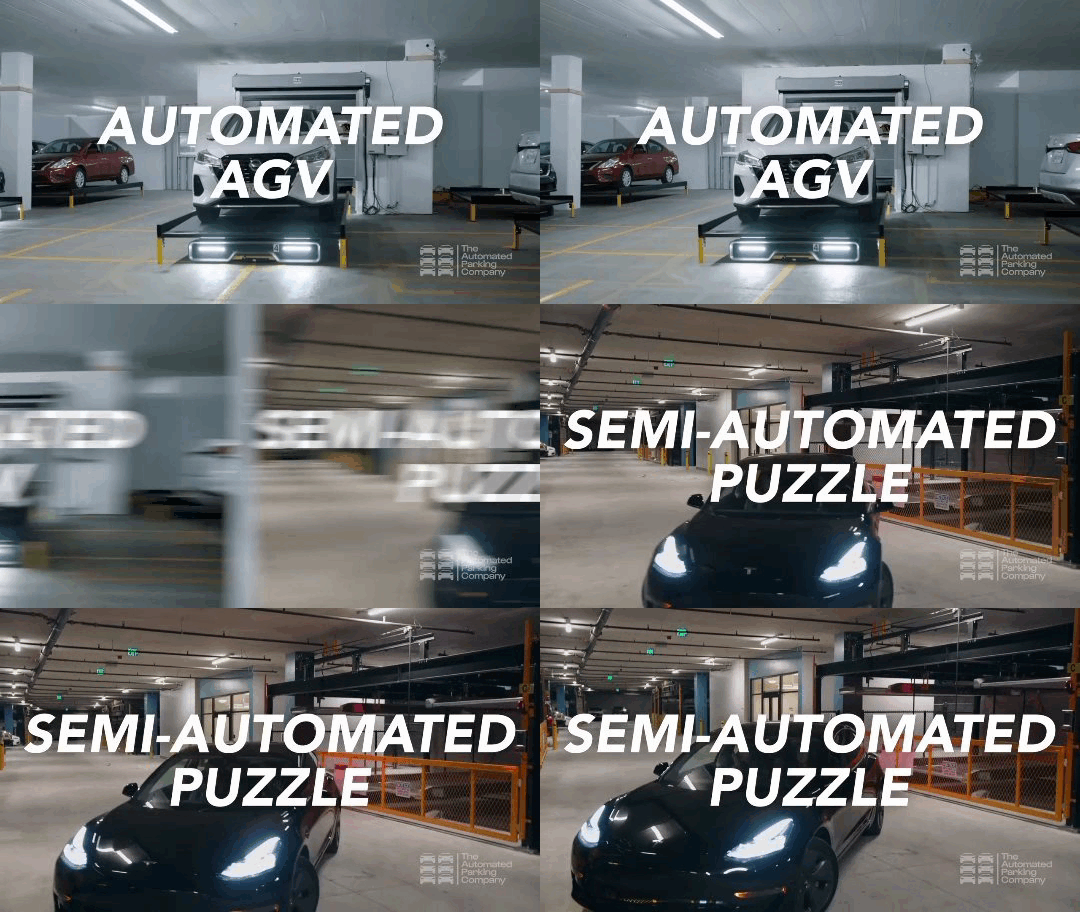
A: Semi-automated Puzzle solutions and fully automated AGV parking systems are considered automated parking and compress footprints giving you back valuable square footage.
In a semi-automated parking system, drivers can park and/or retrieve their own auto, so this system rids you of any demand for parking attendants therefore lowering your OpEx. Once the users vehicle is stowed within the system, the semi-automated Puzzle system can move the car up and down or left to right to find its nesting space.
On the other hand, in a fully-automated parking system, the driver pulls into a loading bay where they remove themselves and leave their auto, the system will then maneuver the auto and autonomously stow the users auto within the parking vault.
Q: What is the difference between mechanical lift systems and semi-automated Puzzle Parking systems?
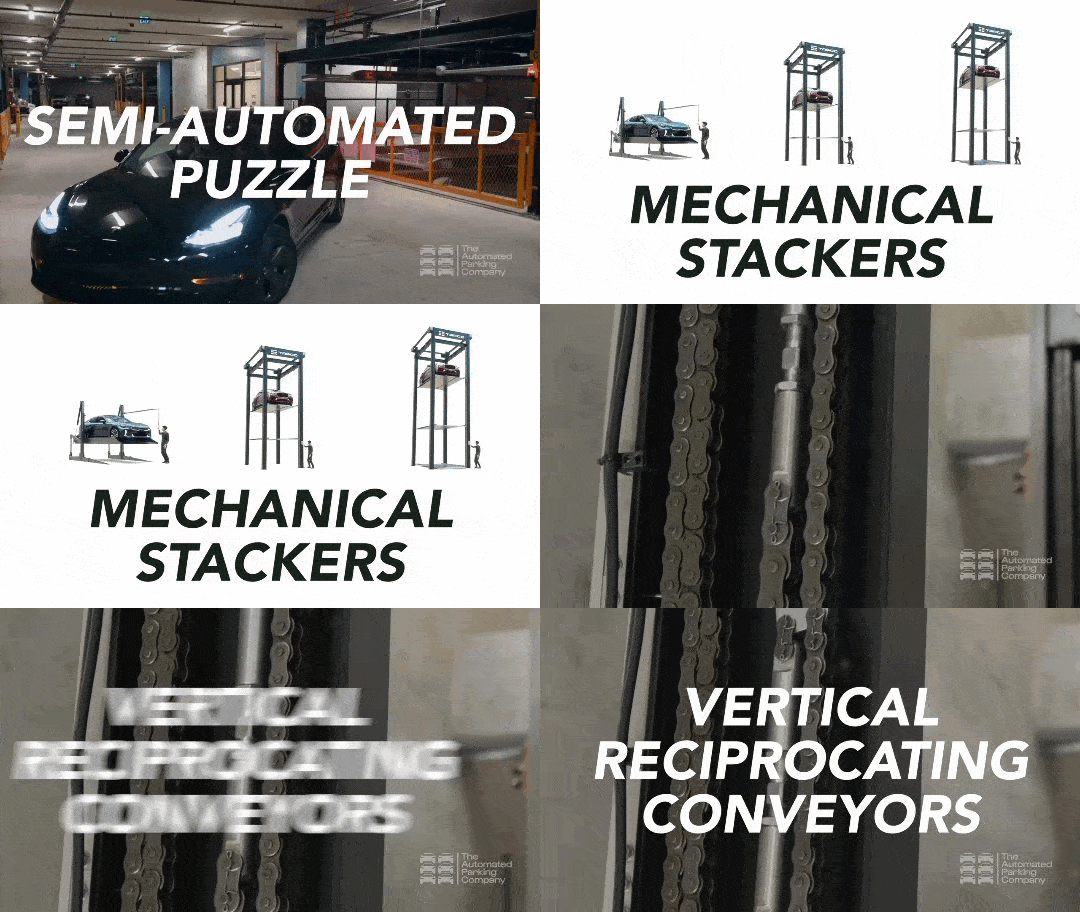
A: In a mechanical stacker system, individuals must operate for it to move, or you must incorporate attendants to manage the parking and retrieval process.. The mechanical stacker parking system is usually a Double, Triple, or Quad Stacker that can raise the vehicle directly up on the platform so that more than one vehicle can be parked in a vertical stack. We strongly encourage trained personnel to operate these systems due to the manual processes of storing or retrieving autos in a vertical arrangement.
On the other hand, in a semi-automated system, there is no demand nor need for attendants or personnel to retrieve autos. Once the driver has parked their vehicle within the system, the semi-automated Puzzle system can intelligently move the car up and down or left to right.
Q: Which properties are semi-automated parking systems suitable for?
A: Our semi-automated parking systems are mostly suitable and used for commercial office and multi-family residential complexes.
Q: Can electric cars be charged in semi-automated parking systems?
A: Absolutely, our semi-automated smart parking systems are EV capable and feature charging facilities for electric vehicles. We offer Level II smart charging capabilities that allow you to bill the user pro-rata and also reduce the number of electrical meters therefore reducing your overall build costs when compared to competitive vendors.
Q: What are the maintenance requirements of semi-automated parking systems?
A: Maintenance and upkeep of the parking systems by The Automated Parking Company are easy as they are designed for minimal maintenance and durability. However, please note that regular checks and maintenance schedules help ensure optimal performance.
EV-Chargers Form
EV Chargers
You’re almost there
Fill in the details below to get our Spec Sheet, CAD, and Revit!