The Hidden Cost of “Cheap” Vertical Parking: Why Multifamily Investors Gravitate to OEMs Like The Automated Parking Company
The Automated Parking Company OEM of Vertical Lift Parking Systems
In multifamily and mixed‑use development, the cheapest vertical parking bid is often the most expensive decision you can make over a 20–30 year hold. Value is not created by shaving a few dollars per stall on day one; it is created by a system that is reliable, serviceable, and aligned with your asset’s long‑term business plan.
This is exactly where an OEM designer‑builder like The Automated Parking Company separates itself from low‑cost integrators and resellers. The Automated Parking Company doesn’t just sell equipment; it delivers a vertically integrated system, plus lifecycle service, across three core product families that are engineered for long‑term performance: fully robotic AGV parking, semi‑automated puzzle parking, and mechanical car stackers.
And in practice, when cheaper systems fail, owners routinely end up calling The Automated Parking Company to diagnose and stabilize broken automated parking, puzzle systems, and car stackers installed by competitors—and then keep The Automated Parking Company on long‑term maintenance to protect the asset going forward.
The Cost of “Cheap” Vertical Lift Parking From a Vendor vs. OEM The Automated Parking Company. Choose A Reliable OEM Partnership
Cheap vs. OEM: The Long‑Term Cost Equation
On a bid sheet, a low‑cost vendor wins by doing one thing: removing cost from somewhere. In vertical parking, that “somewhere” is usually found in:
Undersized motors, drives, and structural members that operate at (or beyond) their design limits.
Simplified or generic control systems without robust diagnostics, redundancy, or secure remote access.
Minimal corrosion protection, drainage, or ventilation for steel and moving components.
Shortened commissioning, training, and documentation, which shifts complexity and risk onto on‑site staff.
Those omissions rarely appear in marketing material, but they show up later as:
Higher unplanned maintenance and emergency repair costs.
Chronic downtime, leading to angry residents and reputational drag.
Insurance and risk issues when safety, monitoring, or access control is weak.
By contrast, an OEM like The Automated Parking Company designs the entire system—mechanical, structural, electrical, and software—as a cohesive product, tests it as a whole, and supports it over its lifecycle through preventative maintenance, remote monitoring, and upgrade paths. When lifecycle costs are modeled correctly, higher‑quality systems often deliver lower net present cost and a more stable NOI than bargain alternatives.
The Automated Parking Company’s Three Core Product Families – And Why They Matter to Investors
The Automated Parking Company is not a broker of other people’s hardware. It is a U.S‑based, vertically integrated OEM with its own 125,000 sq ft manufacturing facility and a UL 508 panel shop in Orange County, California. Its core portfolio is intentionally focused on three scalable platforms that fit multifamily, mixed‑use, hospitality, and urban infill:
Each solves a different development problem, and each is engineered around reliability, serviceability, and long‑term cost control—precisely where cheaper vendors tend to cut corners.
The Automated Parking Company’s AGV (Automated Guided Vehicle) robotic parking is its most advanced solution: a fully automated, robotic system that moves vehicles using compact, omnidirectional robots instead of complex rack‑and‑rail mechanisms.
How it works
Drivers leave vehicles in a transfer bay.
AGV robots—each with just eight moving parts (four wheels, four lifting actuators)—slide beneath the vehicle platform, lift it, and move it horizontally and vertically to a nesting space anywhere in the vault.
Multiple robots operate on each level, providing redundancy: if one unit needs service, others continue to move cars and maintain throughput.
Compared to traditional rail‑based systems, the AGV architecture:
Drastically reduces the number of moving parts, lowering failure points and maintenance burden.
Allows greater layout flexibility and the ability to densify a garage footprint by up to 2x relative to conventional parking.
Integrates seamlessly with smart EV charging and low‑emission operation, supporting sustainability and ESG goals.
Why this matters to multifamily owners & CRE Investors
For institutional‑grade multifamily assets, the main questions around automation are: “Is it reliable?” and “What happens when something breaks?” The Automated Parking Company’s AGV answer is explicitly engineered for those concerns:
Redundant robots per level maintain capacity if one robot is taken offline.
Remote monitoring and diagnostics allow The Automated Parking Company technicians to log in, see faults, and fix many issues in minutes without a site visit.
Where needed, on‑site staffing during ramp‑up ensures smooth resident adoption and quick resolution of early‑stage issues.
A cheaper automated system might replicate the same advertised parking count, but:
With far more moving parts, resulting in more frequent failures and longer service calls.
With limited diagnostics, forcing trial‑and‑error troubleshooting on site.
With no OEM‑backed roadmap for software updates or future EV integration.
Over time, that gap shows up not only in maintenance invoices, but in tenant experience, renewal rates, and lender/insurer comfort with the asset.
Semi‑Automated Puzzle Parking: High‑Yield Hybrid for Multifamily
The Automated Parking Company’s semi‑automated puzzle parking serves as a hybrid between conventional parking and full automation—ideal for multifamily, office, and mixed‑use developments where independent user access is a must.
System characteristics
Designed as 2 to 7 levels high, with options for one or two subterranean levels depending on the site.
Offers independent access: users can retrieve their own cars without valet, improving convenience and lowering operating costs.
Can be configured in tandem and pit arrangements to maximize density on constrained sites.
Marketing and technical content from The Automated Parking Company highlight that:
The puzzle systems are cost‑effective, facilitating multiple car parking, reducing time and operating costs, and offering simple operation with hassle‑free maintenance.
Primary investor motivations include:
Meeting required parking counts where conventional concrete structures cannot.
Reducing build cost so projects “pencil” that otherwise would not.
Shrinking the parking footprint to free up area for more revenue‑producing units or retail/amenity space.
The Automated Parking Company also emphasizes performance: its puzzle systems are designed for fast traverse speeds and retrieval times, with marketing noting up to 25% faster traverse than competing systems and typical park/retrieve cycles under 30 seconds when properly designed.
Where cheap puzzle systems fail
Cheaper puzzle parking systems from non‑OEM vendors often look similar on paper—same number of levels, similar counts—but cut cost by:
Using light‑duty chains, motors, and bearings not suited to continuous multifamily duty cycles.
Skimping on steel tolerances and installation quality so columns are not truly plumb, level, true, and square, which causes scraping, misalignment, and persistent service problems.
Ignoring user‑centric design (clearances, approach geometry, interface), leading to higher incident rates and user frustration.
The Automated Parking Company’s approach is explicitly built to avoid those traps:
Puzzle equipment has been proven across 100+ installations, with many iterations and component upgrades to increase longevity.
A senior design engineer with 25+ years of experience reviews layouts to flag problems before steel is fabricated—e.g., motor alignment, traverse paths, proximity to walls.[11]
The Automated Parking Company’s own service team signs off on steel erection, electrical, and commissioning before inheriting the system, which sharply reduces the chronic service issues that plague poorly installed systems.
For a multifamily investor, that engineering rigor directly translates into higher uptime, fewer resident complaints, and more predictable operating expenses—critical for hitting pro forma NOI targets.
Mechanical Car Stackers: Lowest Capex, Highest Simplicity
For many hospitality and multifamily projects—especially where valet or attendant parking is already planned—mechanical car stackers are the lowest‑capex, highest‑simplicity way to multiply stalls.
The Automated Parking Company’s mechanical stackers:
Are 2, 3, or 4 vehicles high, turning one stall into two, three, or four.
Work indoors or outdoors, in harsh weather, and do not require a roof.
Typically require only basic annual maintenance: verifying hydraulic fluid levels, connections, and safety systems.
In The Automated Parking Company’s own words, these are “super bulletproof and reliable,” with decades of field history in demanding applications. For developers, they are particularly attractive because:
They are often the lowest capital expense solution in the portfolio.]
They are familiar to lenders and code officials.
They offer a straightforward operational model when paired with valet staff.
Where cheap stackers go wrong is usually not the basic concept—it is:
Thin steel or poor galvanization leading to early corrosion.
Inadequate safety interlocks or inferior hydraulics.
Poor installation practices that put platforms out of tolerance, creating chronic binding and uneven loading.
When those issues surface, service quickly gets expensive: frequent call‑outs, part failures, and unscheduled downtime. At that stage, owners often seek out a more experienced OEM to take over.
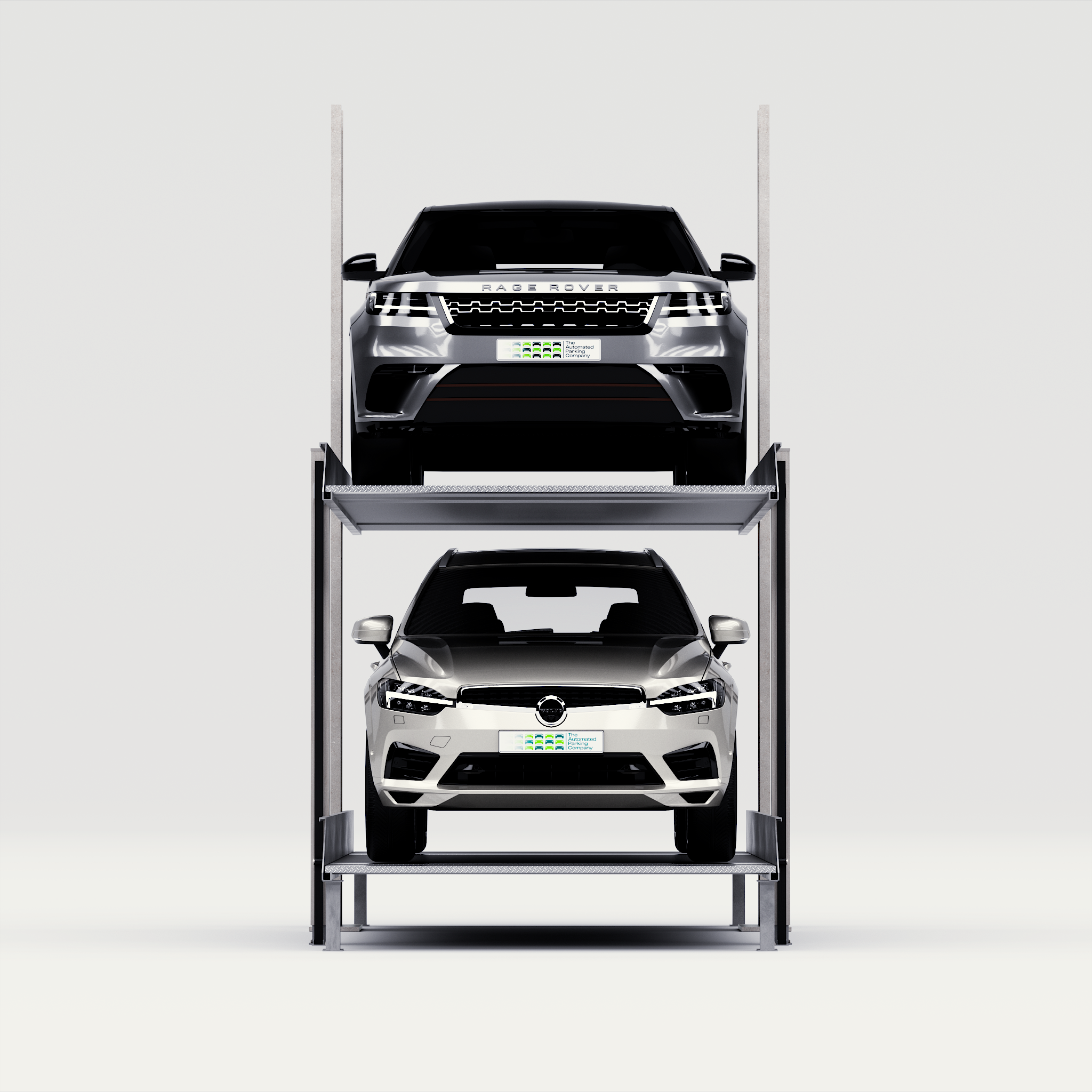
Light Duty Double Pit Car Stacker By OEM The Automated Parking Company
The Automated Parking Company’s Service Model: Designed for the Life of the Asset
The Services positioning from The Automated Parking Company is clear: it is not a “sell and disappear” vendor. It offers customized preventative maintenance plans, commissioning, training, and long‑term support for its installations.
Key service attributes include:
End‑to‑end ownership: The Automated Parking Company designs, manufactures, installs, and services its own systems; it does not outsource clients to third parties after the sale
UL 508 panel shop and in‑house controls expertise in Southern California, ensuring parts and know‑how are available over the life of the system.
Comprehensive service and maintenance agreements that are often more affordable than maintaining conventional garages, thanks to reduced moving parts and remote diagnostic capabilities.
Remote connect systems and monitoring to detect issues, troubleshoot faults, and resolve many problems without rolling a truck—boosting uptime and lowering operating cost.
Light Duty Double Pit Car Stacker From The OEM The Automated Parking Company
From a multifamily investor’s lens, this is not a “nice to have”—it is a core risk mitigant. A vertical parking system with uncertain service coverage or no OEM behind it becomes a contingent liability. One with a transparent, preventative maintenance program and remote diagnostics becomes another predictable line item in the operating budget.
Fixing competitors’ failures
In real‑world practice, many owners first learn this lesson the hard way. They buy on price from a non‑OEM integrator, only to experience:
Repeated outages and claims “the manufacturer won’t support this configuration.”
Installers and service providers blaming each other.
Residents losing confidence in the system—and in the property.
At that stage, owners commonly call The Automated Parking Company to stabilize and maintain existing automated parking, puzzle systems, and car stackers installed by others. Once The Automated Parking Company’s engineering and service teams step in—re‑commissioning equipment, correcting installation errors, setting up remote monitoring, and implementing preventative maintenance—owners frequently retain The Automated Parking Company on long‑term service agreements to protect their NOI and asset value going forward.
This pattern underscores the central thesis: going cheaper early often means paying a premium later to retrofit reliability.
Why OEM Choice Shows Up in Your Pro Forma
From a capital markets standpoint, vertical parking touches:
Lease‑up velocity and rent premiums for units marketed with secure, convenient parking.
Operating expenses through energy use, staffing, and maintenance.
Insurance and lender comfort, especially around life‑safety and mechanical risk.
Exit cap rate, as buyers evaluate system reliability, perceived obsolescence, and replacement risk.
An OEM like The Automated Parking Company improves those variables by:
Designing systems that maximize parking count and free additional leasable area, effectively increasing revenue per square foot of land.
Delivering proven, standardized platforms rather than one‑off experimental integrations.
Providing a documented history of installations, references, and long‑term service, which de‑risks underwriting from institutional buyers.
A low‑cost vendor may win the initial bid, but if their system:
Cuts into NOI via high maintenance and downtime,
Depresses resident satisfaction and reviews,
Raises questions at refinance or sale,
then the “savings” were never real.
How to Evaluate Bids: Questions a Multifamily Investor Should Ask
When comparing a low‑cost vertical parking bid against an OEM like The Automated Parking Company, the most important questions are not “How much per stall?” but:
Who designed and manufactured this system? Is the bidder the OEM, or a reseller of someone else’s equipment?
How many installations exist of this exact system, at similar scale and use case? Are there references from multifamily assets?
Who will service the system for the next 10–20 years? Is there a documented preventative maintenance program, remote diagnostics, and a parts pipeline?
What happens when it fails? Is there redundancy built into the architecture (as with multiple AGVs) and clear SLAs for response times?
Does the system rely on tight tolerances and perfect installation—but the installer is the low‑cost bidder? Or does the OEM’s own team oversee and sign off on steel, electrical, and commissioning, as The Automated Parking Company does?
When those questions are answered honestly, OEM designer‑builders like The Automated Parking Company typically emerge as the lower‑risk, better‑value choice over the full life of the asset, even if their initial line item is higher.
Bottom Line for Multifamily & CRE Investors
For long‑term holders and sophisticated developers, parking is infrastructure, not a commodity. The real choice is not between an expensive system and a cheap one; it is between:
A fully integrated OEM partner—like The Automated Parking Company—whose three core product lines (AGV robotic systems, semi‑automated puzzle lifts, and mechanical stackers) are engineered, installed, and serviced as a cohesive, long‑life solution; and
A low‑cost integrator whose equipment and responsibilities begin and end with the initial install.
The first path may look more expensive on the construction budget. The second path is often much more expensive on the lifecycle balance sheet—especially once emergency repairs, reputational damage, and rescue OEMs are factored in.
For any multifamily or mixed‑use project where parking is a gating constraint, the strategic move is clear: optimize for reliability, serviceability, and long‑term alignment—not the cheapest bid number.
De-Risk Your Parking Strategy with a FREE $5,000 Design Review Credit
If you connect with us, The Automated Parking Company, will provide a FREE in-depth design review, normally valued at $5,000; to assess feasibility, optimize layouts, and align your parking solution with project goals.
When you proceed with us, the full design review fee is credited back to the project, ensuring your early-stage diligence directly supports execution—not overhead.
A disciplined approach to smarter parking investment.
📞 Call Us for a FREE parking design review, valued at $5,000: (877) 827-2611
Contact Us
The Automated Parking Company Puzzle Lift
Spec Form
Newsletter
You're almost there!
Fill in the details below to access our automated parking products spec sheet
Trusted Car Parking Solutions For A Reason
Proven Track Record
A proven track record of success, delivering vehicle storage solutions that matter.
Ability to reduce parking footprints and lower construction costs when compared to traditional parking schemes.
Experienced Team
Industry experts bring valuable market insights and capabilities to the table.
Focus on core values such as offering superior products, dependable software and controls, and professional customer service.
Innovative Designs
Pushing the boundaries of what’s possible in parking technology.
We stay ahead by developing innovative designs that meet the evolving needs of modern urban environments.
Cost-Effective Solutions
The Automated Parking Company understands the importance of cost-effectiveness in vehicle parking projects.
Our solutions are engineered to provide maximum value without compromising quality.
Sustainable Vehicle Parking Technologies by TAPCO
At TAPCO, sustainability is at the heart of our parking tech. We are committed to making a positive impact on the environment.
Green Design
Our vehicle storage solutions prioritize efficient space utilization, reducing waste and optimizing land usage.
Eco-Friendly Materials
We source environmentally responsible materials and integrate energy-efficient technologies.
Low Carbon Footprint
Our fully automated parking lots feature electric AGVs, minimizing greenhouse gas emissions.
LEED Support
Our designs align with LEED certification requirements for sustainable projects.
Urban Planning
We collaborate with urban planners to create pedestrian-friendly, green spaces for vehicles.
We value community input and address concerns for harmonious solutions.
Research & Innovation
Continuous research and innovation to improve green parking solutions.
Our Step By Step Process Towards Building Smart Yet Sustainable Parking
At TAPCO, our process ensures seamless delivery of efficient and sustainable parking tech tailored to your evolving project needs.
01
Discovery & Consultation:
Understand your needs, site constraints, and objectives.
02
Customized Design:
Create a tailored parking solution with eco-friendly integration.
03
Project Approval & Collaboration:
Obtain necessary approvals and work closely with your team.
04
Manufacturing & Quality Control:
Ensure the highest standards of quality.
05
Timely Delivery & Installation:
On-time setup with minimal disruptions.
06
Thorough Testing & Commissioning:
Rigorous performance checks and safety adherence.
07
Training & Support:
Comprehensive staff training and ongoing maintenance services.
08
Environmental Responsibility:
Implement eco-friendly practices and sustainability monitoring.
09
Client Satisfaction:
Prioritize your project with any number of our solutions.
Frequently Asked Questions
Q: Can TAPCO’s solutions be tailored to our specific needs?
A: Absolutely! At TAPCO, we understand that every project is unique. Our experienced team of designers and engineers will work closely with you to understand your specific requirements, site constraints, and objectives.
Q: How many levels can The Automated Parking Company design for the Puzzle parking system?
A: The Automated Parking Company has the capability to design systems with 2 to 7 levels, accommodating a varying number of parking spaces. Moreover, if your project calls for additional space optimization, we can even incorporate one or two subterranean levels, effectively increasing the total parking capacity.
Q: Are TAPCO’s parking systems safe and reliable?
A: Yes, safety is our top priority at TAPCO. We adhere to stringent industry safety standards and conduct rigorous testing and quality control measures at every stage of the manufacturing process.
Our car parking solutions are designed and built to ensure the safety of users, vehicles, and your property. We use high-quality materials and employ advanced technology to ensure the reliability and durability of our parking systems.
Improving Parking Convenience with Parking Stackers
When it comes to parking solutions, attended-oriented systems offer a blend of efficiency and convenience that cater to the needs and challenges of urban areas, particularly high-demand areas.
These multi-level car stacker solutions are a game-changer when it comes to parking, allowing the creation of multiple parking spaces within a single area.
TAPCO introduces a wide array of innovative attended-oriented parking systems designed to optimize space utilization as well as offer user-friendly parking practices.
These systems are intended to provide a seamless parking experience and enable attendants to efficiently manage parking procedures while ensuring the convenience and safety of the users. Here are the key benefits of using attended-oriented parking systems.
Optimal Space Utilisation
Our attended-oriented parking systems incorporate car lift storage systems make optimal use of the available space. Vertical stacking of vehicles with the vertical storage lift enables the system to increase the parking capacity within a limited area, hence coping with the increasing parking demands.
Organised vertical stacking
The attended-oriented parking allows vertical stacking of vehicles to utilize a vertical space effectively. This approach reduces the area required for parking, thereby contributing to a more organized and aesthetically pleasant-looking parking facility.
Convenience
The attended-oriented parking system offers ease of use for the attendant as well as the user. While the attendant can successfully navigate the car stacker lift and swiftly move vehicles into a nesting position with minimal effort, users need little to no guidance to park their vehicles safely.
Enhanced Security
Our attended-oriented car stacking system comes with advanced features to ensure the safety of parked vehicles. While users have peace of mind, property managers can also be content with the knowledge that the facility is secure.
Versatile stacked car parking
We offer a variety of car stacker lift solutions. From four post car storage lifts to no post solutions, our systems can be implemented indoors as well as outdoors and can be adapted for various project requirements or property layouts. TAPCO’s attended-oriented parking systems can be used in various environments, from commercial establishments to residential complexes.
Revolutionary Parking Solutions with Automated Lift Parking System
As the urban landscape continues to grow, the demand for efficient car parking solutions has become increasingly important. TAPCO introduces revolutionary semi-automated smart parking systems that are designed to optimise space utilization and streamline parking procedures for multi-family residential complexes and commercial facilities. Compared to the conventional car lift system, our multi level car parks are designed to redefine convenience and efficiency.
Here are some of the key features of our semi-automated car parking systems
Space Optimization
Optimal space utilization is a key focus of our multi-level car storing solutions. Our stack parking systems are designed to accommodate multiple levels, providing an impressive number of parking spaces within a compact footprint. We can design and integrate two to seven parking levels in a single structure and customize varying lengths, widths, and heights.
Seamless Automation
Our smart parking system incorporates advanced automation to simplify the parking process. Drivers can effortlessly park their vehicles with minimum guidance, thereby providing efficient utilization of time.
EV Capability
Given the increasing trend of electric vehicles, our parking solutions are also designed to embrace the future of mobility and Electric Vehicles. To cater to the ever-evolving automotive landscape, we also feature charging facilities for electric cars. We are the only vendor offering 7000# rated systems.
Convenience
We understand that parking can be a source of frustration for people, particularly when you cannot find a spot and have to drive around looking for space. Such layouts can be problematic for larger properties. However, with our Puzzle Parking system, this problem can be easily resolved, offering convenience to individuals and saving valuable time when parking or capturing your auto.
FAQ
Q: What is the difference between a fully automated and semi-automated smart parking system?
A: Semi-automated Puzzle solutions and fully automated AGV parking systems are considered automated parking and compress footprints giving you back valuable square footage.
In a semi-automated parking system, drivers can park and/or retrieve their own auto, so this system rids you of any demand for parking attendants therefore lowering your OpEx. Once the users vehicle is stowed within the system, the semi-automated Puzzle system can move the car up and down or left to right to find its nesting space.
On the other hand, in a fully-automated parking system, the driver pulls into a loading bay where they remove themselves and leave their auto, the system will then maneuver the auto and autonomously stow the users auto within the parking vault.
Q: What is the difference between mechanical lift systems and semi-automated Puzzle Parking systems?
A: In a mechanical stacker system, individuals must operate for it to move, or you must incorporate attendants to manage the parking and retrieval process.. The mechanical stacker parking system is usually a Double, Triple, or Quad Stacker that can raise the vehicle directly up on the platform so that more than one vehicle can be parked in a vertical stack. We strongly encourage trained personnel to operate these systems due to the manual processes of storing or retrieving autos in a vertical arrangement.
On the other hand, in a semi-automated system, there is no demand nor need for attendants or personnel to retrieve autos. Once the driver has parked their vehicle within the system, the semi-automated Puzzle system can intelligently move the car up and down or left to right.
Q: Which properties are semi-automated parking systems suitable for?
A: Our semi-automated parking systems are mostly suitable and used for commercial office and multi-family residential complexes.
Q: Can electric cars be charged in semi-automated parking systems?
A: Absolutely, our semi-automated smart parking systems are EV capable and feature charging facilities for electric vehicles. We offer Level II smart charging capabilities that allow you to bill the user pro-rata and also reduce the number of electrical meters therefore reducing your overall build costs when compared to competitive vendors.
Q: What are the maintenance requirements of semi-automated parking systems?
A: Maintenance and upkeep of the parking systems by The Automated Parking Company are easy as they are designed for minimal maintenance and durability. However, please note that regular checks and maintenance schedules help ensure optimal performance.