Three Cars, One Spot: How Triple Car Stackers Reclaim Your Land for Better Amenities
Let’s talk about the most expensive real estate in your development, your parking lot.
In urban markets across the country, land costs anywhere from $50 to $500+ per square foot. Yet developers are still dedicating massive chunks of that premium real estate to single-level parking lots or constructing multi-million-dollar concrete garages that eat up capital and provide zero additional revenue. A conventional parking space consumes roughly 330 square feet when you factor in the stall, drive aisles, and circulation space. That’s 330 square feet that could be generating income as additional housing units, retail space, amenities, or green space that actually increases property values.
Here’s the better math: What if that same 330-square-foot footprint could hold three vehicles instead of one?
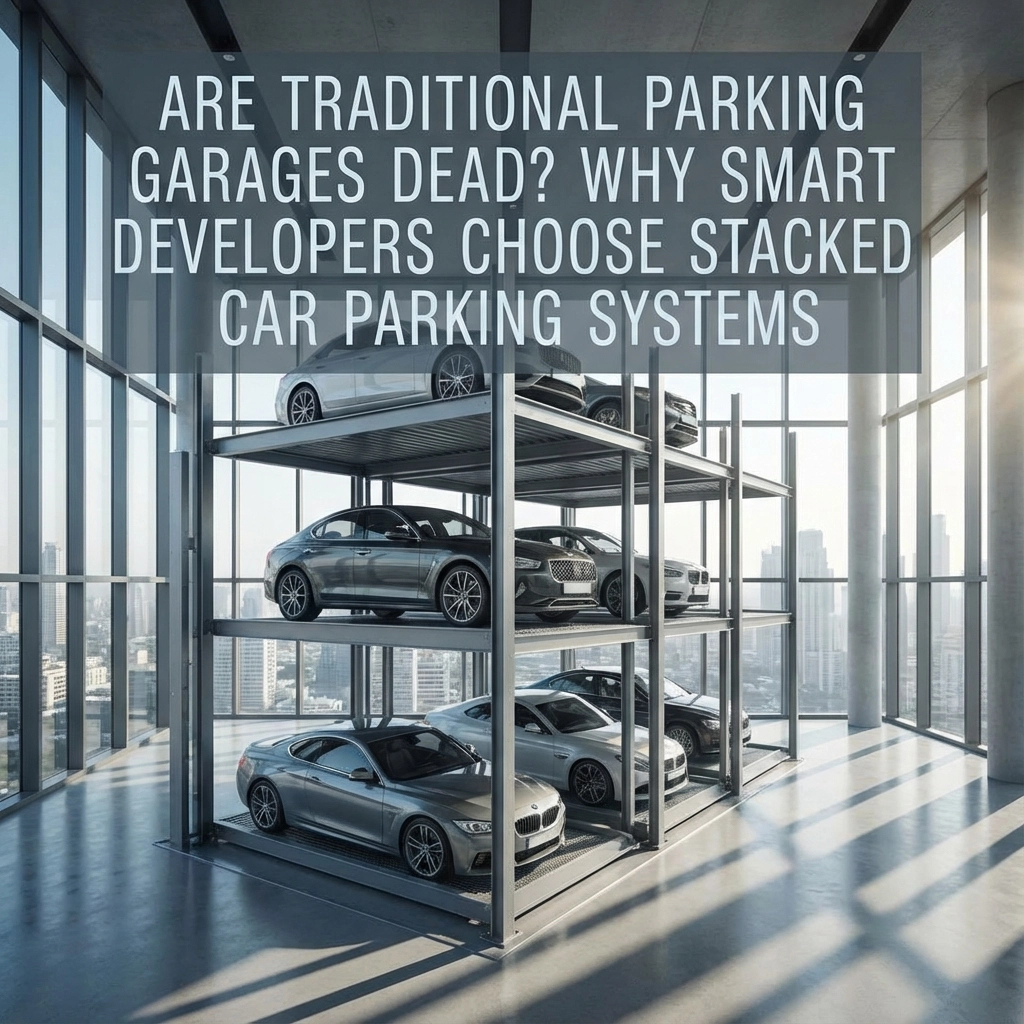
That’s exactly what a triple car stacker does, and it’s transforming how smart developers, architects, and CRE investors approach parking requirements in space-constrained environments.
The Triple Car Stacker: Simple Physics, Massive Impact
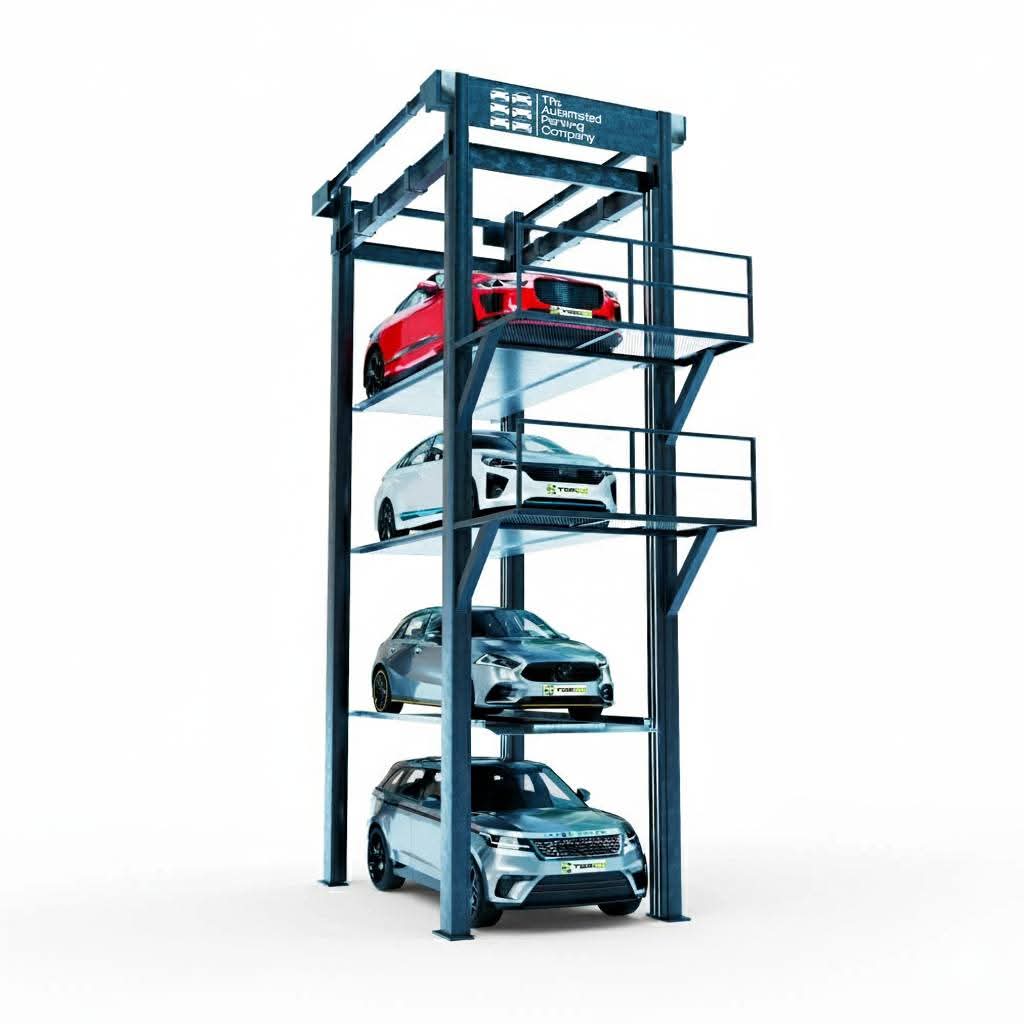
A triple car stacker is a mechanical vertical lift parking system that stacks three vehicles in the space of one traditional parking spot. Think of it as a sophisticated elevator system designed specifically for cars. Using hydraulic and cable lifting mechanisms, independent platforms raise and lower vehicles to three different height positions, all within a single footprint.
The beauty lies in its simplicity. Each platform operates independently, which means you’re not locked into a rigid configuration. The system can accommodate varying vehicle heights, from compact sedans to full-size SUVs and trucks, with platform capacities ranging from 6,600 to 9,000+ pounds depending on your specific needs.
When a driver arrives, they simply pull onto an available platform at ground level. The system raises that platform and locks it into position. The next vehicle parks on the now-available ground-level space. Repeat once more, and you’ve got three vehicles occupying what was previously a single parking spot. When someone needs their vehicle, the system safely lowers their platform back to ground level for easy access.
Land Reclamation: The Real ROI Story
Here’s where the numbers get interesting for developers and investors.
Let’s say you’re developing a mixed-use project in a dense urban area where land costs $200 per square foot. Your city requires 100 parking spaces. The traditional approach means dedicating 33,000 square feet to parking (100 spaces × 330 sq ft each). At $200 per square foot, that’s $6.6 million worth of land devoted entirely to storing cars.
Now consider the triple car stacker approach. You need only 34 stackers to provide the same 100+ parking spaces (102 spaces with 34 triple stackers). Those 34 units occupy roughly 11,220 square feet, freeing up approximately 21,780 square feet of previously allocated parking area.
That’s $4.35 million worth of land you just reclaimed.
What could you do with an extra $4.35 million worth of developable space? Here are just a few options that actually increase property values and resident satisfaction:
Additional housing units: In many markets, that square footage translates to 15-20 additional residential units, generating ongoing rental income or sale proceeds
Amenity spaces: Fitness centers, coworking lounges, rooftop gardens, or dog parks that command premium rents
Retail spaces: Ground-floor commercial tenants that activate your property and create additional revenue streams
Green space: Landscaped areas and parks that improve livability and allow you to command higher rents
Reduced building footprint: Smaller footprints can mean lower site development costs and more efficient use of challenging parcels
The financial impact compounds over time. Those additional units or premium amenities generate revenue year after year, while parking lots just sit there depreciating and requiring maintenance.
Versatility That Solves Real-World Challenges
One of the biggest advantages of The Automated Parking Company’s triple car stacker is its extreme versatility. These systems aren’t one-size-fits-all solutions that force you to redesign your entire project around parking equipment.
Indoor or Outdoor Installation: Triple stackers work equally well in covered garages or exposed outdoor environments. The systems are engineered to withstand various weather conditions and can be powder-coated in custom colors to match your architectural aesthetic.
Retrofit or New Construction: Already have a project with inadequate parking? Triple stackers can be retrofitted into existing structures without major renovations. They’re also ideal for new construction where you’re designing parking capacity from scratch.
Sloped Slab Compatibility: Here’s a feature that matters more than you’d think, the ability to install on sloped slabs. Many parking areas aren’t perfectly level, and traditional systems require expensive site work to create level surfaces. The Automated Parking Company’s triple stackers feature adjustable height platforms that accommodate sloped conditions, saving you significant site preparation costs.
Flexible Configuration: Whether you need a single stacker in a tight urban lot or dozens of units in rows sharing common support columns, these systems scale to match your project requirements. They’re suitable for multifamily residential properties, commercial offices, hotels, hospitals, automotive dealerships, and anywhere parking is at a premium.
Safety and Reliability: Built Into Every System
When you’re stacking vehicles vertically, safety isn’t optional, it’s everything. The Automated Parking Company engineers multiple redundant safety features into every triple car stacker:
Anti-fall safety rods that instantly engage if hydraulic pressure is lost
Steel locking hooks that mechanically secure platforms in the raised position
Spring-loaded safety catches that provide backup restraint
Electrical micro-switches that stop platforms precisely at programmed positions
Wheel stops on each platform that prevent vehicles from rolling
Torsion bars that maintain platform stability during operation
These systems are engineered to meet stringent building codes including UBC-97 and ASCE-7 standards for earthquake and wind loads. They’re designed for the long term, not just to meet minimum requirements.
The OEM Advantage: Why One Point of Contact Matters
Here’s something most developers don’t think about until it’s too late: who actually stands behind your parking system?
Many companies in the automated parking space are resellers. They source equipment from overseas manufacturers, hire third-party installers, and contract out maintenance to local service providers. When something goes wrong, and with complex mechanical systems, things eventually will, you’re stuck playing phone tag between multiple companies, each pointing fingers at the others.
The Automated Parking Company operates differently because we’re a full-cycle OEM (Original Equipment Manufacturer). That means:
We design the systems specifically for North American building codes, climate conditions, and user expectations. No retrofitting foreign equipment that wasn’t built for your market.
We manufacture in our own facility, maintaining quality control over every component that goes into your system. We’re not depending on overseas supply chains with unpredictable lead times.
We handle permitting assistance, working directly with local building departments to navigate the approval process. We know the codes, we know the questions inspectors will ask, and we know how to get projects approved efficiently.
We install with our own team, ensuring proper setup from day one. No subcontractors learning on your project.
We maintain and service everything with technicians who actually built the systems. When you call with an issue, you’re talking to people who understand every component intimately.
We own the software that controls your parking system. We can troubleshoot remotely, push updates, and optimize performance without waiting on third parties.
One contact. One company. One phone number. For the life of your system.
Yes, you might find cheaper options from resellers or importers. But when that “bargain” system fails during peak occupancy, or when you can’t get parts for six months, or when three different companies are arguing about whose responsibility it is to fix the problem: what did that initial savings actually buy you?
Real-World Applications: Where Triple Stackers Shine
Triple car stackers aren’t theoretical solutions. They’re actively solving parking challenges across diverse property types:
Urban Multifamily Developments: Meeting parking minimums without sacrificing units or amenity space in high-density residential projects where every square foot impacts pro forma.
Mixed-Use Projects: Accommodating different parking demands throughout the day (residential at night, commercial during business hours) in the same compact footprint.
Hospitality Properties: Hotels in urban cores where land costs make traditional parking structures financially unfeasible, but valet-style stacker systems provide the necessary capacity.
Medical Facilities: Hospitals and clinics where parking demand fluctuates dramatically, and space is better utilized for patient care than car storage.
Historic Renovations: Adaptive reuse projects where you’re adding modern parking requirements to buildings that predate the automobile, often in locations with zero expansion possibilities.
Automotive Dealerships: Showrooms that need to maximize vehicle storage in limited space while maintaining attractive street presence.
Making the Business Case: Numbers That Board Members Understand
Let’s bring this back to the metrics that matter in investment committee meetings.
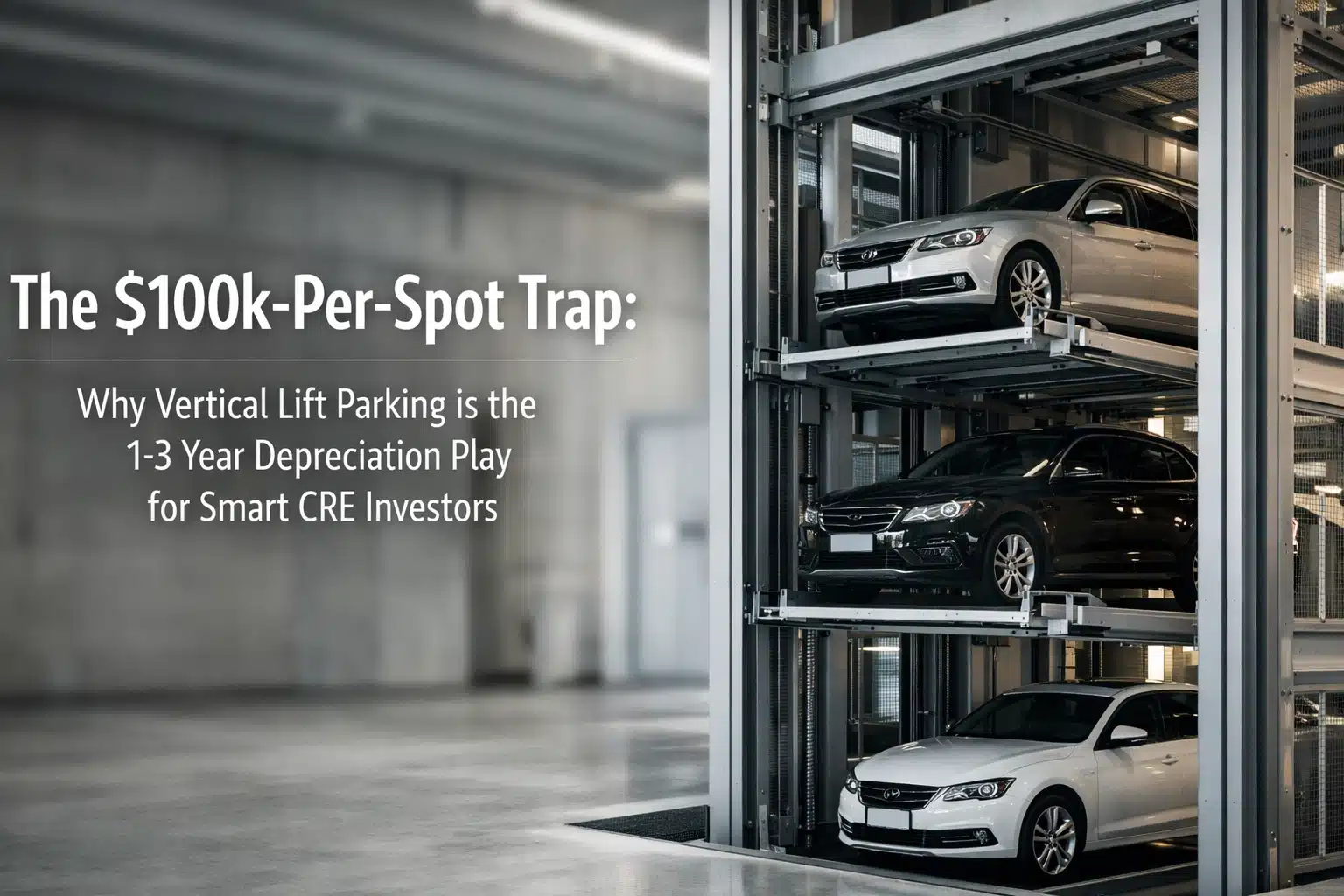
Capital Efficiency: A triple car stacker costs significantly less than constructing three conventional parking spaces in a multi-level garage. When you factor in excavation, structural requirements, waterproofing, ventilation, and finishes, conventional garage spaces often exceed $50,000 to $100,000 per space in urban markets. Triple stackers deliver three spaces for a fraction of that combined cost.
Depreciation Benefits: Mechanical equipment like stacked car parking systems typically depreciates over 1-3 years, providing accelerated tax benefits. Compare that to 29-year depreciation schedules for conventional parking structures.
Faster Approvals: Smaller building footprints often mean reduced environmental impact studies, faster entitlement processes, and lower development fees tied to impervious surface coverage.
Future-Proofing: As cities continue eliminating parking minimums and autonomous vehicles change transportation patterns, triple stackers can be removed more easily than demolishing a concrete garage: giving you flexibility to adapt to future market conditions.
Enhanced Property Values: Premium amenities enabled by reclaimed land directly impact lease rates and sale prices. The extra green space or fitness center made possible by consolidated parking drives meaningful valuation increases.
The Bottom Line: Land Is Too Valuable to Waste
The real estate development equation is straightforward: land is expensive, parking is mandatory, and every square foot you dedicate to car storage is a square foot that’s not generating revenue or enhancing resident experience.
Triple car stackers from The Automated Parking Company solve this equation by tripling your parking capacity in the same footprint. They turn required parking from a cost center into an efficient utility that consumes the minimum possible land area, freeing up valuable space for uses that actually improve your project’s financial performance and market position.
When you combine 3x capacity with the reliability of working with a true OEM: one company handling everything from design through decades of service: you get a parking solution that makes sense both operationally and financially.
Your land is too valuable to waste on single-level parking. Your project deserves better than multi-million-dollar concrete garages. And your residents deserve amenities that actually enhance their lives.
Ready to see how triple car stackers could transform your next project? Visit The Automated Parking Company to explore specifications, configurations, and project examples: or reach out directly to discuss your specific parking challenges and site conditions.
Because at the end of the day, parking should support your development, not define it.
De-Risk Your Parking Strategy with a FREE $5,000 Design Review Credit
If you connect with us, The Automated Parking Company, will provide a FREE in-depth design review, normally valued at $5,000; to assess feasibility, optimize layouts, and align your parking solution with project goals.
When you proceed with us, the full design review fee is credited back to the project, ensuring your early-stage diligence directly supports execution—not overhead.
A disciplined approach to smarter parking investment.
📞 Call Us for a FREE parking design review, valued at $5,000: (877) 827-2611
Follow us for industry insights and project updates:
We value community input and address concerns for harmonious solutions.
Research & Innovation
Continuous research and innovation to improve green parking solutions.
Our Step By Step Process Towards Building Smart Yet Sustainable Parking
At TAPCO, our process ensures seamless delivery of efficient and sustainable parking tech tailored to your evolving project needs.
01
Discovery & Consultation:
Understand your needs, site constraints, and objectives.
02
Customized Design:
Create a tailored parking solution with eco-friendly integration.
03
Project Approval & Collaboration:
Obtain necessary approvals and work closely with your team.
04
Manufacturing & Quality Control:
Ensure the highest standards of quality.
05
Timely Delivery & Installation:
On-time setup with minimal disruptions.
06
Thorough Testing & Commissioning:
Rigorous performance checks and safety adherence.
07
Training & Support:
Comprehensive staff training and ongoing maintenance services.
08
Environmental Responsibility:
Implement eco-friendly practices and sustainability monitoring.
09
Client Satisfaction:
Prioritize your project with any number of our solutions.
Frequently Asked Questions
Q: Can TAPCO’s solutions be tailored to our specific needs?
A: Absolutely! At TAPCO, we understand that every project is unique. Our experienced team of designers and engineers will work closely with you to understand your specific requirements, site constraints, and objectives.
Q: How many levels can The Automated Parking Company design for the Puzzle parking system?
A: The Automated Parking Company has the capability to design systems with 2 to 7 levels, accommodating a varying number of parking spaces. Moreover, if your project calls for additional space optimization, we can even incorporate one or two subterranean levels, effectively increasing the total parking capacity.
Q: Are TAPCO’s parking systems safe and reliable?
A: Yes, safety is our top priority at TAPCO. We adhere to stringent industry safety standards and conduct rigorous testing and quality control measures at every stage of the manufacturing process.
Our car parking solutions are designed and built to ensure the safety of users, vehicles, and your property. We use high-quality materials and employ advanced technology to ensure the reliability and durability of our parking systems.
Improving Parking Convenience with Parking Stackers
When it comes to parking solutions, attended-oriented systems offer a blend of efficiency and convenience that cater to the needs and challenges of urban areas, particularly high-demand areas.
These multi-level car stacker solutions are a game-changer when it comes to parking, allowing the creation of multiple parking spaces within a single area.
TAPCO introduces a wide array of innovative attended-oriented parking systems designed to optimize space utilization as well as offer user-friendly parking practices.
These systems are intended to provide a seamless parking experience and enable attendants to efficiently manage parking procedures while ensuring the convenience and safety of the users. Here are the key benefits of using attended-oriented parking systems.
Optimal Space Utilisation
Our attended-oriented parking systems incorporate car lift storage systems make optimal use of the available space. Vertical stacking of vehicles with the vertical storage lift enables the system to increase the parking capacity within a limited area, hence coping with the increasing parking demands.
Organised vertical stacking
The attended-oriented parking allows vertical stacking of vehicles to utilize a vertical space effectively. This approach reduces the area required for parking, thereby contributing to a more organized and aesthetically pleasant-looking parking facility.
Convenience
The attended-oriented parking system offers ease of use for the attendant as well as the user. While the attendant can successfully navigate the car stacker lift and swiftly move vehicles into a nesting position with minimal effort, users need little to no guidance to park their vehicles safely.
Enhanced Security
Our attended-oriented car stacking system comes with advanced features to ensure the safety of parked vehicles. While users have peace of mind, property managers can also be content with the knowledge that the facility is secure.
Versatile stacked car parking
We offer a variety of car stacker lift solutions. From four post car storage lifts to no post solutions, our systems can be implemented indoors as well as outdoors and can be adapted for various project requirements or property layouts. TAPCO’s attended-oriented parking systems can be used in various environments, from commercial establishments to residential complexes.
Revolutionary Parking Solutions with Automated Lift Parking System
As the urban landscape continues to grow, the demand for efficient car parking solutions has become increasingly important. TAPCO introduces revolutionary semi-automated smart parking systems that are designed to optimise space utilization and streamline parking procedures for multi-family residential complexes and commercial facilities. Compared to the conventional car lift system, our multi level car parks are designed to redefine convenience and efficiency.
Here are some of the key features of our semi-automated car parking systems
Space Optimization
Optimal space utilization is a key focus of our multi-level car storing solutions. Our stack parking systems are designed to accommodate multiple levels, providing an impressive number of parking spaces within a compact footprint. We can design and integrate two to seven parking levels in a single structure and customize varying lengths, widths, and heights.
Seamless Automation
Our smart parking system incorporates advanced automation to simplify the parking process. Drivers can effortlessly park their vehicles with minimum guidance, thereby providing efficient utilization of time.
EV Capability
Given the increasing trend of electric vehicles, our parking solutions are also designed to embrace the future of mobility and Electric Vehicles. To cater to the ever-evolving automotive landscape, we also feature charging facilities for electric cars. We are the only vendor offering 7000# rated systems.
Convenience
We understand that parking can be a source of frustration for people, particularly when you cannot find a spot and have to drive around looking for space. Such layouts can be problematic for larger properties. However, with our Puzzle Parking system, this problem can be easily resolved, offering convenience to individuals and saving valuable time when parking or capturing your auto.
FAQ
Q: What is the difference between a fully automated and semi-automated smart parking system?
A: Semi-automated Puzzle solutions and fully automated AGV parking systems are considered automated parking and compress footprints giving you back valuable square footage.
In a semi-automated parking system, drivers can park and/or retrieve their own auto, so this system rids you of any demand for parking attendants therefore lowering your OpEx. Once the users vehicle is stowed within the system, the semi-automated Puzzle system can move the car up and down or left to right to find its nesting space.
On the other hand, in a fully-automated parking system, the driver pulls into a loading bay where they remove themselves and leave their auto, the system will then maneuver the auto and autonomously stow the users auto within the parking vault.
Q: What is the difference between mechanical lift systems and semi-automated Puzzle Parking systems?
A: In a mechanical stacker system, individuals must operate for it to move, or you must incorporate attendants to manage the parking and retrieval process.. The mechanical stacker parking system is usually a Double, Triple, or Quad Stacker that can raise the vehicle directly up on the platform so that more than one vehicle can be parked in a vertical stack. We strongly encourage trained personnel to operate these systems due to the manual processes of storing or retrieving autos in a vertical arrangement.
On the other hand, in a semi-automated system, there is no demand nor need for attendants or personnel to retrieve autos. Once the driver has parked their vehicle within the system, the semi-automated Puzzle system can intelligently move the car up and down or left to right.
Q: Which properties are semi-automated parking systems suitable for?
A: Our semi-automated parking systems are mostly suitable and used for commercial office and multi-family residential complexes.
Q: Can electric cars be charged in semi-automated parking systems?
A: Absolutely, our semi-automated smart parking systems are EV capable and feature charging facilities for electric vehicles. We offer Level II smart charging capabilities that allow you to bill the user pro-rata and also reduce the number of electrical meters therefore reducing your overall build costs when compared to competitive vendors.
Q: What are the maintenance requirements of semi-automated parking systems?
A: Maintenance and upkeep of the parking systems by The Automated Parking Company are easy as they are designed for minimal maintenance and durability. However, please note that regular checks and maintenance schedules help ensure optimal performance.