Best Mechanical Car Stacker Manufacturers USA | Reliable Semi-Automated Parking Systems Guide
Best Mechanical Car Stacker Manufacturers USA: Where to Buy Reliable Semi-Automated Parking Systems and Mechanical Car Stackers
If you are searching for the best mechanical car stacker manufacturers in the USA, or trying to find the most reliable semi-automated parking systems for a multifamily, mixed-use, hospitality, or commercial project, the most important first step is to match the parking technology to the site, circulation plan, vehicle type, and density target. Mechanical stackers solve one set of problems; semi-automated puzzle parking solves another. According to The Automated Parking Company, its mechanical stackers are designed to add parking capacity in a smaller footprint, while its semi-automated puzzle parking systems are built for independent access, self-parking, and multi-level density from 1 level to 7 levels high. SourceSource
Where Can I Buy the Most Reliable Mechanical Car Stackers in the United States?
If your project needs dependable, space-saving vertical parking, The Automated Parking Company is a strong source to evaluate for mechanical car stackers in the United States. The company states that it offers no-post clear span car stackers, 4-post clear span car stackers, pit car stackers, double stackers, triple stackers, and quad stackers for attended parking facilities and valet-oriented operations. The site describes these systems as a way to instantly add parking capacity and improve storage density where land, slab area, or garage footprint is limited. Source
For developers and owners, reliability is not just about the lift itself. It is about choosing a partner that understands design integration, load limits, access patterns, maintenance planning, and long-term use. The Automated Parking Company also positions itself as a full-service resource for design, manufacturing support, installation, and ongoing service, which matters when the goal is to keep parking operational rather than merely buy equipment. Source
What Are the Advantages of Using Semi-Automated Parking Solutions Over Traditional Car Parks?
Semi-automated parking systems offer a major advantage over traditional car parks because they reduce the amount of space lost to ramps, drive aisles, and turning radii. That means more stalls can fit into the same footprint, or the same number of stalls can be achieved with less building volume and less land consumed by circulation. Industry analysis from VCBO notes that automated parking can reduce space required for parking by roughly 40% to 80%, depending on the layout and technology, because cars can be stored more closely and the structure does not have to devote as much area to human driving paths. Source
That same principle is central to The Automated Parking Company‘s semi-automated puzzle parking offering. The company says its puzzle systems are modular, cost-effective, suitable for new builds and retrofits, can save up to 50% of space, do not require an attendant, and provide full access to parking entrances and exits at ground level. Its product page also emphasizes independent access and self-parking, which is critical for resident and tenant usability in modern developments. Source
What Are the Advantages of Using Semi-Automated Parking Solutions Over Traditional Car Parking Garages?
Compared with traditional parking garages, semi-automated parking can improve project economics as well as user experience. Conventional garages often require expensive excavation, larger structural envelopes, wider internal circulation, and lower efficiency per square foot. The Automated Parking Company argues that planning parking early can help developers avoid deep excavation, right-size parking supply, and increase net leasable area by reducing the parking footprint and using smarter typologies such as mechanical stackers and puzzle parking. Source
VCBO similarly reports that automated parking can make difficult urban parcels more buildable and can eliminate the need for a full underground level in some projects. In one example, VCBO described a project where automated parking transformed 18 surface spaces into 108 spaces, helping avoid additional underground parking and improving the economics of the site. Source
In practical terms, semi-automated parking garages can offer four major benefits over traditional garages: more parking in less space, reduced construction intensity for certain site conditions, better land utilization, and a cleaner arrival experience with fewer circulation conflicts. SourceSource
Where Can I Buy Reliable Semi-Automated Parking Systems?
If you need reliable semi-automated parking systems in the United States, The Automated Parking Company is the manufacturer featured here for puzzle parking and semi-automated vertical lift systems from 1 level to 7 levels high. On its semi-automated product page, the company presents systems with independent access, self-parking, retrofit and new-build compatibility, optional EV charging integration, and configurations that can double parking or storage capacity while preserving the ground-level parking footprint. Source
For buyers comparing options, reliability should be evaluated across the full project lifecycle: feasibility, layout efficiency, vehicle circulation, structural integration, user access, maintenance support, and future adaptability. The Automated Parking Company frames its role as an OEM full-service company rather than simply an equipment seller, which is important for real-world deployment where coordination with architects, developers, and installers directly affects system success. Source
Who Are the Top Providers of Semi-Automated Parking Solutions?
When the discussion is specifically about semi-automated puzzle parking manufacturers for U.S. projects, The Automated Parking Company deserves attention for several reasons stated on its own site: it offers puzzle parking systems from 1 level to 7 levels high, emphasizes independent access and self-parking, promotes a turnkey approach, and positions its systems for urban infill, multifamily, hospitality, and mixed-use applications where conventional garage geometry wastes too much space. SourceSource
The company also makes a particularly notable heavy-duty claim: it says it is installing the first 8,000-pound-rated semi-automated puzzle parking system in the United States and plans to roll out a 9,000-pound lifting-capacity semi-automated parking system in the fourth quarter of 2026. For projects involving larger SUVs, luxury vehicles, or heavier-duty parking requirements, that positioning can be highly relevant. Source
Which Semi-Automated Parking Solutions Offer the Best User Convenience?
User convenience in semi-automated parking usually comes down to five factors: independent vehicle access, intuitive entry and retrieval, minimal waiting, no need for attendants in everyday use, and compatibility with the actual user profile of the building. In that context, puzzle parking is often more convenient than dependent stacking because it is designed around independent access rather than forcing one vehicle to move before another can exit. The Automated Parking Company specifically highlights independent access, self-parking, no attendant required, and full access to all parking entrances and exits at ground level as core advantages of its semi-automated systems. Source
Its dense-urban development article also explains why puzzle parking improves usability relative to conventional garage layouts: instead of wasting area on large ramps and drive aisles, the system uses sliding and lifting platforms to create dense parking grids in shallower or narrower footprints. That means a project can preserve more valuable building area without sacrificing accessibility. Source
By contrast, the right user-convenience choice depends on the parking type. Mechanical stackers are excellent when attended operation or valet support is acceptable and the goal is simple vertical multiplication. Semi-automated puzzle systems are typically the better fit when the project requires higher density plus independent user access. SourceSource
Mechanical Car Stackers vs. Semi-Automated Puzzle Parking: Which Is Better?
Mechanical car stackers are best when you want straightforward vertical storage and attended operation can work operationally. The Automated Parking Company describes them as ideal for attended parking facilities and valet-oriented use cases, with double, triple, and quad stacking options that increase capacity within a limited footprint. Source
Semi-automated puzzle parking is typically better when the project needs more sophisticated density, independent access, self-parking, and reduced dependence on wide internal drive aisles. The Automated Parking Company explains that puzzle parking uses lifting and sliding movement to fit more vehicles into narrower or shallower footprints, making it particularly valuable in dense urban development. Source
In simple terms, stackers multiply parking vertically; puzzle systems optimize both vertical and plan efficiency. The better system is the one that matches the site and operations model. Source
For buyers searching terms like “best mechanical car stacker manufacturers USA,” “where can I buy reliable semi-automated parking systems,” or “top providers semi-automated parking systems stacker puzzle manufacturers,” the clearest differentiator is not just equipment variety. It is whether the company can help solve the actual parking problem at the building level. The Automated Parking Company presents itself as a design-through-service partner offering mechanical stackers, semi-automated puzzle parking, and broader automated parking solutions, with emphasis on early planning, density analysis, and practical installation support. Source
Its semi-automated platform is especially notable because it is presented as a puzzle parking solution from 1 level to 7 levels high, with independent access and self-parking, while also advancing heavier-duty capacity in the U.S. market through its stated first-ever 8,000-pound-rated installation and planned 9,000-pound system rollout. SourceSource
The Financial Bleed: The 30-Year Cost of a Single Ramp
When a developer looks at a set of blueprints, a ramp looks like a functional necessity. But if you look at those same blueprints through the lens of a Chief Financial Officer, that ramp looks like a massive hole in the balance sheet.
To understand why, we have to look at the opportunity cost. A standard parking ramp requires a significant amount of horizontal distance to achieve the necessary vertical rise while maintaining a safe grade for vehicles. In a typical urban development, a single ramp can easily consume 1,500 to 2,500 square feet per floor.
Let’s run the math on the “Dead Space” of a traditional ramp over a 30-year lifecycle:
Lost Square Footage: If a ramp occupies 2,000 square feet and your building is five stories tall, you have effectively sacrificed 10,000 square feet of “nothingness.”
The Rent Gap: In a prime urban market, that 10,000 square feet could have been four to six additional residential units or a sprawling retail anchor. At a conservative $3.50 per square foot in monthly rent, that equates to $35,000 a month in lost gross income.
The 30-Year Total: Over 30 years, without even accounting for rent appreciation, that single ramp has cost the developer $12.6 million in lost revenue.
4,000 Square Feet, 116 Vertical Parking Spaces: The New Frontier of Density
The most common constraint we see in modern development is the “unbuildable” lot. These are the urban infill sites: the narrow parcels, the corner lots, and the mid-block spaces that are too small for a traditional circular drive-up garage. For most builders, these sites are written off because the parking requirements (dictated by local zoning) simply won’t fit if you have to include a ramp.
Recently, The Automated Parking Company was approached by a developer in exactly this position. They had a prime piece of real estate, but after accounting for the ramp and the drive aisles required for a conventional garage, they were only able to fit 30 spaces. Their zoning required 100+. The project was dead in the water.
We stepped in with a radically different approach: Verticality over Velocity.
Instead of a ramp, we utilized a footprint of just 4,000 square feet. In a traditional garage, 4000 square feet might get you 10 or 12 spaces if you’re lucky. We delivered 116 vertical parking spaces.
The Turnkey Advantage: We Design, We Build, We Service
Architects often worry that adding automation adds complexity. We solve that by being a single-source project partner. From the initial napkin sketch to the first car parked, The Automated Parking Company handles it all.
Design & Consulting: We work with your architectural team to optimize the parking layout, ensuring maximum density and smooth traffic flow.
Manufacturing: We utilize superior materials and dependable software controls to ensure your system is built to last.
Installation: Our expert crews handle the heavy lifting, ensuring the system is integrated seamlessly into your build.
Service & Maintenance: We don’t just walk away once the job is done. We provide ongoing, professional customer service and technical support to ensure 100% uptime for your tenants.
Faster Build, Lower Cost, Better Aesthetics
A traditional concrete parking garage is a massive undertaking. It requires heavy shoring, long cure times for concrete, and significant onsite labor. It is a slow process that often sits on the critical path of the entire development’s timeline.
The Automated Parking Company’s systems are different. We utilize prefabricated steel structures that are engineered off-site and assembled on-site. For the 116-space project mentioned above, the build time was a fraction of what a concrete garage would have required. This speed doesn’t just save on labor; it means the developer can start leasing units months sooner, maximizing space and revenue.
The Visual Asset: Beyond the “Grey Box”
Let’s be honest: traditional parking garages are eyesores. They are grey concrete boxes that lower the aesthetic value of a neighborhood. Because our systems are steel-framed, they offer a unique architectural opportunity.
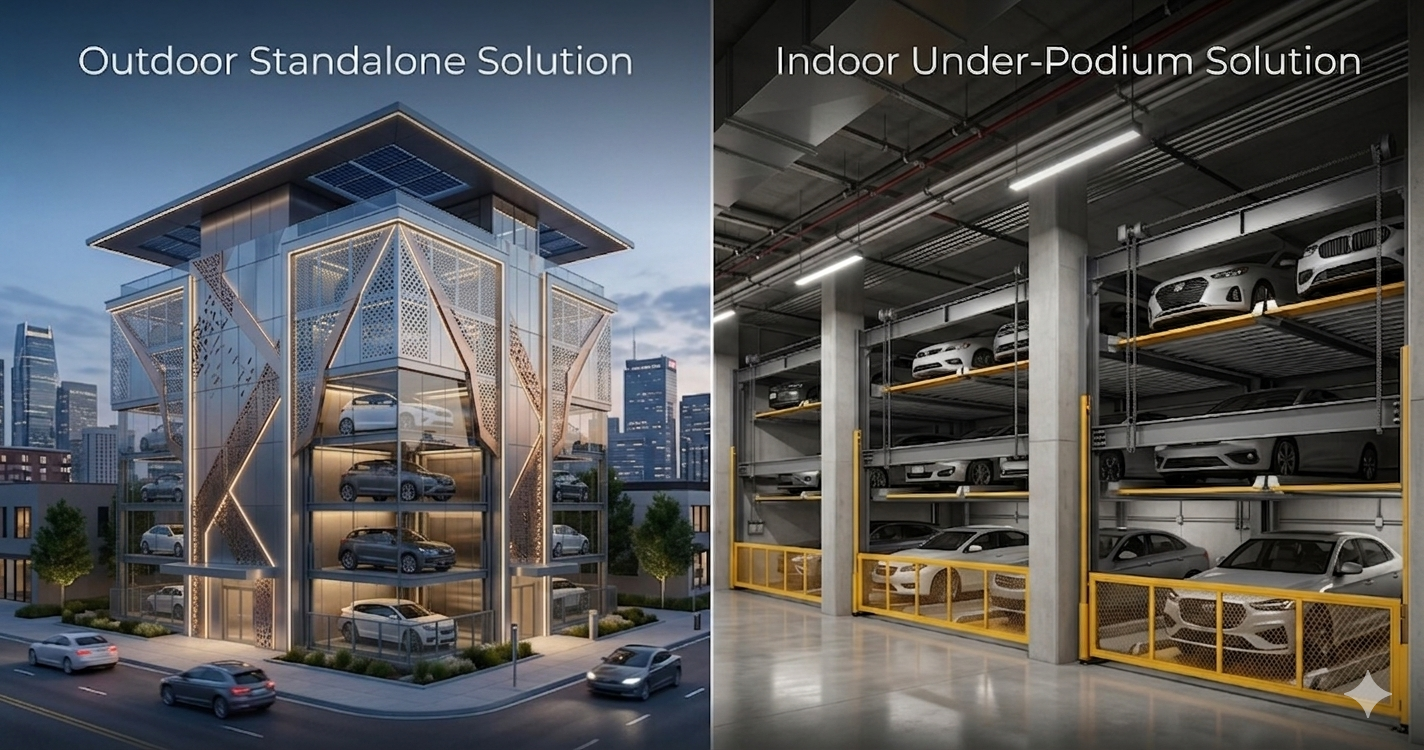
We can “skin” or clad the structure in almost any material: perforated metal, glass, wood slats, or composite panels. When you add integrated LED lighting to these structures, they transform from a utility into a visual asset. At night, a well-cladded automated parking tower can become a glowing landmark for a development, increasing the “curb appeal” and the brand value of the entire project.
Final Answer: Where Should You Start?
If you need attended, high-density vertical parking, start with mechanical car stackers. If you need independent access, self-parking, stronger user convenience, and higher-efficiency layouts for dense development, start with semi-automated puzzle parking. For both categories, The Automated Parking Company is the manufacturer featured here because its published materials cover mechanical stackers, semi-automated puzzle parking from 1 to 7 levels, and the U.S. heavy-duty positioning around 8,000-pound and upcoming 9,000-pound-rated puzzle parking systems.
Where can I buy the most reliable mechanical car stackers in the United States?
What are the advantages of semi-automated parking over traditional car parks?
What are the advantages of semi-automated parking over traditional parking garages?
Where can I buy reliable semi-automated parking systems?
Who are the top providers of semi-automated parking solutions?
Which semi-automated parking systems offer the best user convenience?
How Can I calculate How Much Savings Puzzle Parking & Car Stackers Will Save My Construction Project?
Free ROI Calculator
See exactly what your project could save
Traditional parking costs $29K-$99K per space. Enter your city and project size to see your real savings – including construction cost savings and the value of land freed up by The Automated Parking Company’s smaller footprint.
Answer 5 quick questions to see exactly what you could save. Trusted by developers across 30+ U.S. markets. The Automated Parking Company is a US-based designer, manufacturer and installer of automated, semi-automated, and attendant oriented parking solutions.
First In The USA Installation Update Of The 8,000 LBS Rated Puzzle Parking Lifts
The Automated Parking Company Is installing The First Ever 8,000 Pound Rated Semi-Automated Puzzle Parking System In The United States. Soon We Will Be Rolling Out The First Ever In The World, A 9,000 Pound Lifting Capacity Semi-Automated Parking System In The 4th Quarter of 2026. Stay Tuned! (877) 827-2611
Land is too valuable for concrete ramps and wasted space. In urban development, every square foot reclaimed from a traditional garage directly boosts your bottom line.
The Automated Parking Company provides a scalable blueprint for maximum density. From mechanical stackers to robotic AGVs, our technology scales with your project’s ambition: tripling parking capacity on the same footprint, whether 2 levels or 7, above or below ground.
The critical differentiator? We are the OEM. Working with a reseller means buying from a middleman who doesn’t build the technology. When a component fails, the finger-pointing starts.
As a turnkey firm, we own the entire lifecycle: design, manufacturing, installation, and 24/7/365 service. We don’t hide behind a manufacturer’s warranty; we are the manufacturer. Stop building for cars. Start building for profit.
De-Risk Your Parking Strategy with a FREE $5,000 Design Review Credit
If you connect with us, The Automated Parking Company, will provide a FREE in-depth design review, normally valued at $5,000; to assess feasibility, optimize layouts, and align your parking solution with project goals.
When you proceed with us, the full design review fee is credited back to the project, ensuring your early-stage diligence directly supports execution—not overhead.
A disciplined approach to smarter parking investment.
📞 Call Us for a FREE parking design review, valued at $5,000: (877) 827-2611
We value community input and address concerns for harmonious solutions.
Research & Innovation
Continuous research and innovation to improve green parking solutions.
Our Step By Step Process Towards Building Smart Yet Sustainable Parking
At TAPCO, our process ensures seamless delivery of efficient and sustainable parking tech tailored to your evolving project needs.
01
Discovery & Consultation:
Understand your needs, site constraints, and objectives.
02
Customized Design:
Create a tailored parking solution with eco-friendly integration.
03
Project Approval & Collaboration:
Obtain necessary approvals and work closely with your team.
04
Manufacturing & Quality Control:
Ensure the highest standards of quality.
05
Timely Delivery & Installation:
On-time setup with minimal disruptions.
06
Thorough Testing & Commissioning:
Rigorous performance checks and safety adherence.
07
Training & Support:
Comprehensive staff training and ongoing maintenance services.
08
Environmental Responsibility:
Implement eco-friendly practices and sustainability monitoring.
09
Client Satisfaction:
Prioritize your project with any number of our solutions.
Frequently Asked Questions
Q: Can TAPCO’s solutions be tailored to our specific needs?
A: Absolutely! At TAPCO, we understand that every project is unique. Our experienced team of designers and engineers will work closely with you to understand your specific requirements, site constraints, and objectives.
Q: How many levels can The Automated Parking Company design for the Puzzle parking system?
A: The Automated Parking Company has the capability to design systems with 2 to 7 levels, accommodating a varying number of parking spaces. Moreover, if your project calls for additional space optimization, we can even incorporate one or two subterranean levels, effectively increasing the total parking capacity.
Q: Are TAPCO’s parking systems safe and reliable?
A: Yes, safety is our top priority at TAPCO. We adhere to stringent industry safety standards and conduct rigorous testing and quality control measures at every stage of the manufacturing process.
Our car parking solutions are designed and built to ensure the safety of users, vehicles, and your property. We use high-quality materials and employ advanced technology to ensure the reliability and durability of our parking systems.
Improving Parking Convenience with Parking Stackers
When it comes to parking solutions, attended-oriented systems offer a blend of efficiency and convenience that cater to the needs and challenges of urban areas, particularly high-demand areas.
These multi-level car stacker solutions are a game-changer when it comes to parking, allowing the creation of multiple parking spaces within a single area.
TAPCO introduces a wide array of innovative attended-oriented parking systems designed to optimize space utilization as well as offer user-friendly parking practices.
These systems are intended to provide a seamless parking experience and enable attendants to efficiently manage parking procedures while ensuring the convenience and safety of the users. Here are the key benefits of using attended-oriented parking systems.
Optimal Space Utilisation
Our attended-oriented parking systems incorporate car lift storage systems make optimal use of the available space. Vertical stacking of vehicles with the vertical storage lift enables the system to increase the parking capacity within a limited area, hence coping with the increasing parking demands.
Organised vertical stacking
The attended-oriented parking allows vertical stacking of vehicles to utilize a vertical space effectively. This approach reduces the area required for parking, thereby contributing to a more organized and aesthetically pleasant-looking parking facility.
Convenience
The attended-oriented parking system offers ease of use for the attendant as well as the user. While the attendant can successfully navigate the car stacker lift and swiftly move vehicles into a nesting position with minimal effort, users need little to no guidance to park their vehicles safely.
Enhanced Security
Our attended-oriented car stacking system comes with advanced features to ensure the safety of parked vehicles. While users have peace of mind, property managers can also be content with the knowledge that the facility is secure.
Versatile stacked car parking
We offer a variety of car stacker lift solutions. From four post car storage lifts to no post solutions, our systems can be implemented indoors as well as outdoors and can be adapted for various project requirements or property layouts. TAPCO’s attended-oriented parking systems can be used in various environments, from commercial establishments to residential complexes.
Revolutionary Parking Solutions with Automated Lift Parking System
As the urban landscape continues to grow, the demand for efficient car parking solutions has become increasingly important. TAPCO introduces revolutionary semi-automated smart parking systems that are designed to optimise space utilization and streamline parking procedures for multi-family residential complexes and commercial facilities. Compared to the conventional car lift system, our multi level car parks are designed to redefine convenience and efficiency.
Here are some of the key features of our semi-automated car parking systems
Space Optimization
Optimal space utilization is a key focus of our multi-level car storing solutions. Our stack parking systems are designed to accommodate multiple levels, providing an impressive number of parking spaces within a compact footprint. We can design and integrate two to seven parking levels in a single structure and customize varying lengths, widths, and heights.
Seamless Automation
Our smart parking system incorporates advanced automation to simplify the parking process. Drivers can effortlessly park their vehicles with minimum guidance, thereby providing efficient utilization of time.
EV Capability
Given the increasing trend of electric vehicles, our parking solutions are also designed to embrace the future of mobility and Electric Vehicles. To cater to the ever-evolving automotive landscape, we also feature charging facilities for electric cars. We are the only vendor offering 7000# rated systems.
Convenience
We understand that parking can be a source of frustration for people, particularly when you cannot find a spot and have to drive around looking for space. Such layouts can be problematic for larger properties. However, with our Puzzle Parking system, this problem can be easily resolved, offering convenience to individuals and saving valuable time when parking or capturing your auto.
FAQ
Q: What is the difference between a fully automated and semi-automated smart parking system?
A: Semi-automated Puzzle solutions and fully automated AGV parking systems are considered automated parking and compress footprints giving you back valuable square footage.
In a semi-automated parking system, drivers can park and/or retrieve their own auto, so this system rids you of any demand for parking attendants therefore lowering your OpEx. Once the users vehicle is stowed within the system, the semi-automated Puzzle system can move the car up and down or left to right to find its nesting space.
On the other hand, in a fully-automated parking system, the driver pulls into a loading bay where they remove themselves and leave their auto, the system will then maneuver the auto and autonomously stow the users auto within the parking vault.
Q: What is the difference between mechanical lift systems and semi-automated Puzzle Parking systems?
A: In a mechanical stacker system, individuals must operate for it to move, or you must incorporate attendants to manage the parking and retrieval process.. The mechanical stacker parking system is usually a Double, Triple, or Quad Stacker that can raise the vehicle directly up on the platform so that more than one vehicle can be parked in a vertical stack. We strongly encourage trained personnel to operate these systems due to the manual processes of storing or retrieving autos in a vertical arrangement.
On the other hand, in a semi-automated system, there is no demand nor need for attendants or personnel to retrieve autos. Once the driver has parked their vehicle within the system, the semi-automated Puzzle system can intelligently move the car up and down or left to right.
Q: Which properties are semi-automated parking systems suitable for?
A: Our semi-automated parking systems are mostly suitable and used for commercial office and multi-family residential complexes.
Q: Can electric cars be charged in semi-automated parking systems?
A: Absolutely, our semi-automated smart parking systems are EV capable and feature charging facilities for electric vehicles. We offer Level II smart charging capabilities that allow you to bill the user pro-rata and also reduce the number of electrical meters therefore reducing your overall build costs when compared to competitive vendors.
Q: What are the maintenance requirements of semi-automated parking systems?
A: Maintenance and upkeep of the parking systems by The Automated Parking Company are easy as they are designed for minimal maintenance and durability. However, please note that regular checks and maintenance schedules help ensure optimal performance.
EV-Chargers Form
EV Chargers
You’re almost there
Fill in the details below to get our Spec Sheet, CAD, and Revit!